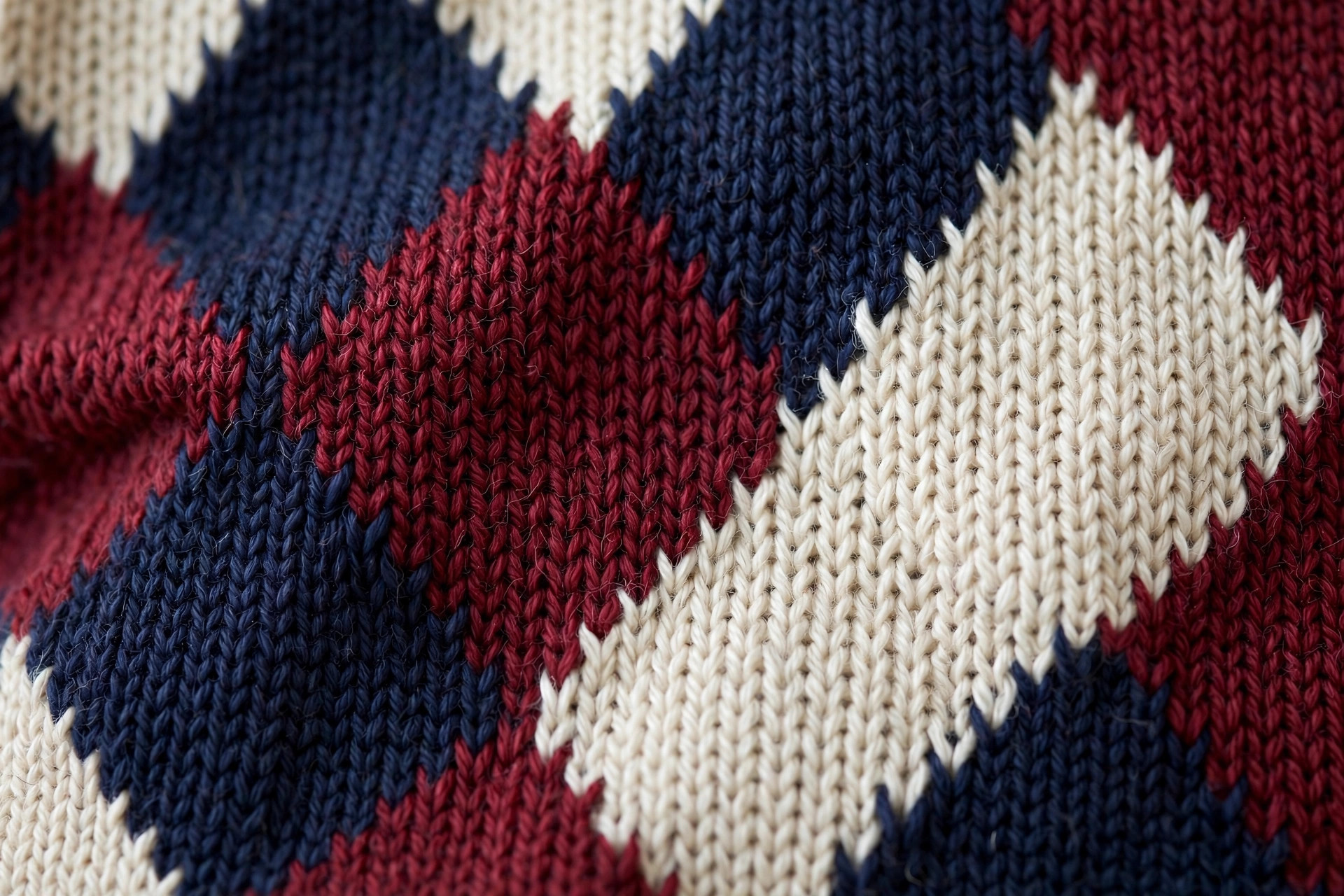
Intarsia is a knitting technique for creating bold blocks of color - argyle diamonds, geometric shapes, pictures - within a single layer of fabric. Each color section is worked with its own ball or bobbin of yarn, and the yarns are twisted together where colors meet, so there are no long floats across the back as in Fair Isle knitting.
What Makes Intarsia
The defining feature is separateness: unlike stranded colorwork, where two yarns travel across the whole row, intarsia uses a separate yarn supply for each color block. When the knitter changes color, the old and new yarns are twisted around each other to prevent holes. The result is a flat, single-thickness fabric that looks nearly the same on both sides - ideal for large, graphic motifs that would be bulky or wasteful in stranded knitting.
Intarsia Through History
Intarsia-style color blocking appears in historic knitting from the Middle East to Europe, but it became a fashion signature in the 20th century: the argyle patterns of 1920s golf wear, the bold geometric sweaters of the 1970s and 1980s, and the designer knits that made color-block sweaters a luxury staple. The name comes from the Italian wood-inlay technique intarsio - fitting, since both arts set contrasting pieces into a flat surface.
Intarsia Today
Modern intarsia spans hand-knit artisan sweaters and machine-knit fashion knits - from preppy argyle vests to graphic designer sweaters with words and pictures. In machine knitting it is produced on specialized flat-bed machines with multiple yarn carriers. For hand knitters, it remains one of the most satisfying techniques: the picture literally emerges row by row.
FAQs
- What is the difference between intarsia and Fair Isle?
- Intarsia uses separate yarns for each color block with no floats on the back; Fair Isle carries two yarns across the whole row, leaving floats. Intarsia suits large blocks of color, Fair Isle suits small repeating patterns.
- Does intarsia have a wrong side?
- The back looks nearly like the front - just with the small twists where colors join - which is why intarsia works well for reversible-look garments.
- Is intarsia hard to knit by hand?
- It requires managing multiple bobbins and twisting yarns at color changes, but the technique itself is just knit and purl. Most knitters master it quickly.
- Can machines knit intarsia?
- Yes - flat-bed knitting machines with multiple yarn carriers produce intarsia for fashion sweaters, though the setup is more complex than for plain knits.
Glossary: see the full fashion glossary for more apparel industry terms.