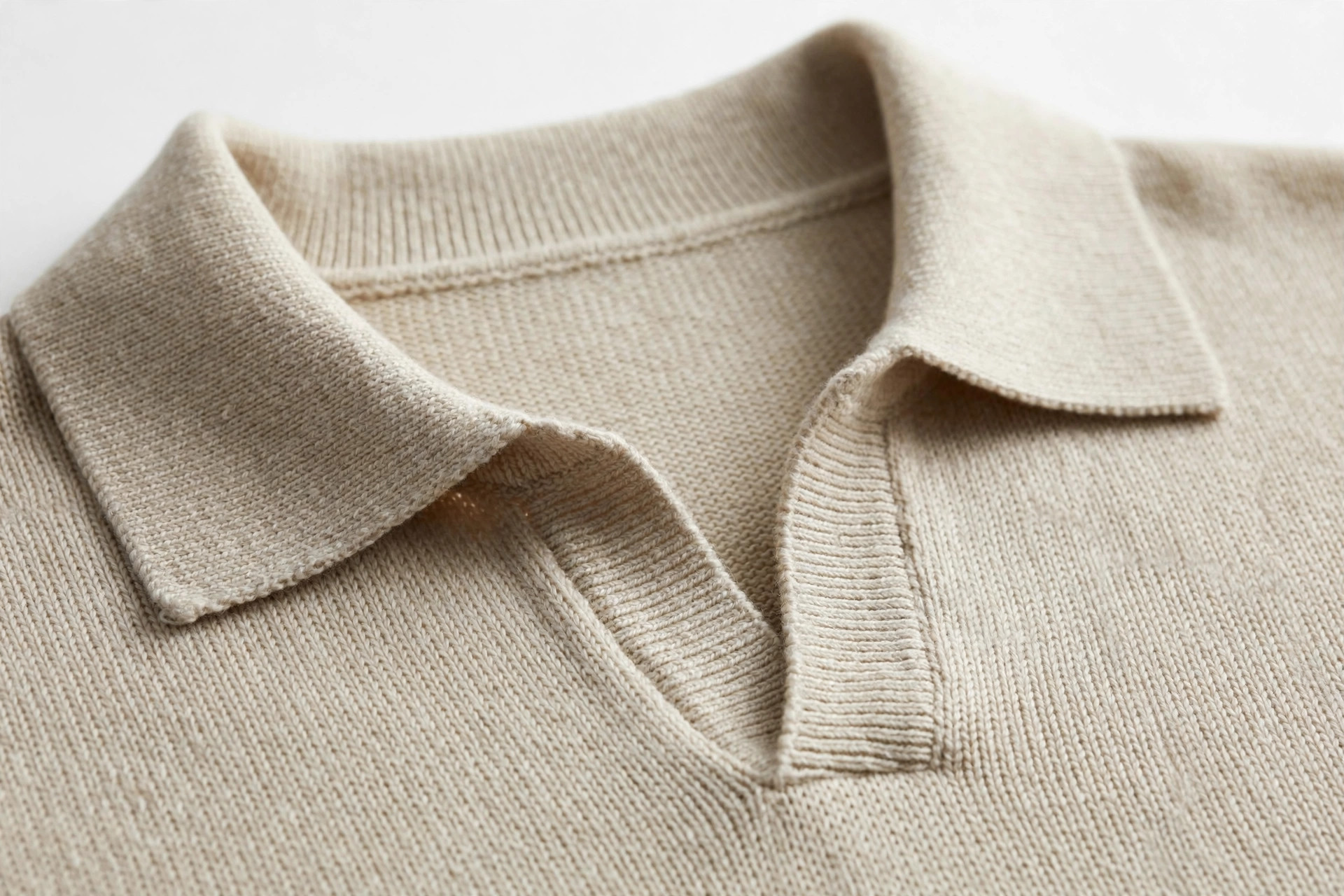
A Johnny collar is a small, soft collar set around a short, open V-shaped placket that has no buttons — a collar that lies open in a neat V at the front of the neck. It is the defining detail of the Johnny-collar shirt: a polo-style knit top that keeps the polo's collar but drops the buttoned placket, giving a cleaner, more minimal neckline. The style is named for its mid-century American sportswear origins and revives regularly in both men's and women's knitwear.
Between a Polo and a V-Neck
The Johnny collar occupies a precise middle ground. A polo shirt has a collar plus a buttoned placket; a V-neck has the V but no collar. The Johnny collar has both the collar and the open V — the placket is a short slit, usually a few inches deep, finished with facings, and the little ribbed or self-fabric collar stands softly around it. Unbuttoned by design, it reads more polished than a plain V-neck and less sporty than a polo.
Because there are no buttons, the depth of the V is fixed by the pattern — worth checking when buying, since Johnny collars range from a modest slit to a deep retro plunge.
Wearing the Johnny Collar
- Men's knit polos and sweaters — the 1960s golf-and-leisure original, revived in fine-gauge knits.
- Women's tops and dresses — a small Johnny collar neatens a knit top without hardware.
- It pairs with nothing at the neck — no tie, no scarf knot — the open V is the finish.
FAQs
- How is a Johnny collar different from a polo collar?
- A polo's placket buttons up; a Johnny collar's short V placket has no buttons and is always worn open.
- Is a Johnny collar the same as a camp collar?
- No. A camp collar is a woven shirt collar that lies flat in a wide notch; a Johnny collar is a small soft knit collar around a short buttonless V.
- Can a Johnny collar be worn closed?
- There is nothing to close it with — the open V is the design. Some modern versions add a hidden zip, but the classic form is simply open.
Detailed Guides: see Johnny Collar in the glossary A–Z listing of the Apparel Search fashion glossary for related terms.