Apparel Search Fit Guides
How to Measure Your Bra Size
Two measurements, one subtraction, and a few honest fit checks — how to find the bra size that actually fits, how sister sizes work, and how to spot the signs that the size you are wearing is wrong.
Ask a professional fitter how a bra size is found and she will not guess from the size you walked in wearing — she will take two measurements and do one subtraction. Everything else in bra fitting is checking the result against your body. You can run the same process at home in about five minutes with a soft dressmaker's tape, and it explains almost every common fit complaint: straps that dig, bands that ride up, cups that spill or gape. This guide walks through the measuring itself, the sister sizes that give you room to adjust, and the signs that tell you whether the size on the label is the size you need.
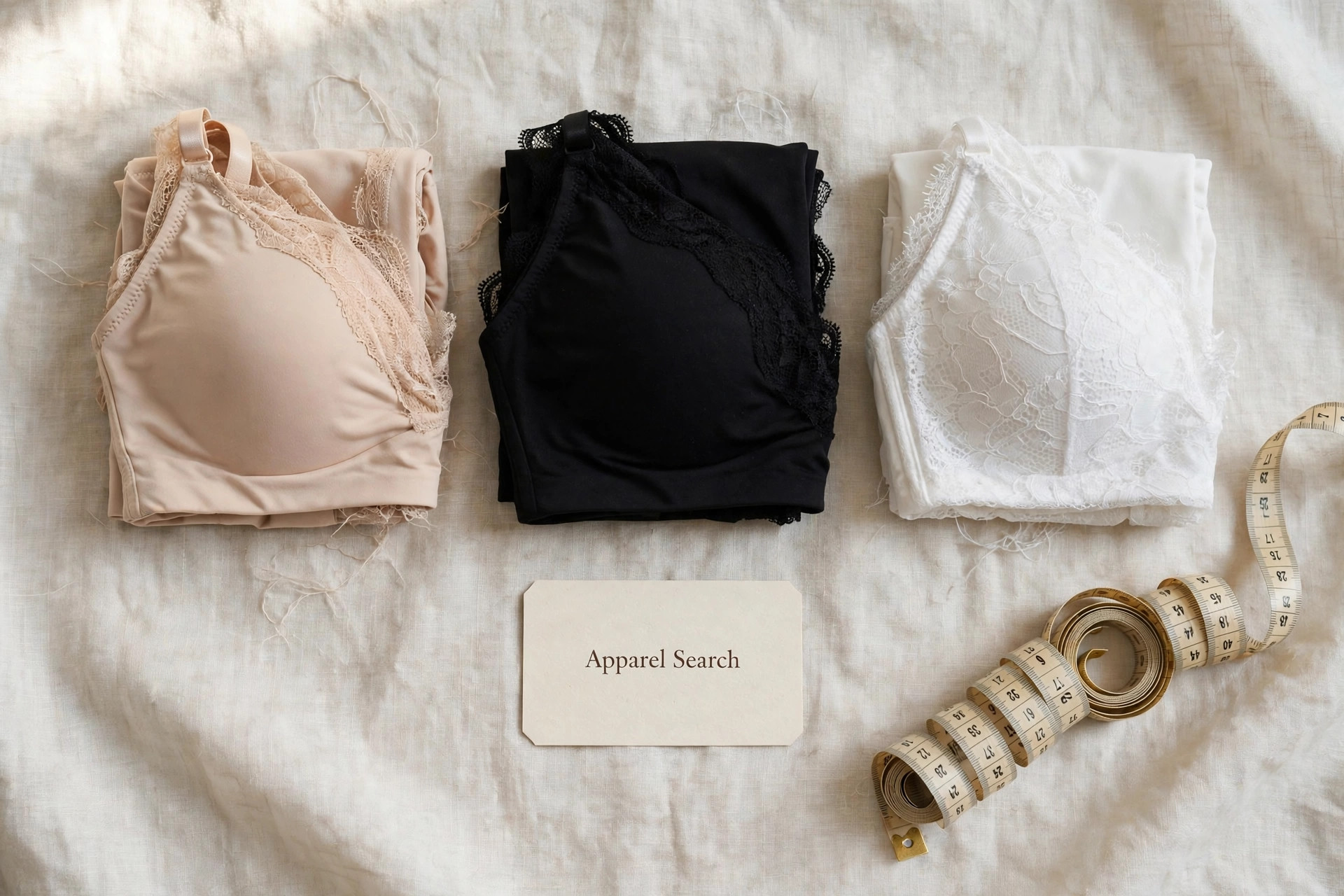
What You Will Need
- A soft measuring tape — the flexible dressmaker's kind. A rigid ruler or a metal builder's tape will not follow the curve of the body and will read wrong.
- A mirror, so you can check the tape is level all the way around rather than drooping at the back.
- Either no bra or your thinnest unpadded one. Measure over a padded or molded bra and you are measuring the bra, not yourself.
- Pen and paper for two numbers: underbust and bust.
Measure in Three Steps
- Measure your band. Wrap the tape around your ribcage directly under the bust, where the bra band sits. It should be snug — firm enough that it does not slide, loose enough to breathe — and level all the way around, which is what the mirror is for. Breathe out naturally and read the number. Round it to the nearest even number: that is your band size. (If you land on an odd number, the even number above is the usual starting band.)
- Measure your bust. Move the tape up to the fullest part of the bust, usually across the nipple line, keeping it level and resting on the surface without compressing anything. Stand relaxed, arms down. Read the number as it falls — no rounding this time.
- Subtract to get the cup. Bust minus band gives the cup letter: a difference under 1 inch is AA, 1 inch is A, 2 is B, 3 is C, 4 is D, 5 is DD (called E in some systems), 6 is DDD or F, and each further inch steps up another letter. A 34-inch band with a 37-inch bust is a 34C. Brand charts differ in how they label the higher letters, so treat the result as your starting size and confirm it with the fit checks below.
Sister Sizes: The Adjustment Nobody Explains
Cup letters are not fixed volumes — a C cup on a 34 band holds less than a C cup on a 38 band, because the letter expresses the difference between band and bust, and that difference scales with the band. Sizes that keep the same cup volume while changing the band are called sister sizes: 32D, 34C and 36B are sisters, as are 30DD, 32D, 34C and 36B one step further along. Sister sizes are the practical tool when a bra is nearly right. If the cups fit but the band is too loose, go down a band and up a cup letter (34C to 32D). If the band is painfully tight but the cups are correct, go up a band and down a letter (34C to 36B). What sister sizing cannot fix is a cup that is simply too small or too large on the correct band — that is a letter change on the same band.
Five Signs Your Current Bra Is the Wrong Size
- The band rides up your back. The band is too big — it should sit level and firm, doing most of the supporting work. Try a smaller band with a larger cup letter.
- You spill out of the cups — over the top, at the sides, or under the arms. The cups are too small or too shallow for you; go up a letter on the same band.
- The straps dig into your shoulders. Straps are meant to position the bra, not carry the weight. Digging straps usually mean the band is too loose and the straps have been shortened to compensate.
- The center front floats away from your chest. On an underwired bra the center panel should rest against the sternum. If it stands away, the cups are generally too small.
- The cups wrinkle, crease or gape at the top. The cups are too big, or the style is cut for a fuller shape than yours — try a smaller letter or a shallower style.
When to Measure Again
A bra size is a snapshot, not a lifetime assignment. Measure again whenever your body changes state: a weight change of roughly ten pounds either way, during pregnancy and again after nursing (our maternity bras guide covers the in-between stages), after starting or stopping hormonal medication, and when a new exercise routine changes your back and chest. Even without any of those, once a year is a sensible rhythm — bodies drift gradually, and elastic gives out on its own schedule, so an annual five minutes with the tape keeps the size you buy matched to the body you have.
Shop Bras
Ready to shop? Product links are kept in one place on the Apparel Search shopping guide:
Shop Bras on AmazonThis link opens the Apparel Search shopping guide for Amazon, where the product links are kept in one place.
Common Questions
What is the +4 method, and should I use it?
The +4 method is the older way of working out band size: measure under the bust, then add four or five inches to get the band. It dates from an era of rigid, non-stretch bands. Modern bands are elastic and are designed to fit at roughly the true underbust measurement, so adding four usually produces a band that rides up and straps that do all the work. If your underbust is an odd number, round up to the next even band size; if you fall between, try both the direct size and one band up and judge by the fit checks, not the label.
My measured size is completely different from the size I usually wear. Is the tape wrong?
Probably not — this is extremely common. Many people wear a too-large band with a too-small cup for years because that combination is what shops stocked most heavily. The measured size is a starting point, not a verdict: try it, then use the fit signs. If the band is firm on the loosest hook, the cups contain everything without spilling or gaping, and the center sits flat, the new size is right whatever the old label said.
Do all brands size bras the same way?
No. Cup lettering diverges between systems once you pass a D cup: UK sizing inserts double letters and then continues FF, G, GG, while US brands use DD, DDD and vary beyond that, and EU sizing uses centimetre bands with its own cup sequence. The same body can honestly be a 34E in one brand and a 34F or 36DD in another. Always check the individual brand's size chart against your two measurements in inches or centimetres rather than converting letter to letter.
How often should I replace a bra, and does that change my size?
A bra worn in rotation — rested a day or two between wearings — typically gives six to twelve months of good support before the elastic relaxes. The tell-tale sign is starting on the tightest hook to get the firmness the loosest hook once gave: the band has stretched beyond its working range. Replacing a stretched bra with the same size usually restores the fit, but re-measure at the same time, because bodies change too — the two effects are easy to confuse.