Apparel Search Jewelry Guides
How to Measure Ring Size
The home methods ranked by how much to trust them, the diameter-versus-circumference trap, and why your knuckle has a vote.
A ring is the least forgiving jewelry purchase there is: a necklace an inch off is a different look, but a ring half a size off is a ring that spins, sticks at the knuckle, or stays in the box. This page — part of the jewelry sizing and wearing guide — sets out the home methods for finding your size, ranked by how much you should trust them, and then covers the two things the number alone cannot tell you: when to measure, and how the knuckle changes the answer. For the rings themselves, every style and stone, see the Jewelry Guide's rings guide.
First, the Two Measurements a Chart Uses
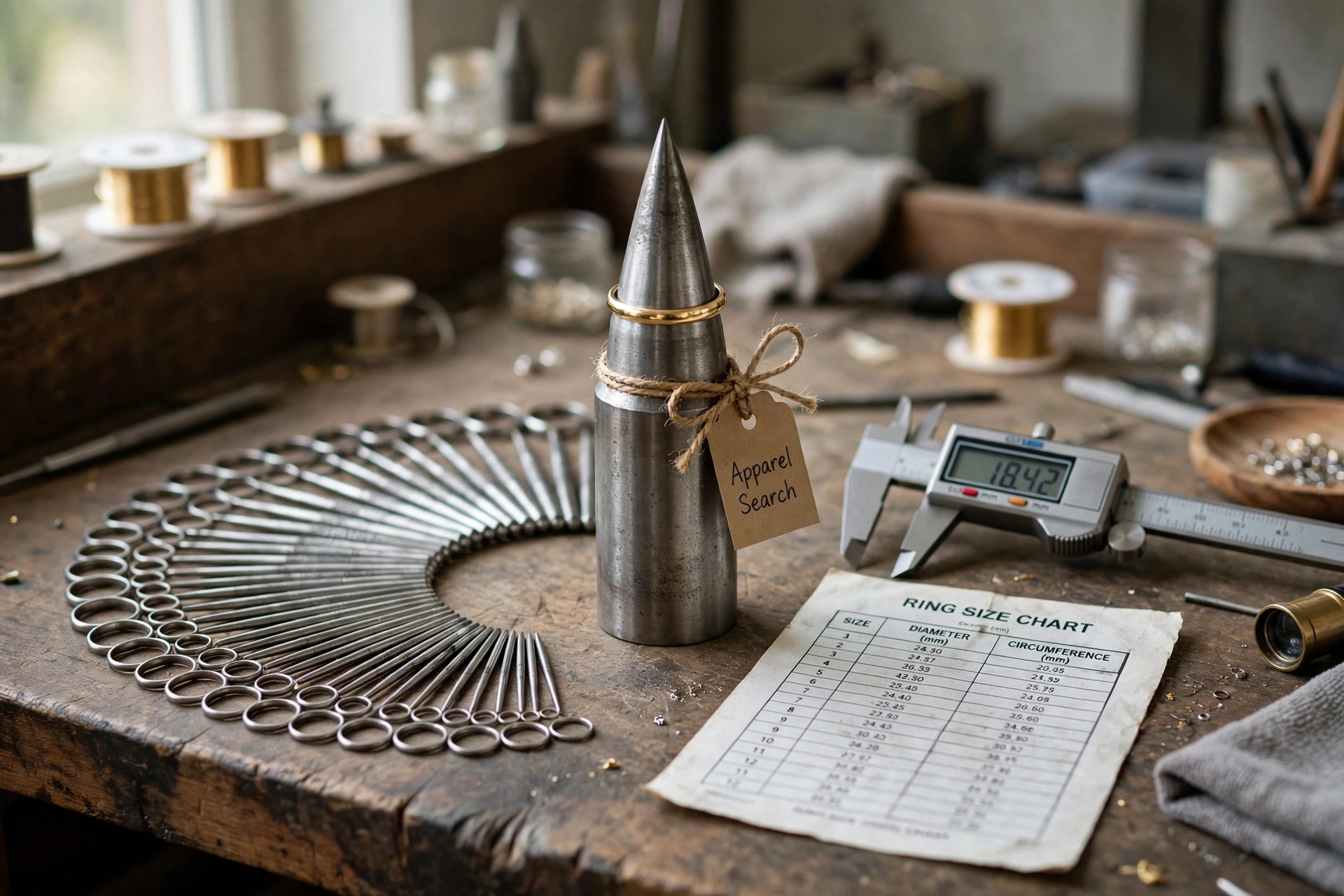
Ring size charts translate between your finger and the US numeric scale using one of two measurements, and confusing them is the commonest measuring error of all. Inside diameter is the straight-line distance across the inside of a ring, from inner edge to inner edge. Inside circumference is the distance around that same inside circle — the measurement a piece of string wrapped around your finger approximates. The two are related by simple geometry — circumference is the diameter multiplied by pi (about 3.14) — so a chart lists both, and the error to avoid is feeding a circumference into the diameter column. A US size 6, for example, corresponds to an inside diameter of about 16.5 millimetres and a circumference of about 51.9 millimetres; a size 7 to about 17.3 millimetres across and 54.4 around. Each full US size adds roughly 0.8 millimetres of diameter, and half sizes sit in between — which is why half a size is a real, orderable difference and not a rounding error.
The Tools, in Jeweler's Terms
A mandrel is the tapered steel rod, marked with sizes, that a ring is slipped onto to read its size. A set of sizing rings — plain bands in every whole and half size — is what a jeweler slides onto your finger. Home methods are substitutes for these two tools, and the methods below are ranked by how faithfully they substitute.
The Methods, Ranked by Reliability
1. In-store sizing — the gold standard
A jeweler's sizing rings take a minute and settle the question, because the tool is the same one the ring will be checked against, and because a jeweler judges the part no measurement captures: your knuckle, and how the ring must travel over it. For an engagement ring or any purchase that is expensive, custom or final-sale, this is the method to use, and most jewelers will size a finger without any obligation to buy. Everything below is for the many purchases where a store visit is impractical.
2. Measure a ring that already fits
If a ring fits the target finger well, measure the ring instead of the finger. Lay it over a ruler and read the inside diameter — the widest distance between the inner edges, taking care to measure the inside, not the outside, and to read straight across the center. Calipers, if you have them, do this job precisely. A common refinement is to place the ring over printed size circles and find the circle that matches the ring's inner edge exactly. Either way you are measuring a rigid, known-fitting object rather than a soft finger, which is why this method ranks second: its weakness is only that it depends on the reference ring genuinely fitting the finger the new ring is for.
3. A printable sizer, used properly
Jewelers and sellers offer printable sizers in two forms: a page of printed circles you lay an existing ring over, and a paper strip, marked with sizes, that you cut out and wrap around the finger. Both are sound in principle and treacherous in one specific way: printers scale pages. A sizer printed at anything other than 100 percent — "actual size," with page scaling and "fit to page" switched off — is a wrong instrument reporting wrong numbers confidently. Every legitimate printable includes a check for exactly this: a printed scale bar or reference line whose length you verify with a ruler, or a circle meant to match a coin of known diameter. If the check fails, fix the print settings before believing any reading from the page. Used that way, a printable strip is the best of the finger-measuring home methods, because paper cut to a printed scale does not stretch the way string does.
4. String or plain paper — estimate only
The famous method: wrap a non-stretch string, thread or strip of paper around the base of the finger, mark where the end meets, lay it flat and measure the length in millimetres, then read that circumference against a size chart. It costs nothing and it gets you into the right neighborhood — and it should be labeled an estimate, for three stacking reasons: string stretches under tension and compresses the finger less than a band does; paper and string have thickness, so the wrap measures slightly outside the circle the ring will occupy; and the pen mark itself has width, which lands in the measurement. Expect the result to run large by half a size or more. Use it to shortlist, then confirm with method 2 or 3 — or a store visit — before ordering anything you cannot exchange.
When to Measure
Fingers are not a fixed size. They are smaller cold and in the morning, larger warm, later in the day, after exercise, and in summer heat. The standard advice follows directly: measure with warm hands, toward the end of the day, under ordinary conditions — not straight in from a cold street and not straight out of a workout. And measure the specific finger the ring is for, on the hand it will be worn on; fingers differ from each other, and the dominant hand commonly runs a little larger.
The Knuckle Decides More Than the Number
A ring lives at the base of the finger but arrives over the knuckle, and for many hands the knuckle is the widest point of the journey. A correct size passes the knuckle with a small resistance — a gentle twist on the way over is normal — and then sits at the base without spinning freely or pinching. If your knuckle is much wider than the base, size for the knuckle and accept an easier fit at the base; jewelers address the gap with sizing aids and spring inserts inside the band. If the ring must be forced, or leaves a deep mark, it is too small regardless of what any chart said. Band width matters too: a wide band covers more finger and grips more of it, so it fits snugger than a narrow band of the same marked size — for broad bands, ordering a quarter to a half size up is the standard adjustment.
Common Questions
Is the string method for ring size accurate?
Only as a rough first estimate. String stretches, paper has thickness, the mark you make has width, and all three errors stack in the same direction — toward a reading that is too large. Results are commonly off by half a size or more. Use a string result to narrow your range, then confirm with a better method: measure a ring that already fits, use a printable sizer checked against its printed scale, or have the finger sized in a store before you commit to a ring you cannot exchange.
What if I am between ring sizes?
Half sizes exist precisely for this, and most jewelers can supply or make them — do not feel forced to round. If you must round, think about the knuckle: a ring has to pass over it, so a finger with a knuckle much wider than its base rounds up and accepts a slightly easy fit at the base, while a finger of even width rounds toward whichever side felt more secure. Wide bands fit snugger than narrow ones of the same marked size, so for a broad band, going up a quarter to a half size is the usual advice.
Do fingers change size during the day?
Yes — fingers are measurably larger warm and later in the day, and smaller when cold, and they also respond to salt, activity and the season. That is why the measuring advice is to size warm hands at the end of the day, at your typical largest. A ring sized on cold morning fingers can be uncomfortably tight by evening; a ring sized on swollen fingers after a workout can spin in winter. Measure under ordinary conditions, more than once.
Can a ring be resized if I get the size wrong?
Often, but not always, and it is the wrong plan to rely on. Plain metal bands can usually be sized up or down by about two sizes by a jeweler. Rings with stones or pattern running all the way around — eternity bands are the classic case — often cannot be resized without remaking them, and some materials resist resizing altogether. Thin bands also have limits. Buy the right size when you can, confirm the method before an important purchase, and ask the seller about resizing before you need it.
Back to the Jewelry Sizing and Wearing Guide
Necklace lengths and layering, bracelet and watch sizing, proportion and choosing metals — the whole fit map.