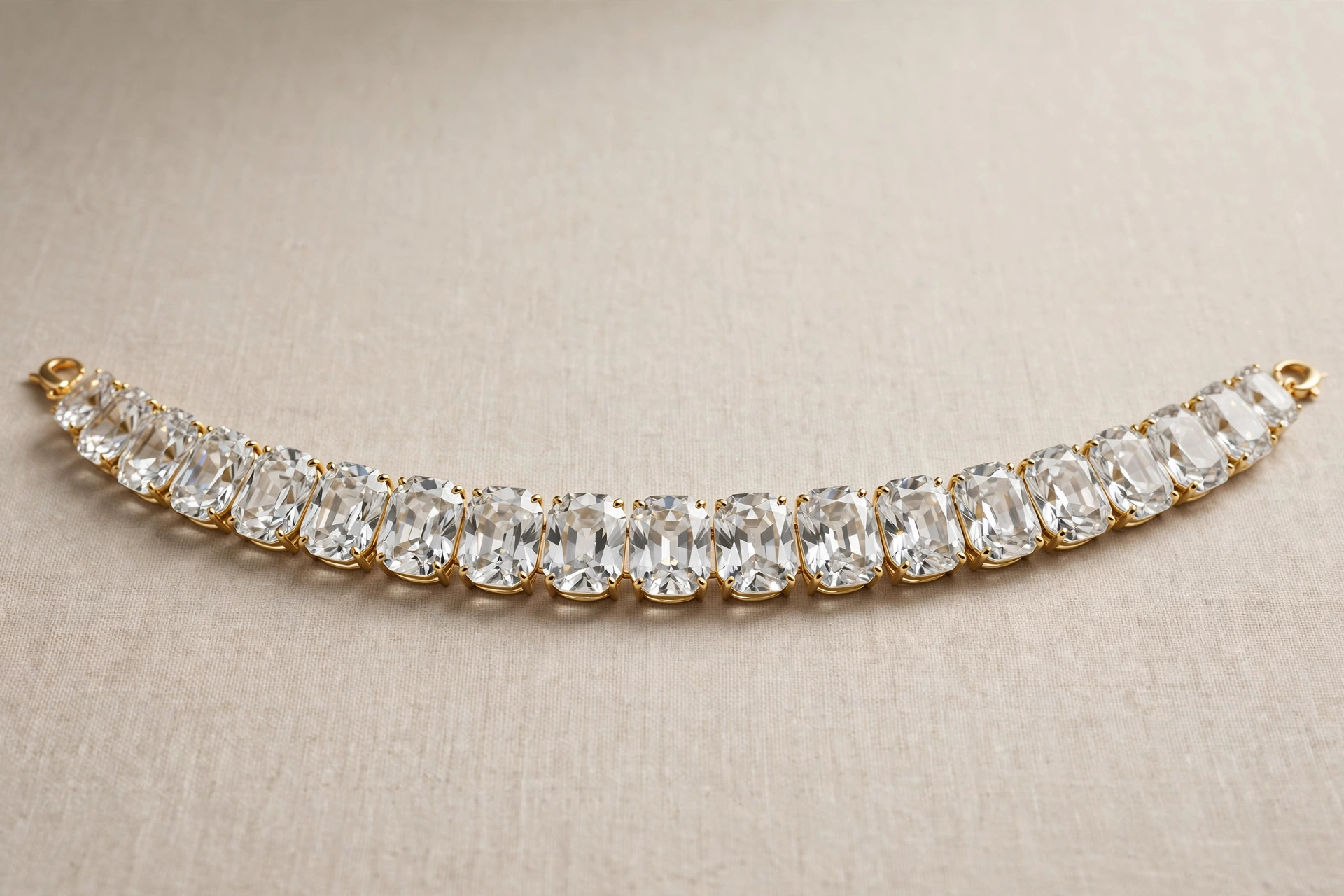
A riviere necklace is a necklace made of a single continuous row of gemstones, all matched in cut and colour, set so closely that the row looks like an unbroken river of light around the neck. The name is French for river. Riviere necklaces are most often made with diamonds, but coloured stones such as sapphires, rubies and amethysts are also classic.
The Georgian Classic
Rivieres became the essential formal necklace of the Georgian and early Victorian eras. Stones were set in closed-back collets, often backed with foil to increase their glow by candlelight. Many early rivieres graduate in size, with the largest stone at the centre front and smaller stones toward the clasp, which keeps the necklace balanced and concentrates its effect where it is most seen.
A well-matched riviere is harder to make than it looks. Every stone must agree in colour, clarity and cut, or the eye goes straight to the one that differs. That matching is a large part of the value of antique examples, and of fine modern versions with individually set stones in an articulated row that flexes around the neck.
- Graduated rivieres - stones grow larger toward the centre front.
- Uniform rivieres - every stone the same size, the modern tennis-necklace form.
- Coloured rivieres - sapphires, emeralds, amethysts or other matched coloured stones.
Riviere and Tennis Necklaces
The modern diamond tennis necklace descends directly from the riviere: it is a uniform, flexible riviere made for everyday wear as well as evening dress. Antique rivieres are usually shorter, more formally set, and often graduated. Either way, the test of quality is the same - even stones, settings that let the row flex smoothly, and a secure clasp, because the necklace is only as strong as its weakest setting.
Judging a Riviere
Work along the row stone by stone. In a good riviere every stone matches its neighbours in colour and brightness, the settings are uniform, and the row flexes in an even curve with no point that bends more stiffly than the rest. On antique pieces, closed backs and foiling are period features, not flaws, but the foil should not be blackened or water-damaged. Because a riviere concentrates so much value in its matching, a single replaced stone that differs from the row is worth noticing: it affects both the look and the price, and a reputable seller will point it out.
FAQs
- What does riviere mean?
- Riviere is French for river. The necklace is named for the unbroken river of light created by its single row of closely matched gemstones.
- What is the difference between a riviere and a tennis necklace?
- They are the same basic form. A tennis necklace is the modern, usually uniform-size and flexible version; antique rivieres are often graduated and more formally set.
- Are riviere necklaces always diamonds?
- No. Diamonds are the most famous, but rivieres have long been made with matched coloured stones such as sapphires, rubies, garnets and amethysts.