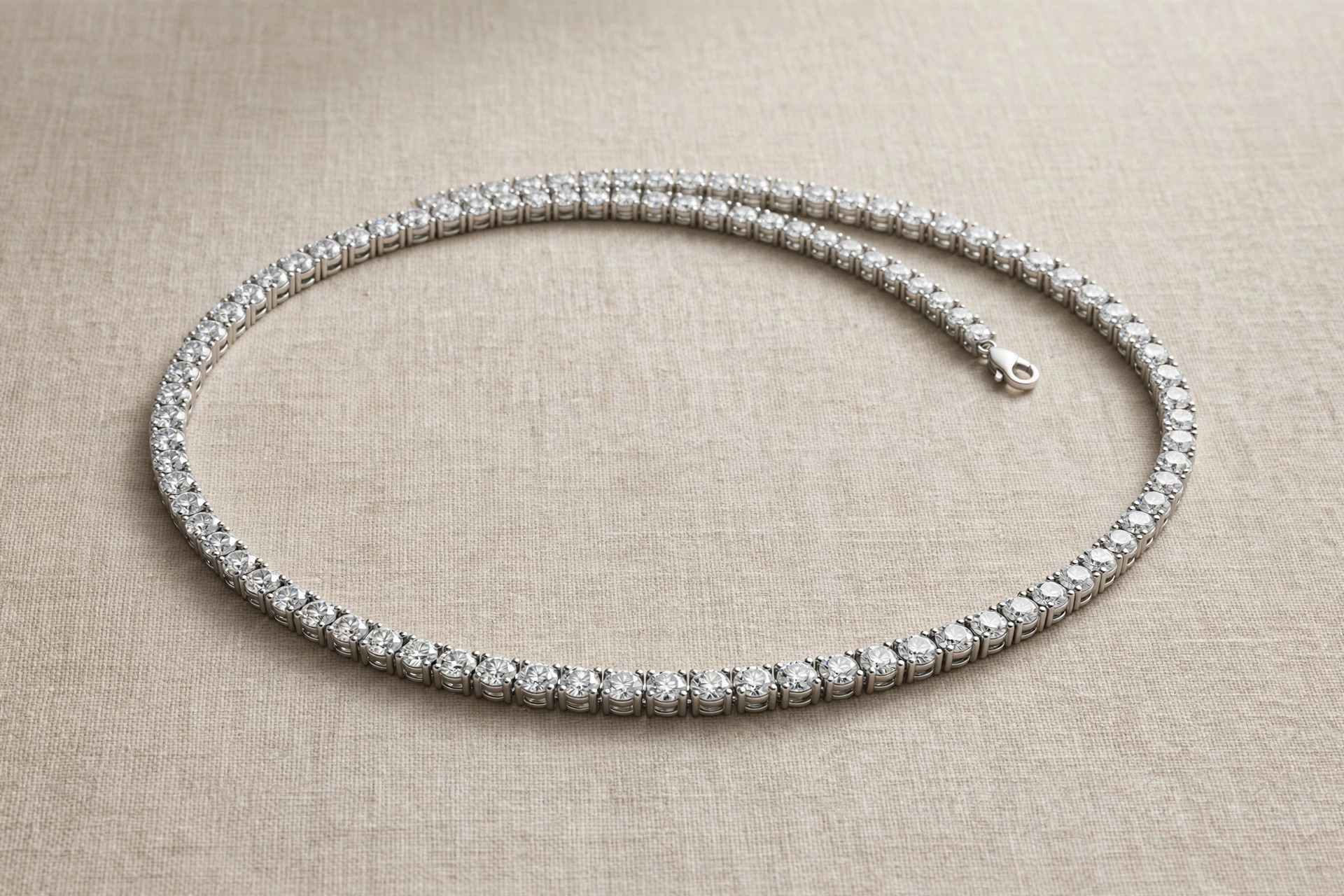
A tennis necklace is a flexible necklace made of a single row of evenly matched diamonds - or, in fashion versions, crystals or cubic zirconia - each stone individually set and linked so the whole row bends smoothly around the neck. It is the necklace counterpart of the tennis bracelet, and a modern, uniform form of the much older riviere necklace.
From Bracelet to Necklace
The tennis name entered jewellery with the bracelet in the late 1970s, when a diamond line bracelet worn during a tennis match made the style famous. The necklace version applies the same idea at neck length: identical stones, minimal settings and complete flexibility, so the row sits flat and sparkles continuously as it moves.
Settings are usually four-claw or bezel, repeated dozens of times, with a secure box clasp and safety catch - essential on a piece whose value is spread along its whole length. Stone size may be uniform, or very slightly graduated toward the front. Total carat weight, and the consistency of the stones, drive the price far more than the metal.
- Diamond tennis necklaces - the classic fine jewellery version.
- Crystal and cubic zirconia versions - the same look in fashion jewellery.
- Bezel-set tennis necklaces - smooth rims around each stone for a modern, snag-free finish.
Choosing and Wearing
Check a tennis necklace by draping it in a curve: it should bend evenly with no stiff or flipped links, and every stone should face forward when worn. Lay it flat and look along the row for any stone that differs in colour or size. Worn, it needs nothing else at the neck - its continuous line is the whole effect - and it moves easily from evening dress to a plain top and blazer.
Judging a Tennis Necklace
Judge a tennis necklace as a row, not as individual stones. Lay it in a gentle curve on a dark surface and look for evenness: one dull, dark or differently coloured stone breaks the line and is the first thing the eye finds when the necklace is worn. Flex the row slowly and feel for any link that resists or clicks, which can signal a stiff or damaged joint. Check the clasp last and most carefully - open and close it several times. On a necklace whose value runs along its whole length, the clasp and its safety catches do the most important job of all.
FAQs
- Why is it called a tennis necklace?
- It takes its name from the tennis bracelet, the diamond line bracelet popularised in the late 1970s. The necklace is the same single row of matched stones at neck length.
- How long should a tennis necklace be?
- Most are 16 to 18 inches, sitting at the collarbone so the row of stones is fully visible. Longer versions exist but cost rises quickly with length.
- What clasp does a tennis necklace have?
- Usually a box clasp, often with one or two safety catches, because the necklace is valuable along its entire length and must not open accidentally.