Suspender Factory Directory
Factories manufacturing suspenders, braces, belts and straps.
Suspenders, called braces in Britain, hold trousers up from the shoulders, and they are manufactured by a small, specialized corner of the accessories industry: webbing and strap factories that weave or buy elastic, cut it to length, and finish it with clips, adjusters and leather ends. This directory lists suspender factories and explains the product’s construction.
The category is small because the product is simple and durable, but the details separate good suspenders from bad ones: elastic that keeps its recovery, clips that grip without tearing fabric, and a back junction, X, Y or H shaped, that is stitched to survive daily tension.
Suspender Resources
Suspender Styles and Markets
The market divides into formal, work and fashion suspenders, and factories often serve all three from the same webbing. Formal suspenders are button-on styles in silk or rigid woven straps, sold with dress trousers and evening wear and finished with leather ends. Work suspenders are wide elastic with heavy clips or loop attachments for tool belts, sized generously and bought for function; firefighting and logger styles are a recognized subcategory with their own hardware standards. Fashion suspenders run from narrow retro styles to printed novelty elastic sold as gifts and costumes. Width is the visible spec: roughly 25 millimeters reads as fashion, 35 as general purpose, and 50 as work. For private label buyers, the elastic itself can carry a woven brand name or pattern, which turns a commodity strap into a branded product and is the main reason to work directly with a webbing factory like the listing below rather than a finisher who buys plain elastic.
How Suspenders Are Made
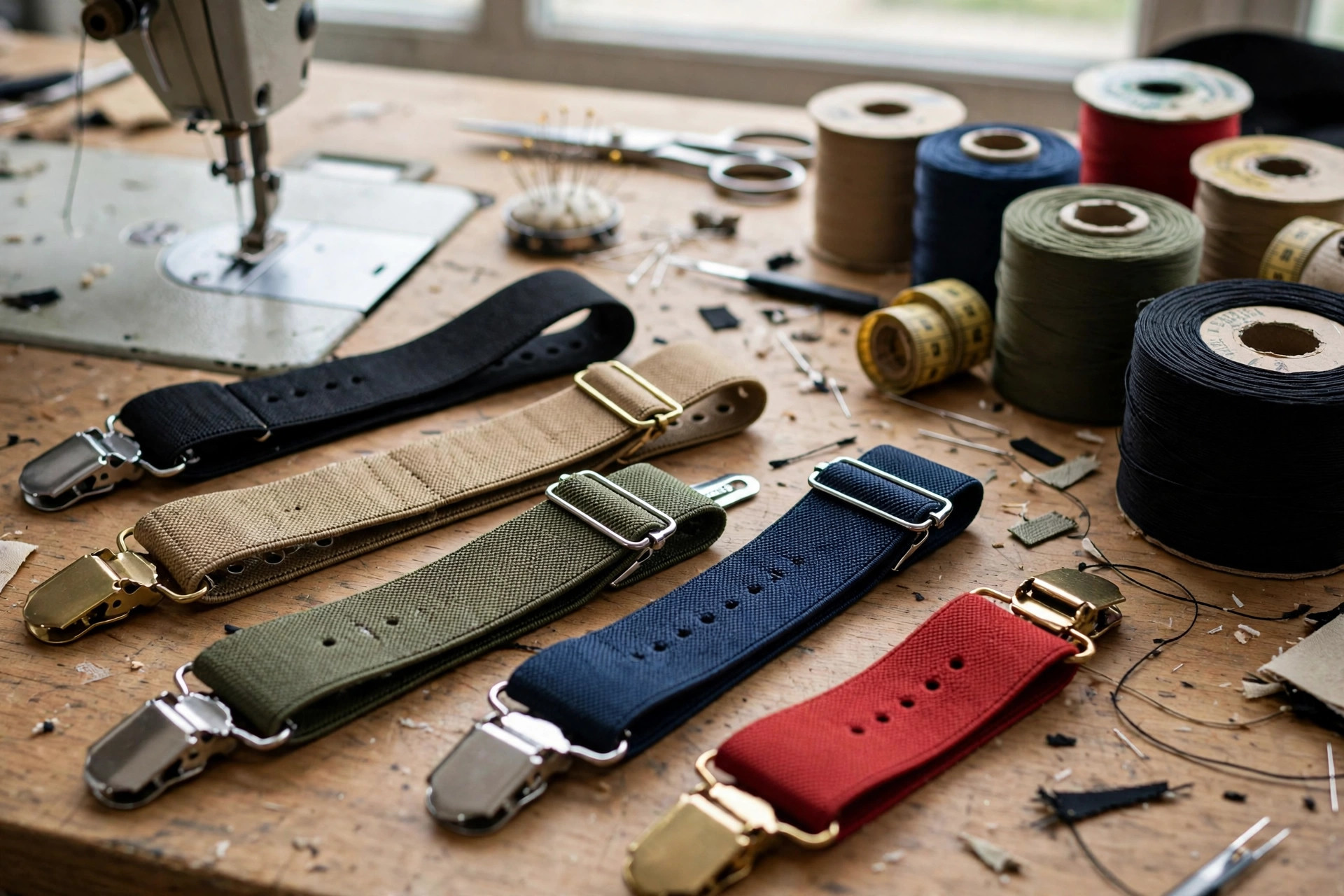
Production begins with the strap. Elastic webbing is woven with rubber or elastane cores for stretch and recovery, in widths most commonly 25, 35 and 50 millimeters; rigid suspenders use woven fabric straps without stretch, for formal and work styles. Straps are cut to length, and the ends are finished with the attachment system: metal clips (alligator or trigger style), button-on leather ends, or loop ends for brace buttons. Adjusters slide on the front straps to set length, and the back junction piece, often leather, joins the straps in an X or Y configuration and is stitched or riveted under tension test. Work suspenders for tool belts and firefighting use heavier webbing and hardware, and novelty and fashion suspenders add printed or jacquard woven designs to the elastic itself.
Suspender Factory Listings
Yiwu Baijin Tapes Factory
(China) Yiwu Baijin Tapes Factory, founded in 2001, is situated in Beiyuan Industrial Zone with a building area of 1800 sq. m. As a private enterprise, it was formerly the branch factory of Baijin Leatherware Co., Ltd, founded in 1995. The factory mainly produces two series, rigid and elastic. They manufacture fabric straps, fashionable waist straps, belts and suspenders.
Belt manufacturer: canvas belts, genuine leather belts, elastic belts, bead belts. Suspender manufacturer.
Common Questions
What is the difference between elastic and rigid suspenders?
Elastic suspenders stretch for comfort and are the modern standard; rigid suspenders use non-stretch woven straps and are the traditional formal style, sized more precisely because they cannot give. The listing below makes both series.
What do the X-back and Y-back styles mean?
They describe how the straps join at the back: an X-back crosses the straps in an X with four attachment points, and a Y-back joins the two shoulder straps into a single back strap with three. X-backs spread the load more evenly for work use.
What fails first on cheap suspenders?
The elastic loses recovery and the clips lose grip or tear trouser fabric. Quality factories specify elastane content and recovery testing for the webbing and use clips with smooth, lined jaws that hold by pressure rather than by biting.