Suspenders
Clothing Definitions — definitions of garments and clothing terms from Apparel Search
Search Apparel Search
At a Glance
Definition: Suspenders has two opposite transatlantic meanings: in US English, straps run over the shoulders that hold up trousers or a skirt (called braces in Britain); in British English, small straps or bands that hold up socks or stockings (called garters in North America).
Also known as: Braces (British name for the shoulder-strap garment)
Category: Clothing Definitions
Suspenders has several meanings. In British English, suspenders — called garters in North America — are small straps or bands that hold up socks or stockings. In US English, suspenders — called braces in Great Britain and sometimes in North America — are straps run over the shoulders that hold up trousers or a skirt. The two meanings cross the Atlantic in opposite directions, which makes suspenders one of the classic traps of clothing vocabulary: the same word names a small leg strap in one country and a pair of shoulder straps in the other.
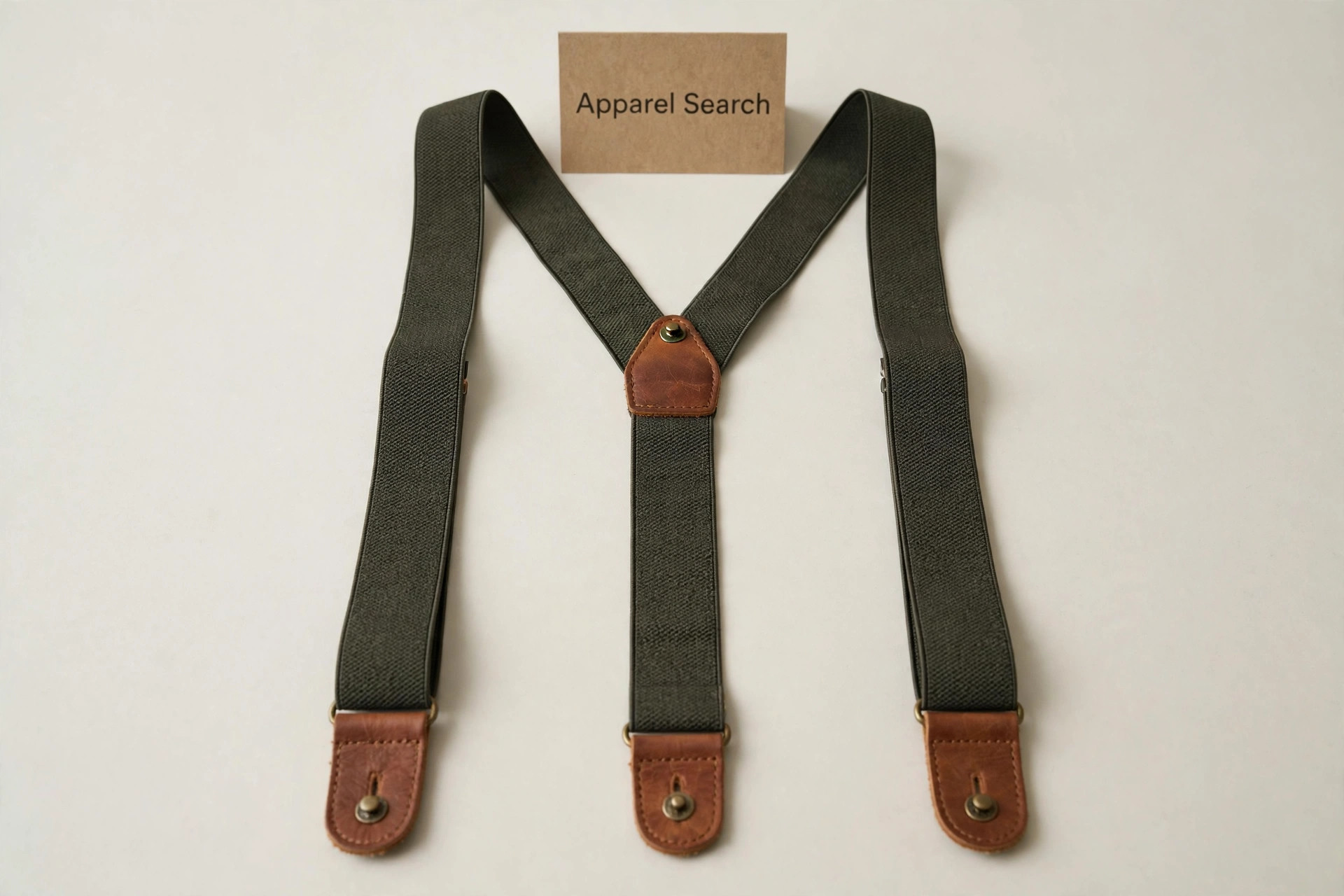
Two Garments, One Word
Few clothing words cause as much transatlantic confusion as suspenders, and the confusion is built into the definition itself: each English-speaking region uses the word for the garment the other region names differently. A British reader shopping in America for suspenders to hold up stockings will be handed shoulder braces; an American reader in London asking for suspenders will be shown small straps for socks. The safe method in either country is to describe the job — straps over the shoulders for trousers, or bands for socks and stockings — rather than trusting the single word.
Both meanings are at root the same idea: a strap that suspends a garment against gravity. The pant and trouser trade uses the shoulder sense; the hosiery trade uses the leg sense; and the suit is where the shoulder sense does its most formal work.
The Shoulder-Strap Garment
The shoulder-strap garment has the longer fashion history. Before elastic and before the belt became universal, braces were the standard way to carry trousers, buttoned to the waistband and cut to hold the trousers at the natural waist with a clean, unbroken front. Formal trousers are still made without belt loops for this reason, and braces remain the correct support for a waistcoat worn over them, since a belt's buckle would spoil the line. Elastic webbing, leather ends, button and clip fittings, and Y-back and X-back arrangements are the modern variations.
Fittings decide how a pair of braces behaves in wear. Button fittings — leather or fabric ends that button to the trouser waistband — are the traditional and most secure form, and the only correct form with formal trousers. Clip fittings grip the waistband and fit any trousers, at some risk to the cloth. The back arrangement matters too: a Y-back joins the two front straps into one at the back, while an X-back keeps two separate straps, and the choice affects how the straps sit on different shoulder shapes. Elastic width and quality decide how evenly the load is carried through a long day. For choosing between clip-on and button-on braces, widths and materials, measuring and adjusting, and wearing suspenders with suits, chinos and jeans, see the Men's Suspenders Guide.
Braces never entirely disappeared. They remained standard with formal and business dress through the belt's rise, because they let trousers hang from the shoulders at the natural waist instead of being gripped at the hips, and they have returned repeatedly as a visible style choice, worn with the straps showing over a shirt as readily as hidden under a jacket or waistcoat. The modern pair is usually elastic webbing in a plain colour or a striped or patterned weave, with leather ends for buttons or metal clips for convenience — the same two fittings, and the same Y-back and X-back choice, that the traditional form established.
The Leg-Strap Meaning
The British suspenders — North American garters — solve the older problem of hosiery: before elastic tops, socks and stockings slid down, and a strap or band with a fastening kept them up. The garter family includes the ceremonial garter of orders of chivalry, the wedding garter, the armband garters once used to hold up shirt sleeves, and the suspender belt, a waist band with straps that holds up stockings, which is the direct relative of the small straps in this definition.
Elastic changed both garments without ending either. Elastic tops reduced the need for sock suspenders, and elastic webbing made shoulder braces more comfortable and more adjustable at the same time. The vocabulary, however, never harmonised: the Atlantic still runs the two meanings in opposite directions, and catalogues, novels and shopping searches still trip over it.
Not to Be Confused With
The same word, opposite garments. In the United States, suspenders are the shoulder straps that hold up trousers — the garment Britain calls braces. In Britain, suspenders are the small straps that hold up socks or stockings — the garment North America calls garters. Neither use is wrong; each is the reverse of the other, so in transatlantic shopping or reading, describe the job the strap does rather than relying on the word alone.
Common Questions
What are suspenders in American English?
In US English, suspenders are straps run over the shoulders that hold up trousers or a skirt. The same garment is called braces in Great Britain, and sometimes in North America as well.
What are suspenders in British English?
In British English, suspenders are small straps or bands that hold up socks or stockings. North America calls those straps garters, the exact reverse of the shoulder-strap naming.
How do trouser suspenders attach?
Shoulder suspenders, or braces, attach to the trouser waistband with buttons or clips at the front and back and pass over the shoulders, carrying the trousers' weight from the shoulders instead of squeezing the waist as a belt does.