Trousers
Clothing Definitions — definitions of garments and clothing terms from Apparel Search
Search Apparel Search
At a Glance
Definition: Trousers are a garment for the lower body that covers each leg separately, worn at the waist or hips and held up by their own fastenings, a belt or suspenders — called pants in North American English.
Also known as: Pants (North American English)
Category: Clothing Definitions
Word Origin
Trousers comes, through the older word trouse, from Gaelic triubhas — the close-fitting hose-and-breeches garment of Ireland and the Scottish Highlands, whose tailored descendant is still worn as trews. The word travelled with the garment as separate-leg dress became standard European wear.
Trousers, or pants in North American English, are an item of clothing worn on the lower part of the body, covering both legs separately rather than together as in skirts and dresses. They are worn at the hips or waist and may be held up by their own fastenings, a belt or suspenders. Together with a shirt, trousers are the standard clothing for men in many parts of the world, and the default lower garment for everyone in most modern wardrobes. This page sets out how trousers are classified — by length, fit and features — and how the same garment came to carry two names.
The Two-Leg Principle
The definition's core — both legs separately — sounds obvious only because trousers won. For most of recorded dress in many cultures, lower-body clothing was a wrapped or skirted garment covering both legs together; bifurcated clothing spread with horse riding, labour and military life, where separate legs are a practical necessity. Trousers were introduced into European society at several points in history, but gained their current predominance only in the 16th century.
Once established, trousers became the most engineered everyday garment in the wardrobe: rise, waistband construction, fly front, pockets cut into the seams, creases pressed or deliberately absent, hems cuffed or plain — every element varied by fashion while the two-leg structure stays fixed. Leggings are the form-fitting end of the same family: trousers of a clingy material, usually a knit.
Lengths, Fit and Features
By length, trousers can run from the waist all the way down to the top of the foot, or stop almost anywhere from the upper thigh to the ankle. The most common short form, shorts, stops anywhere from the upper thigh to the knee and is usually informal wear; cut-offs are homemade shorts made by cutting the legs off trousers. Capris are women's pants that end mid-calf or just below the calf. Some trousers have detachable legs, usually with zippers, that convert between lengths. Children who have outgrown the leg length are jokingly said to be wearing "floods", from trousers hiked up to keep them dry in flood water.
Buyers navigate trousers by a small set of measurements and cuts: waist size and inside-leg length first, then rise — the distance from waistband to crotch seam, which decides where the trousers sit and how they feel — and leg shape, straight, tapered, flared or wide, which is where fashion operates. Flared legs make bell-bottoms. Other variable features include front and back pockets, turn-ups or cuffs, pleats for a looser fit, an elasticized waistband, and the fly, closed by zipper or buttons — or absent altogether. Belt loops may be present to support a belt; formal trousers are often made without them and intended for suspenders, called braces in British English, which keep the front flat under a waistcoat.
Trousers in Dress and History
It is customary in the western world for men to wear trousers rather than skirts or dresses, and many women and girls find trousers and shorts more practical and comfortable than skirts for most activities. The exceptions prove the rule's shape: the Scottish kilt and the Greek tsolias are worn on ceremonial occasions, and garments such as cassocks are worn by religious functionaries — skirted dress surviving where ceremony, not practicality, governs.
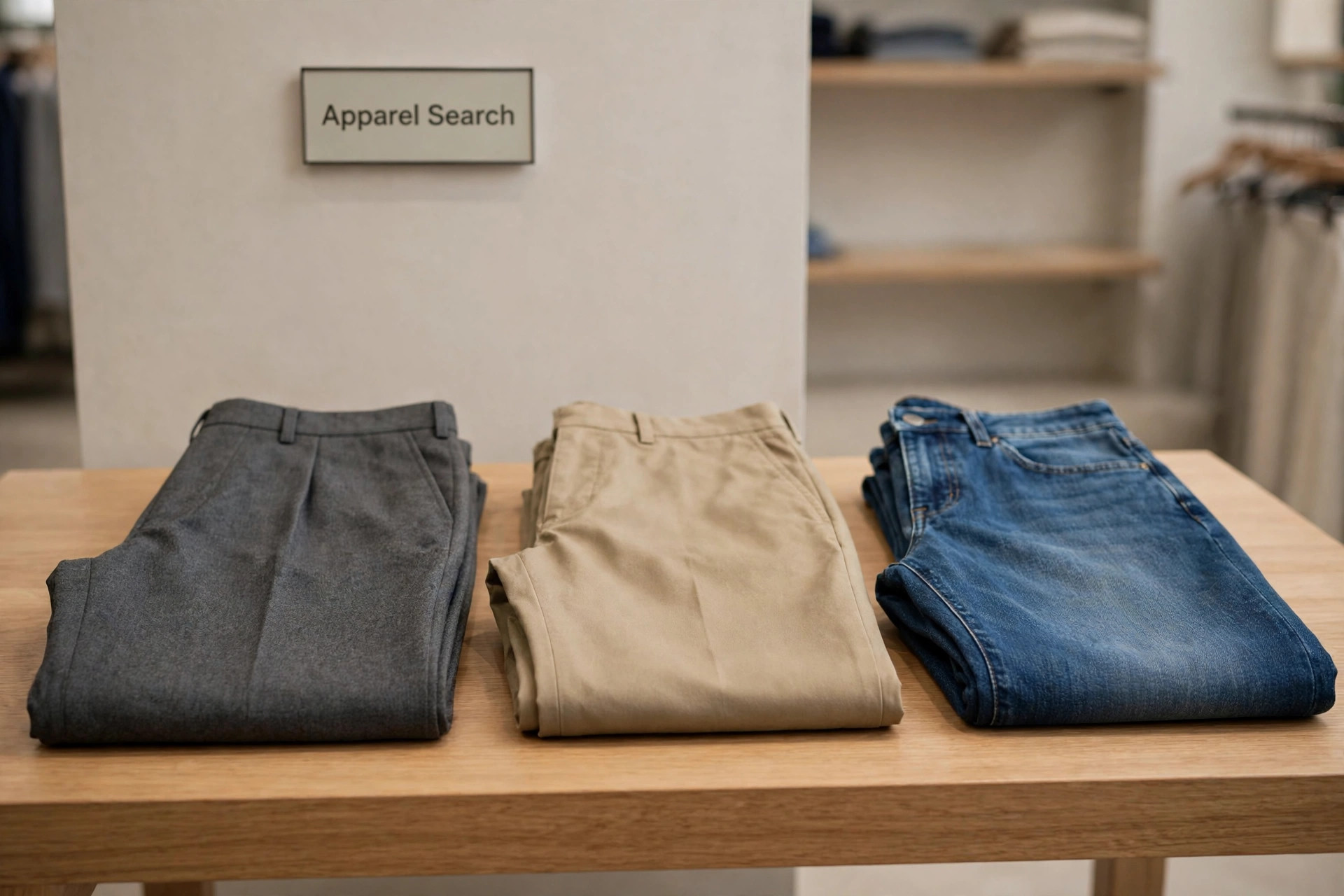
A very common type of strong, informal trouser made of thick blue cloth is blue jeans, the family's most successful member, with its own world of designer jeans. Khakis, in cotton chino cloth, are the standard casual alternative. At the formal end, trousers are half of a suit, cut to match the jacket. The family's history reaches back through the codpiece of Renaissance dress, the flap that closed the front of braies and hose. Trouser styling also moves with fashion — baggy, low-worn styles that show the waistband of the underwear beneath have come and gone among skaters and other groups, for whom the loose fit also gives freedom of movement.
Cloth decides where a pair of trousers sits on the formal scale. Wool in plain weaves makes suit and dress trousers; cotton makes chinos, cords and the everyday casual range; linen makes summer trousers that crease by design; denim makes jeans. The pattern does not change — waistband, fly, two legs, hems — but the same pattern in different cloth is a different garment socially, which is why trousers are described by cloth and cut together ("wool flannel trousers", "cotton chinos") and never by pattern alone. Few other garments carry so much of their meaning in their material.
Not to Be Confused With
Same garment, two names — with one trap. Trousers is the British and general word; pants is the North American word for exactly the same garment, covering each leg separately and worn at the waist or hips. The trap is that in British English pants also means underwear — the garment worn under trousers. A British catalogue that lists pants means underpants; an American one means trousers. Where the meaning must be unambiguous, trousers is the safe word.
Common Questions
What is the difference between trousers and pants?
They are the same garment with regional names: trousers in British and general usage, pants in North American English. In British English, pants can also mean underwear, which is why trousers is the unambiguous word in international catalogues.
How are trousers held up?
Trousers are worn at the hips or waist and held up by their own fastenings, a belt, or suspenders (braces). Formal trousers are often made without belt loops and intended for braces, which keep the front flat under a waistcoat.
What are the main trouser lengths?
Full-length trousers run from the waist to the top of the foot. Shorts, the most common short form, stop anywhere from the upper thigh to the knee and are usually informal. Capris are women's pants ending mid-calf or just below the calf, and some trousers have detachable legs, usually with zippers, that convert between lengths.