Socks
Clothing Definitions — definitions of garments and clothing terms from Apparel Search
Search Apparel Search
At a Glance
Definition: A sock is a knitted covering for the foot and lower leg, worn inside footwear to ease friction, absorb sweat and provide warmth and cushioning, made in lengths from a hidden foot covering to the knee.
Category: Clothing Definitions
Word Origin
The word reaches back to Latin soccus, a light shoe or slipper — the footwear worn by actors in Roman comedy, as the heavy buskin was worn in tragedy. Through Old English socc the name passed from the loose slipper to the close knitted covering worn inside the shoe.
A sock is the working layer between foot and shoe: a close, bag-like knitted covering for the foot and lower leg, designed to ease chafing between skin and footwear, to keep feet warm and to absorb sweat. Socks are sold in pairs, and unlike shoes the two socks of a pair are normally identical. This page covers what a sock actually does, the lengths and styles it is made in, its fibres and care, and where it sits in the hosiery family beside stockings and pantyhose. The word also names the inner lining of a shoe — a separate meaning from the garment, noted here only to keep the two apart.
What a Sock Actually Does
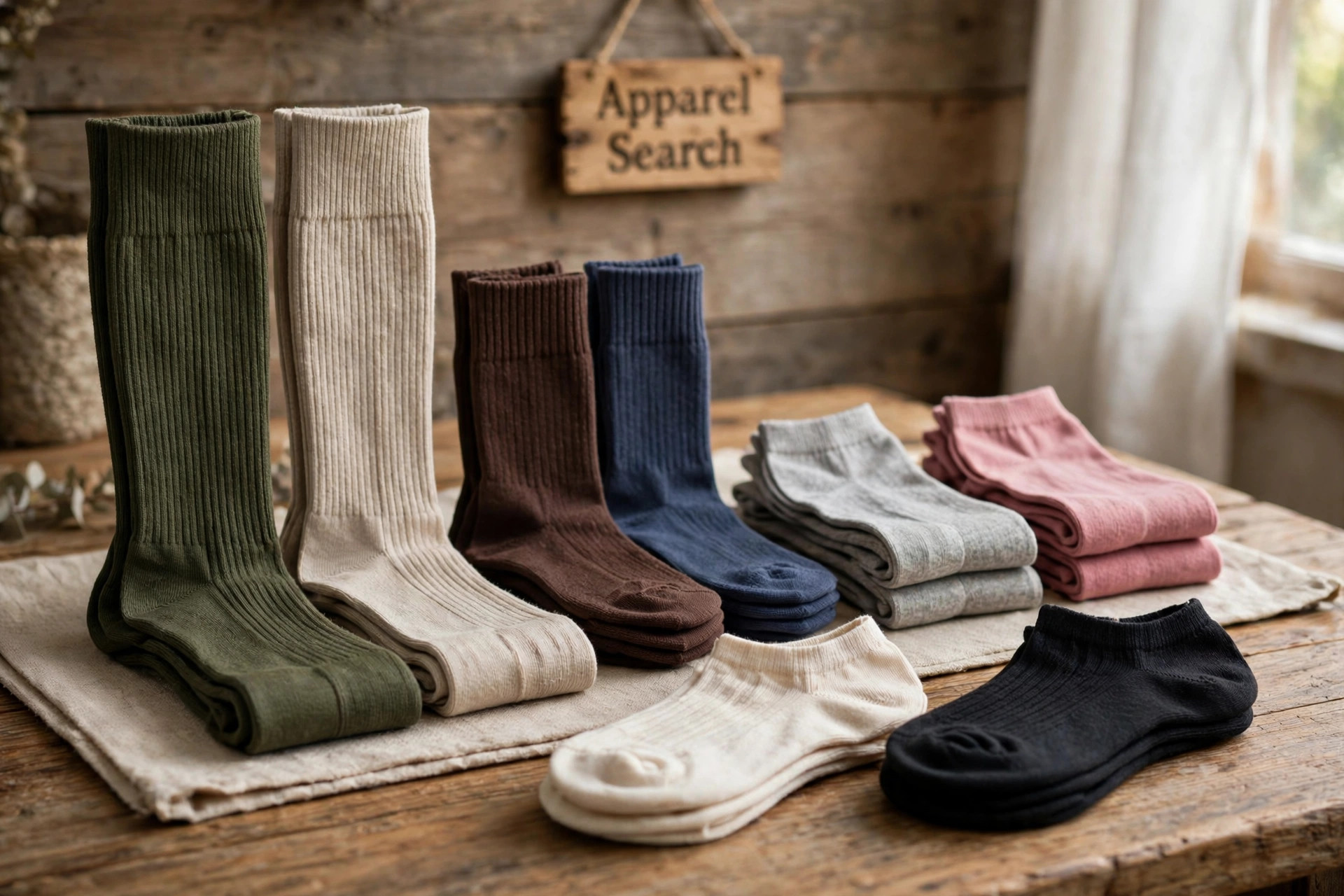
Each of the sock's three classic jobs explains a piece of its design. Friction comes first: the shoe rubs against the sock, the sock moves with the foot, and the skin is spared the blistering a bare foot in a shoe quickly earns. Warmth comes from the knitted structure itself, which traps air — thickest in boot and winter socks. Sweat absorption matters because feet sweat heavily; a sock that takes moisture up keeps the skin more comfortable and the shoe fresher, and changing socks is the simplest piece of foot care there is. Cushioning is the unstated fourth job: padded soles in athletic and boot socks absorb impact at the heel and the ball of the foot.
Lengths and Styles
Sock lengths run on a clear scale. Low-cut socks cover only the foot and sit hidden inside the shoe; ankle socks end just above it; crew socks reach the mid-calf; and knee socks reach to just below the knee. Boot socks are a thicker, longer style made to be worn inside boots, cushioning the shin and calf against the boot shaft.
Within those lengths, men's, women's and children's socks divide by use as much as by size. Dress socks are thin, smooth and long enough to keep the leg covered when sitting. Athletic socks add cushioning, arch-support bands and moisture-managing fibres. Novelty socks carry prints and colour as a fashion statement, and children's socks favour durability and easy sizing. Socks are sold in size ranges matched to shoe sizes, so fit is read off the wearer's shoe size rather than measured garment by garment. The same knitted-tube idea applied to the arms gives arm warmers, sometimes sold as arm socks.
Choosing socks is mostly a matter of matching fibre and weight to use: thin, smooth socks for dress shoes, where bulk would spoil the fit; cushioned, moisture-managing socks for sport; heavy wool socks for boots and cold weather. Length follows the same logic — the sock should always cover every point where shoe or boot touches skin, which is why a crew sock worn with boots chafes at the shin and a boot sock exists to prevent it.
Fibres, Construction and Care
The traditional sock fibres are cotton, wool and nylon, and most modern socks are blends of these with a little elastane for stretch and fit. Each fibre earns its place: cotton absorbs sweat but stays wet; wool absorbs and insulates even when damp, which suits cold weather and hiking; nylon adds strength and abrasion resistance; and modern performance synthetics move moisture away from the skin for sport. A sock's life ends at the heel and toe, where it wears thin first, so reinforced heels and toes are the mark of a sock made to last.
Care is simple but fibre-specific. Cotton socks wash hot and wear hard, though they shrink a little and fade. Wool socks are washed cool and gently to avoid felting. Turning socks inside out before washing protects their outer surface and gives the inside — where the sweat is — the cleanest wash. The knitting behind all of this belongs to hosiery manufacturing, a specialised branch of the industry with its own sock machinery, covered with the wider hosiery machinery of the trade.
Socks in the Hosiery Family
Socks belong to hosiery, the branch of clothing that covers the feet and legs, and they are classed with underwear in most wardrobes. The family divides by length and construction: socks end at or below the knee and are separate garments, one for each foot; stockings cover the whole leg and are held up at the thigh; and pantyhose join two legs to a brief in a single garment. The Not to Be Confused With box below sets the three side by side.
Not to Be Confused With
Three hosiery garments divided by length and construction. A sock covers the foot and part of the leg, ending at or below the knee, and is a separate garment for each foot. A stocking covers the foot and the whole leg, held up at the thigh by elastic, garters or a garter belt, and is likewise one of a pair. Pantyhose join the two legs to a brief at the top, making one garment worn like underwear. If it stops below the knee it is a sock; if it is a pair held up at the thigh it is stockings; if it is all one piece to the waist it is pantyhose.
Common Questions
What are the main sock lengths?
From shortest to longest: low-cut and no-show socks that cover only the foot and sit hidden inside a shoe; ankle socks ending just above the shoe; crew socks reaching the mid-calf; and knee socks reaching to just below the knee. Boot socks are a thicker, longer style made to wear inside boots, cushioning the shin and calf against the boot shaft.
What are socks made from?
Most commonly cotton, wool or nylon, and in modern socks, blends of all three with elastane for stretch and fit. Cotton absorbs sweat but stays wet; wool absorbs and insulates even when damp, which suits cold weather and hiking; nylon adds strength and abrasion resistance; synthetic performance fibres move moisture away from the skin for sport.
How do socks differ from stockings and pantyhose?
By length and construction. Socks end at or below the knee and are separate garments for each foot. Stockings cover the whole leg and are held up at the thigh. Pantyhose join two stockings to a brief in one garment. All three belong to hosiery, the branch of clothing that covers the feet and legs.