Footwear
Clothing Definitions — definitions of garments and clothing terms from Apparel Search
Search Apparel Search
At a Glance
Definition: Footwear is the collective term for everything worn on the feet — shoes, boots, sandals and slippers — made for protection, support, hygiene and adornment.
Category: Clothing Definitions
Footwear is the general name for everything worn on the feet: boots, shoes, sandals, slippers and every speciality form between them. It is worn to protect the foot from the ground and the weather, for hygiene, for support in work and sport, and as adornment — often all four at once. Hosiery such as socks is usually worn underneath it. This page is the anchor for the whole subject: it sets out the materials footwear is made from, the parts it is built from, and the main types, each of which has its own definition elsewhere in this section. For the broader terminology and history survey, see Footwear Terminology — Fashion Terms.
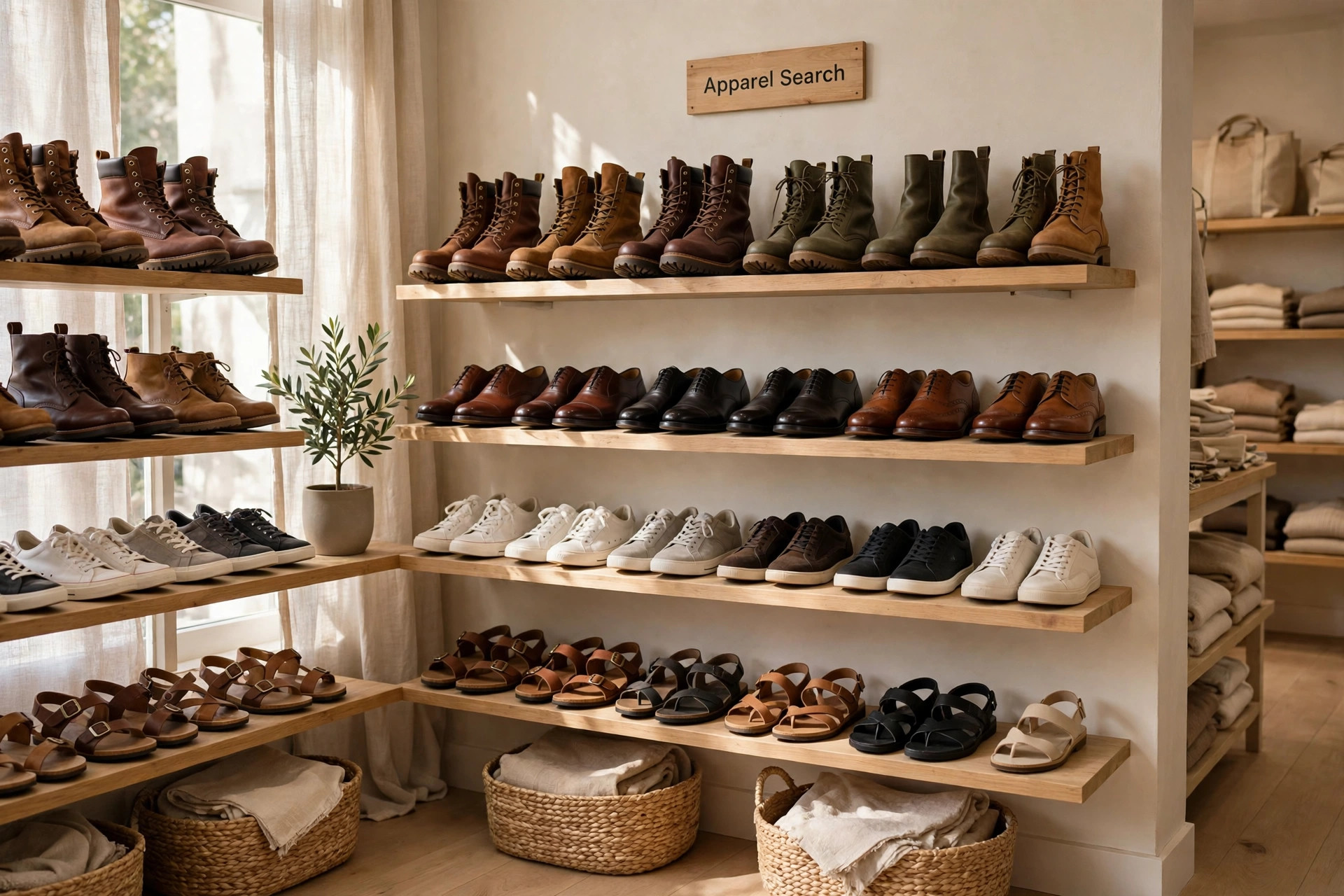
Why Feet Are Covered
The foot is the body's point of contact with the ground, and footwear exists first to manage that contact. A sole puts a durable, shaped layer between skin and surface, protecting against sharp objects, rough ground, heat, cold and wet. An upper holds that sole in place and shields the top of the foot, while the fit of the whole article decides how the wearer's weight is carried — which is why a walking boot, a running shoe and a dress shoe, all footwear, are built so differently from one another.
Beyond protection, footwear signals occasion and identity. It is the part of an outfit most tightly governed by activity and dress code: the same person may own work boots, athletic shoes, formal shoes and house slippers, each correct in one setting and wrong in the others. Footwear also follows fashion closely, with heel heights, toe shapes and sneaker styles changing by season, so the category is at once the most functional and one of the most expressive parts of dress.
Materials
Leather is the traditional footwear material: durable, breathable and able to mould to the foot with wear, it remains the standard for boots and dress shoes. Textiles — canvas, mesh and knitted uppers — dominate athletic and casual footwear, where light weight and ventilation matter more than polish. Rubber is the classic sole material and is also moulded into whole boots; plastics and synthetic microfibres provide waterproof and low-cost alternatives; and wood survives in the clog, one of the oldest footwear forms of all.
Most real footwear combines materials: a leather upper on a rubber sole, a textile upper on a foam midsole, a waterproof membrane inside a hiking boot. The research vocabulary reflects this — waterproof constructions, breathable linings and cushioned soles are named and compared because each combination suits a different use. Choosing footwear therefore starts with material: what the ground, the weather and the activity will do to the foot, and which combination answers it.
The Parts of a Shoe or Boot
However different the types look, they share a common anatomy, set out in full on our footwear components page. The sole is the foundation — outsole, midsole and insole layered together — and the heel raises and supports the back of the foot, from a boot's stacked leather heel to a stiletto. The upper is everything above the sole, closed by laces threaded through eyelets reinforced with a grommet, by straps, zips or elastic, or simply slipped onto the foot.
Each part varies by type and each variation has its own term, which is why footwear vocabulary is so large. Tread patterns are engineered for grip on court, trail or ice; air cushioning is built into athletic soles; a toe cap, a counter and a shank each do a named job. Learning the parts is the quickest way to read any footwear description, because catalogues and definitions alike describe new types as combinations of familiar components.
The Main Types: Boots and Shoes
Boots enclose the foot and ankle and often part of the leg. The family includes cowboy boots, riding boots, Wellington boots for wet work, and fashion forms such as go-go boots and kinky boots. Shoes end below the ankle: athletic shoes and sneakers, climbing shoes, clogs, moccasins, mules and penny loafers, and the heeled family — high heels, platform shoes and stiletto heels.
Sandals reduce the upper to straps holding a sole — flip flops are the simplest form — while slippers are the soft indoor branch of the family. Around these main types sits a long tail of speciality footwear named by activity: baseball cleats, bowling shoes, golf shoes, hiking boots, pointe shoes, tap shoes, waders and more, each engineered for one surface or movement. Guides to men's footwear and women's footwear, and the terms survey of women's shoes, organise that range by wearer; related coverings such as spats and socks complete the picture of what is worn on and over the foot.
Not to Be Confused With
Footwear is the whole category — everything worn on the feet. A shoe is only one member of it: the low-cut kind that ends below the ankle. Boots, sandals, slippers and sneakers are all footwear, but none of them is a shoe in the strict sense, which is why the trade and these definitions use footwear whenever the entire family is meant.
Common Questions
What is footwear?
Footwear is the collective term for everything worn on the feet, including boots, shoes, sandals and slippers. It is worn for protection against the environment, for hygiene, for support and as adornment, usually over socks or other hosiery.
What is the difference between footwear and shoes?
Footwear is the whole category of things worn on the feet. Shoes are one type within it — footwear that ends below the ankle. Boots, sandals, slippers and sneakers are all footwear but are not, strictly, shoes.
What are the main types of footwear?
The main divisions are boots, which enclose the foot and ankle; shoes, which end below the ankle; sandals, which hold a sole on with straps; and slippers for indoor wear. Around them sit speciality types named by activity, from climbing shoes and cleats to pointe shoes and waders.