Women's Mule Shoes Guide
The shoe with no back: a mule is defined by its open, unconstrained heel — which is why one pattern runs from bedroom slippers to evening heels.
Shop Women's Mule Shoes Now
Shop Women's Mule Shoes on Amazon Shop Women's Mule Shoes on eBayThe Amazon and eBay links on this page are affiliate links. If you make a purchase through them, Apparel Search may earn a commission.
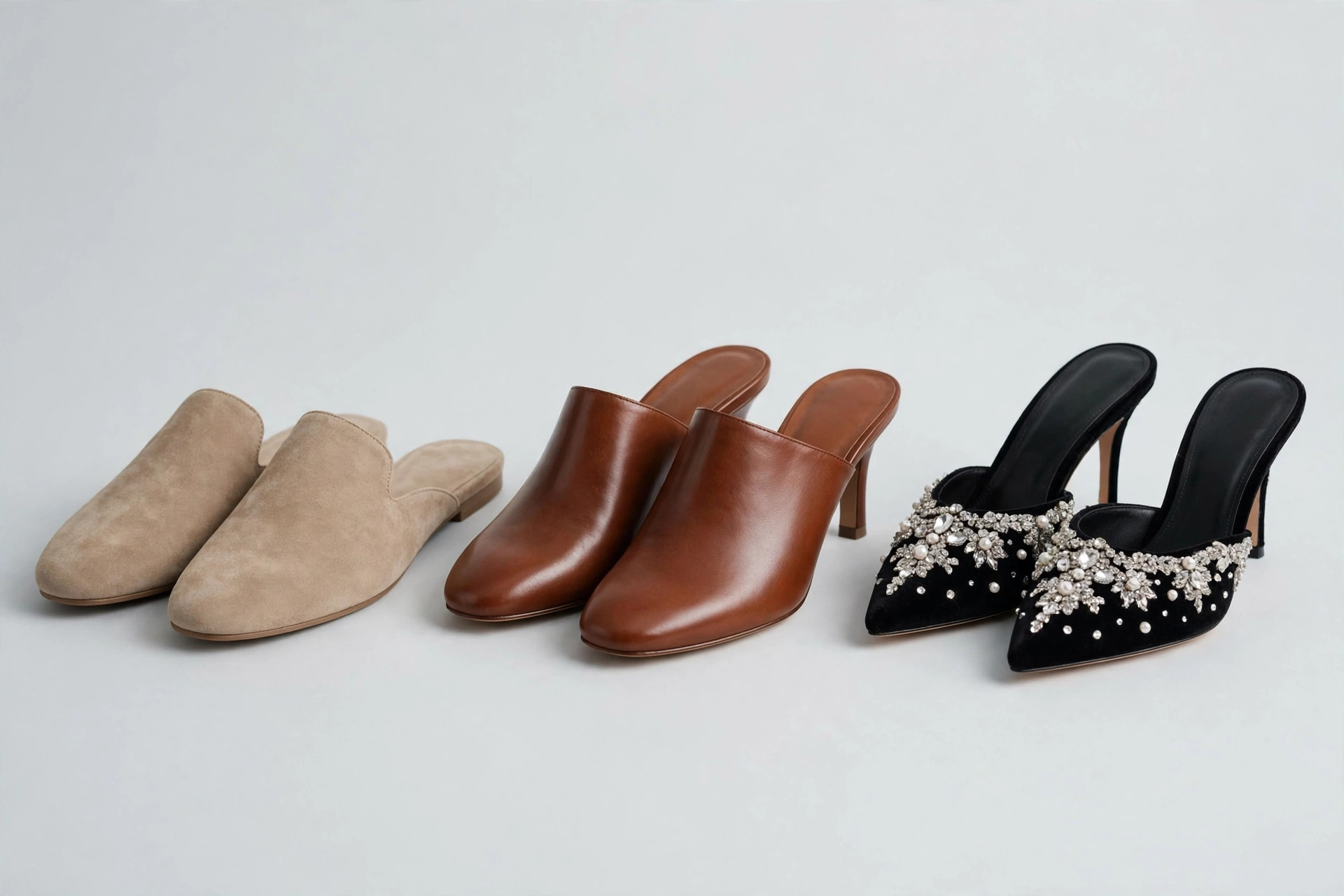
A mule is a shoe with no fitting or structure around the heel: a backless shoe with no heel constraint. That single absence is the entire definition, and it explains the mule's extraordinary range — the category runs from bedroom slippers to formal evening shoes, because everything in front of the heel can be anything: any toe, any heel height, any material, in casual or dressy forms.
The backless design is ancient and recurring; the mule returns to fashion whenever ease is in style, because it is the fastest shoe in the wardrobe: slide in, walk out. Its name is shared with the animal, tradition says, for the same stubborn simplicity — but the likelier inheritance is the Latin mulleus, a Roman shoe. Either way, the form has outlasted every era that adopted it.
The Mule Family: Heels, Flats, Clogs and Slides
Heeled mules run from kitten heels to stilettos, in leather, satin and embellished evening forms; the backless line lengthens the leg, which is why the style is a formal staple. Flat mules — the pointed-toe loafer mule above all — became the modern office and travel shoe: the polish of a loafer with the ease of a slipper. Clog mules put a mule upper on a wooden or molded clog sole. Slides are the open-toe, flat branch of the family.
Toes split the family further: closed-toe mules read as shoes and suit work and cooler weather; open-toe and peep-toe mules read as sandals and suit summer and evening. A heeled, closed-toe mule and an open-toe slide share nothing but the missing heel cup — and that, in this category, is enough to make them cousins.
How a Backless Shoe Stays On
A mule stays on by fit, not by fastening: the upper must grip the forefoot and instep snugly enough that the shoe travels with the foot. This makes sizing exact — a mule that is even slightly large will slap, slide and tire the toes that claw to hold it. The heel should sit fully on the footbed, not hang off the back edge, and the widest part of the foot should meet the widest part of the shoe.
Walking in heeled mules is a skill of small steps and a relaxed foot; if you are gripping with your toes, the pair is wrong. Higher vamps (uppers that cover more of the foot) hold better than low, skimpy ones, and a slightly padded footbed keeps the slide from becoming a slap. Try mules at the end of the day, on your real feet, and walk the shop's hard floor, not its carpet.
Styling and Care
Mules are the shortcut shoe of a considered wardrobe: heeled mules finish dresses and tailoring; loafer mules sharpen jeans and trousers; slides carry summer. Because the heel is bare, the shoe draws the eye to the ankle — cropped trousers, midi skirts and anything that shows the shoe's line is its natural partner. Our blog's mule coverage, linked below, follows the style's trend cycles.
Care is ordinary shoe care with one addition: the exposed footbed takes the wear, so clean and condition it as you do the upper, and let pairs rest between wearings. Store heeled mules upright so the backless uppers are not crushed. Choose the fit honestly, and the mule repays you with the easiest elegance in footwear — no laces, no straps, no back, no fuss.
Related Women's Guides
Photos


Looking for Women's Clothing Stores?
If you are ready to shop rather than browse guides, visit our women’s clothing shopping directory for stores carrying women's mule shoes and much more, or use the Amazon and eBay buttons at the top of this page.