Platform Shoe
Clothing Definitions — definitions of garments and clothing terms from Apparel Search
Search Apparel Search
At a Glance
Definition: A platform shoe is a shoe, boot or sandal with a thick sole under the whole foot, which raises the wearer evenly instead of pitching the foot forward in the way a high heel does.
Category: Clothing Definitions
A platform shoe raises the whole foot on one thick sole. It can be a shoe, a boot or a sandal: what defines it is the deep sole carried under toe and heel alike, built in cork, plastic, rubber or wood, and worn for fashion and for the height it gives. Because the foot itself stays comparatively level, a platform can add inches that a spiked heel would make punishing — the bargain that has brought the style back in wave after wave since ancient times, and most noisily in the 1970s. This page explains how a platform is built, traces the fad years and the revivals, and separates the platform from the wedge, the flatform and the stiletto.
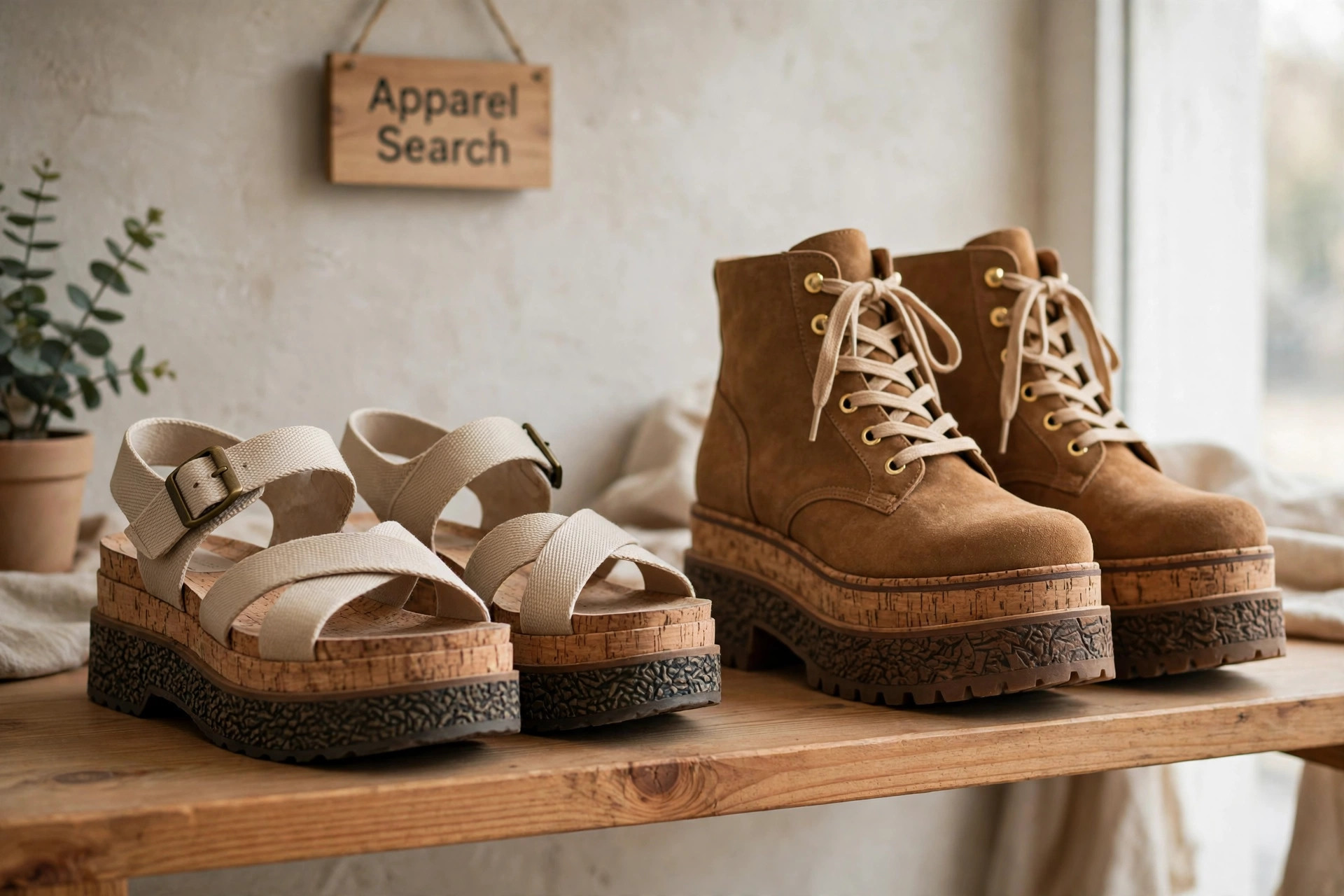
A Sole Under the Whole Foot
The measurement that matters in a platform is not the height of the heel but the difference between the sole's thickness under the toes and its thickness under the heel. A deep platform under the front of the foot cancels out much of a high heel behind it, so the shoe can stand tall while the foot rests at a gentle angle. That geometry is the platform's whole claim: height without the steep pitch, and without nearly the discomfort, of a spike heel worn on its own.
The sole has to be light, because a solid block of any dense material would be too heavy to walk in. Cork and light woods did the work in the classic period — a wooden-soled platform is technically also a clog — and moulded plastic, rubber and foam compositions do it now. The deep side wall of the sole is the style's visual signature, and it is usually finished by wrapping it in suede, leather or fabric, so the material of the wrapping, as much as the sole inside it, decides how the shoe looks and how it is cleaned.
Old Height, and the 1930s to 1950s
Raised soles are an old device, and platform footwear has been worn in various cultures since ancient times, for height, for ceremony and for keeping the foot above wet or dirty ground. In the United States the modern platform had a first, smaller run of popularity in the 1930s and 1940s and into the very early 1950s, as a fashion shoe rather than a craze. Nothing in that period matched what came twenty years later, but it established the pattern the later fad followed: a thick sole offered as glamour, taken up first as a novelty and then as a standard option in the shoe shop.
The 1970s Fad and Its Revivals
The biggest and longest platform fad in American history began somewhere between 1969 and 1973 and ran into the late 1980s. At first the wearers were chiefly young women in their teens and twenties, with younger girls and older women joining in and, during the disco years, young men as well. The shoes did give height more comfortably than spike heels, but the original accounts are plain that they were worn first of all to attract attention — height as display.
The fad standardised early and stayed remarkably uniform. Its most popular style was a simple quarter-strap sandal: light tan water-buffalo-hide straps, darkening with age, on a beige suede-wrapped cork wedge-heel platform sole, introduced under the brand name Kork-Ease. The design is said never to have been formally designed at all, yet its light weight and soft leather supported a crowd of imitators, and even counting the copies there was very little variation beyond differences in height. As the years passed, makers such as Candie's pushed heights and shapes toward the outrageous, while Famolare and Cherokee of California answered with comfort platforms that combined the lift with sneaker-like or even orthopaedic support. Scandinavian clogs, themselves thought outrageous at the start of the decade, had become classics by its end, carried by the same taste for a raised wooden sole.
Platforms resurfaced in the late 1990s — the chunky Buffalo Boots were the European favourites of that wave, popular notably in Germany and Norway from the mid-1990s into the early 2000s — and they had firmly re-established themselves in the fashions of the early twenty-first century, with a higher threshold of what counted as outrageous than the 1970s ever set. Since then the platform sole has stayed a recurring option on sandals, boots and trainers, rising and falling in height rather than disappearing.
Wearing and Caring for Platforms
Care follows the sole. Cork should be sealed against water and never soaked; wrapped soles are cleaned as their covering dictates, suede with a brush, leather with leather care, fabric gently. The fixings deserve a regular check: the leverage of a deep sole works straps, stitching and glue lines harder than a flat shoe does, and a strap that pulls free from a tall platform fails further from the ground. Fit is judged as on any footwear — room for the toes, a heel held without slipping — with the added point that the wearer's balance, not the shoe's pitch, is what a very tall platform tests.
Not to Be Confused With
Four ways of gaining height, four different soles. A platform shoe carries a thick sole under the whole foot, so the foot stays comparatively level however tall the shoe stands. A flatform is the platform's level-headed subtype: a thick sole of nearly even depth from toe to heel, giving height with almost no pitch at all. A wedge is one continuous sole that is thick at the heel and tapers toward the toe, so the foot is pitched, but the whole length of the sole meets the ground. A stiletto gains its height at the heel alone, on a narrow spike, with no platform under the toes to soften the angle.
Common Questions
What is a platform shoe?
A platform shoe is a shoe, boot or sandal with a thick sole under the whole foot, often of cork, plastic, rubber or wood. A wooden-soled platform shoe is technically also a clog. Platforms are worn for fashion and for the added height the deep sole gives.
How is a platform shoe different from a high heel?
A high heel raises the heel alone and pitches the foot forward. A platform raises the whole foot, so a shoe can combine a deep platform with a high heel while the foot itself rests at a much gentler angle — height with less of the spike heel's discomfort.
Why were platform shoes so popular in the 1970s?
The American fad that began around 1969-1973 and lasted into the late 1980s offered added height without nearly the discomfort of spike heels, but contemporary accounts say the shoes were worn primarily for the sake of attracting attention, as fashion — above all in the disco era.