Sandals
Clothing Definitions — definitions of garments and clothing terms from Apparel Search
Search Apparel Search
At a Glance
Definition: Sandals are an open type of footwear, consisting of a sole held to the foot by straps so that much of the foot stays exposed to the air.
Category: Clothing Definitions
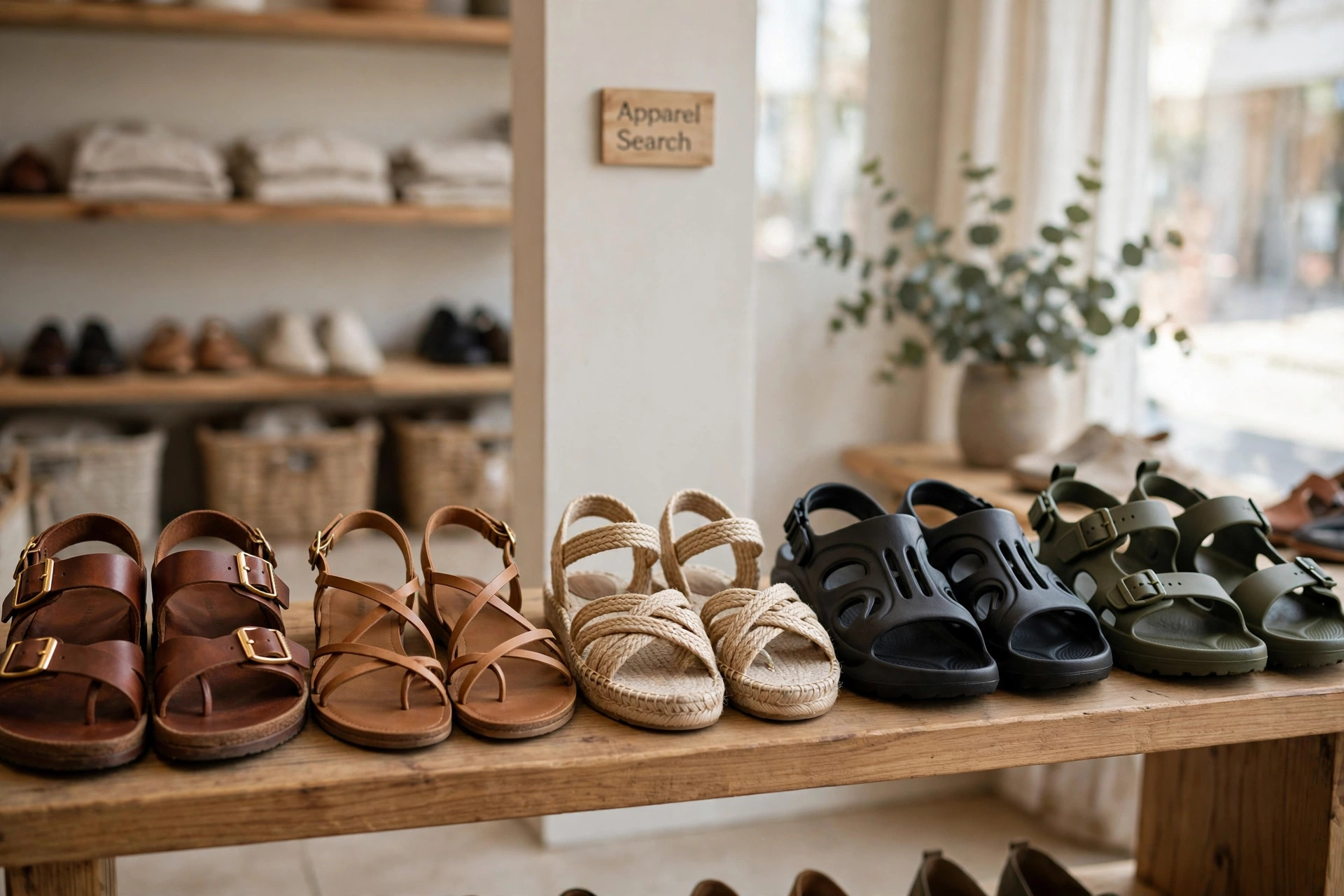
Sandals are an open type of footwear, held to the foot by straps over a flat sole so that much of the foot stays exposed to the air. Espadrilles are a kind of sandal, and mules and flip-flops are close relatives — flip-flops, the simplest form, can only be worn with bare feet or special socks. Sandals are made of rope, rubber, leather, wood, as in clogs and the Japanese geta, or tatami, as in zori. Because the construction is so simple, the sandal is one of the oldest forms of footwear, and versions of it appear in nearly every warm-climate clothing tradition.
A Sole and Straps
The sandal's structure has only two elements: a sole cut to the shape of the foot, and something to hold it on. Everything else is variation. The holding may be a thong passing between the first two toes, as in the flip-flop and the zori; straps crossing the instep; a strap around the heel, which turns a slip-on into a walking sandal; or laces and ties running up the leg, as on the travelling waraji. The sole may be flat or contoured, thin or built up — the geta raises it clear of the ground on wooden blocks — but it is never closed over the toes or heel, and that openness is the definition.
The materials are whatever lies flat and wears well. Rope and woven straw serve where plant fibres are plentiful, leather where hides are, wood where a raised, washable sole is wanted, and tatami — woven rush — in Japan. Rubber, and later moulded plastics, took over the beach end of the family in the twentieth century because they ignore water entirely. The design belongs to warm climates, where an enclosed shoe is a burden and a wet sandal dries in minutes, and it is among the oldest forms of footwear precisely because it asks so little of the maker: a flat piece, a few straps, and the foot is shod.
Japanese Forms: Geta, Zori and Waraji
The Japanese tradition shows how far the simple sandal can be developed. The zori is a flat-soled sandal held by cloth thongs between the toes. The geta raises the same idea off the ground on a wooden sole supported by one or two horizontal wooden blocks, keeping the foot above mud and puddles. The waraji, woven from straw with straw or cloth thongs and sometimes extra ties over the foot and around the leg, was the travelling sandal, sturdy enough for long journeys on foot. This construction — a sole piece held on by thongs from the inner and outer side of the foot to the gap between the first two toes — was the norm in Japan before the westernisation of clothing, and it is the direct ancestor of the rubber flip-flop worn on beaches worldwide.
That ancestry survives in language. It is said that the New Zealand expression "jandals" for rubber beach sandals — called "thongs" in Australia — comes from "Japanese sandals", because the shape resembles the Japanese zori: basically a rubber sole piece held on to the foot by two cloth thongs extending from the inner and outer side of the foot to the gap between the big toe and the second toe.
Choosing and Wearing Sandals
Because a sandal holds the foot mainly by its straps, fit is about strap placement rather than the enclosed sizing of a shoe. Straps should hold the foot without rubbing, the sole should match the length of the foot so the toes do not hang over the front edge, and a contoured footbed gives support that a completely flat sole cannot. Leather sandals mould to the foot with wear and suit dry conditions; rubber and synthetic sandals tolerate water and suit the beach and pool; rope-soled espadrilles are light summer footwear best kept dry.
Women's sandals and men's sandals each come in a wide variety of styles, from flat walking sandals and heeled dress sandals to sport sandals with rugged soles. The Apparel Search guides to the styles of women's sandals, women's sandals and men's sandals cover those styles in detail.
Care follows the material. Leather benefits from cleaning and conditioning and should dry away from direct heat. Rubber and plastic sandals wash clean with soap and water. Rope and tatami soles should be kept as dry as possible, since natural fibres weaken and stain when they stay wet. Stored flat and out of strong sunlight, a well-made pair of sandals lasts many summers — one reason the design has survived, essentially unchanged, for thousands of years.
Not to Be Confused With
A sandal is the general form: an open sole held to the foot by straps, which may include a strap around the heel. A flip-flop is the simplest sandal — a flat sole held only by a thong between the toes, with nothing at the heel. An espadrille is defined by its sole rather than its straps: a flat or low-heeled shoe or sandal with a sole of woven rope.
Common Questions
What makes a shoe a sandal?
A sandal is open footwear: a sole held to the foot by straps, leaving most of the foot exposed. That separates sandals from shoes and boots, which enclose the foot, and from slippers, which are closed indoor footwear. Mules, which have no back strap, and flip-flops, which are held only by a toe post, are both related forms.
Where does the word jandals come from?
Jandals is the New Zealand expression for rubber beach sandals, called thongs in Australia. It is said to come from Japanese sandals, because the shape resembles the Japanese zori, a flat sole held on by two cloth thongs passing between the big toe and the second toe.
What are sandals made of?
Almost any flat, durable material: rope, rubber, leather, wood and tatami are all traditional. Modern sandals add moulded plastic soles, fabric straps and cushioned footbeds, but the structure — a sole and straps — stays the same across all of them.