Riding Boots
Clothing Definitions — definitions of garments and clothing terms from Apparel Search
Search Apparel Search
At a Glance
Definition: Riding boots are knee-high boots, usually of leather, made for horseback riding, with a smooth sole and a defined low heel that stops the foot slipping through the stirrup.
Category: Clothing Definitions
Riding boots are boots made to be used for horseback riding. The modern form is usually knee-high and made of leather, plain and close-fitting, with a low heel — even though the raised heel is traditionally said to have been invented for riding, to stop the boot slipping through the stirrup, and relatives such as the cowboy boot keep a much higher one. This page explains the parts of a riding boot and the job each part does in the saddle, how the boots are fitted and cared for, and how the working boot differs from the fashion boots that copy its outline.
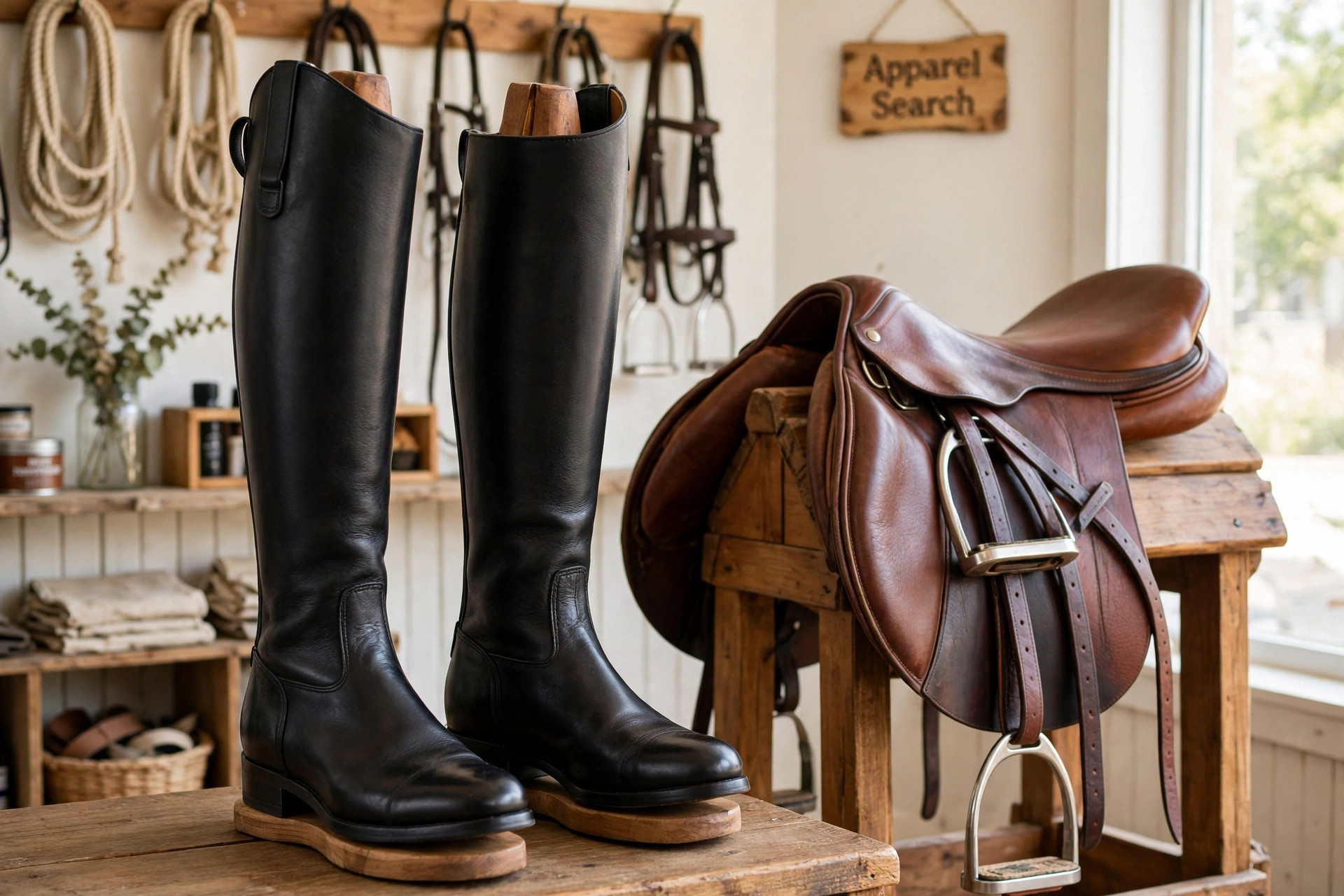
Parts of the Boot and Their Work
A riding boot is read from the ground up. The sole is smooth leather or a fine-profile rubber — smooth because a deeply lugged sole could jam in the stirrup instead of releasing in a fall. The heel is the safety device: a clear step of about an inch on English-style boots that catches the stirrup iron and holds the foot in position. The foot is cut plain and close, often with an elastic panel or laces at the ankle on field boots so the ankle can flex downward, since correct riding position drops weight into the heel.
The shaft does the visible work. Knee-high, it protects the rider's leg against the saddle, the stirrup leather and the horse's side, and gives a smooth surface that does not catch on tack. It is stiff enough in dress boots to stand smooth, softer in schooling boots, and always close to the calf, because any fold or gap between boot and leg will rub through a long ride. Zips up the back or side are the modern convenience replacing the boot pulls and boot jack of the traditional pull-on boot, and spur rests above the heel hold a spur at its set height.
The family divides by discipline and formality. Dress boots are plain-fronted and the stiffest and smartest, worn for showing, dressage and hunting formality. Field boots lace at the ankle, the lacing giving the flexion a jumping or general riding position needs, and are the common schooling and competition choice. Hunting boots add a coloured top — a band of contrasting leather at the shaft's rim — to the dress boot's form. Below the knee the family shortens: jodhpur and paddock boots end at the ankle and are worn for yard work and by children, often with half chaps standing in for the tall boot's shaft.
Fitting and Care
Fitting is by foot size, calf width and shaft height together, and the three are specified separately on better boots. The shaft should reach the back of the knee without pressing into it when the knee bends, and the calf should be snug without cutting circulation. New tall boots are expected to drop slightly in height as the ankle creases settle, which is why they are bought a fraction high.
Care is stable care. Mud and sweat are the enemies, so boots are wiped or washed down after riding, dried away from direct heat, and kept on boot trees so the shafts stand and the ankles do not collapse into creases. Working pairs are fed with leather dressing rather than fashion polish; polished dress boots for the show ring are the exception, shined to a hard gloss as part of turnout.
Breaking in is part of the fitting. A new tall boot is stiff at the ankle and high at the knee by design; over the first rides the leather creases at the ankle, the boot drops to its working height and the shaft moulds to the calf. Boots bought already comfortable at the knee are usually boots that will end too short, which is why experienced riders accept a week of stiffness as the price of the finished fit.
Riding Boots and Fashion Boots
Fashion has borrowed the silhouette freely. The go-go boots of the 1960s took the knee-high outline into party dress in white patent, and high-street “riding boots” recur whenever the equestrian look is in fashion, usually with a decorative strap and buckle standing in for the working details. The cowboy boot is the closer relative — a true working saddle boot of the Western tradition, keeping a higher, angled heel, a taller and often decorated shaft and a pointed toe. The working definition stays where it began: a smooth-soled, heeled, tall leather boot built around a stirrup and a horse's side, one member of the wider footwear and shoe family specialised for the saddle.
Not to Be Confused With
Three tall boots, three jobs. A riding boot is a leather boot built for the saddle: smooth sole, defined heel against the stirrup, close knee-high shaft. A Wellington boot is a waterproof rubber boot for wet ground and yard work — it has no place in a stirrup, and its job is keeping water out, not holding a foot in position. A fashion riding-style boot borrows the riding boot's outline — tall shaft, low heel, sometimes a strap and buckle — without the stirrup-safe sole and heel the working boot is defined by.
Common Questions
Why do riding boots have a heel?
The heel stops the boot from slipping through the stirrup. The raised heel is traditionally said to have been invented for riding boots for exactly that purpose, and every true riding boot keeps a defined heel — low on modern English-style boots, higher on the cowboy boot.
Why are riding boots knee-high?
The tall leather shaft protects the rider's leg against the saddle, the stirrup leather and the horse's side, and gives a smooth, close surface that does not rub or catch while riding. Modern riding boots are usually knee-high and made of leather.
What is the difference between riding boots and cowboy boots?
Both descend from working saddle boots, but the cowboy boot keeps a higher, angled heel, a taller and often decorated shaft and a pointed toe for its own stirrup tradition, while the modern riding boot is plainer, close-fitting and low-heeled, made for English-style riding and schooling.