Men's Footwear Guide
Men's footwear is the whole wardrobe worn on the feet: garments for the feet that protect against the ground and the weather, ease walking and prevent injury, and - second only to protection - signal the wearer's purpose and standing. The family runs from oxfords and loafers to boots, sneakers, sandals and steel-toe work shoes, with socks and hosiery worn inside most of them for comfort. This guide is the map of that family: how the categories divide by job, how a shoe is built, and how to choose the pair that matches the day you actually have.
Shop Men's Footwear Now
Shop Men's Footwear on Amazon Shop Men's Footwear on eBayThe Amazon and eBay links on this page are affiliate links. If you make a purchase through them, Apparel Search may earn a commission.
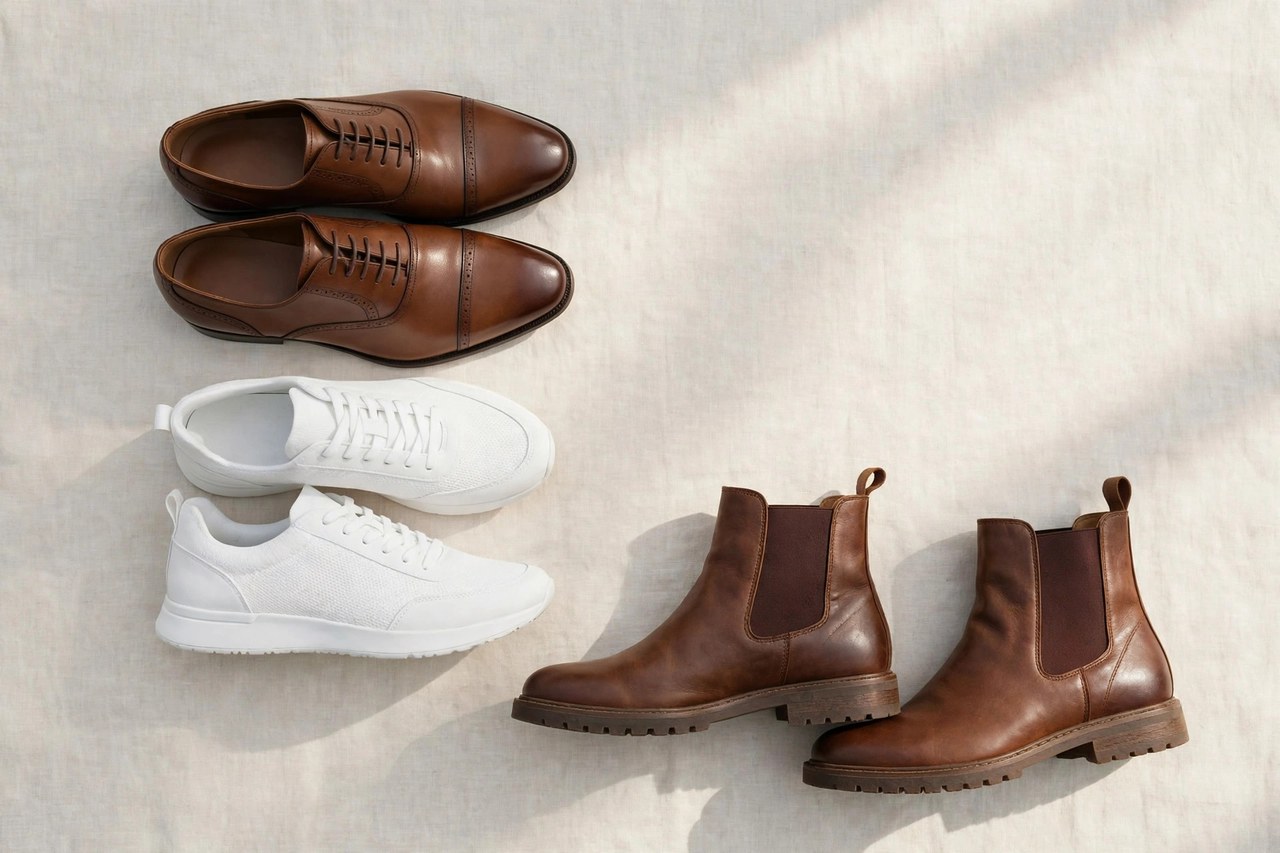
Men's footwear is the whole wardrobe worn on the feet: garments for the feet that protect against the ground and the weather, ease walking and prevent injury, and - second only to protection - signal the wearer's purpose and standing. The family runs from oxfords and loafers to boots, sneakers, sandals and steel-toe work shoes, with socks and hosiery worn inside most of them for comfort. This guide is the map of that family: how the categories divide by job, how a shoe is built, and how to choose the pair that matches the day you actually have. This guide walks through the choices that matter - style, fit, fabric and finish - with the practical detail a product listing rarely gives you, and closes with the care habits that keep the garment in service.
Styles and Construction
A shoe is three systems: the upper (leather, canvas, knit or synthetic, cut to the shoe's style), the sole unit (outsole for grip and wear, midsole for cushioning on athletic shoes, insole for the foot's bed), and the attachment between them - cemented, stitched, or Goodyear-welted, in rising order of cost, durability and repairability. The categories divide by job: dress shoes (oxfords, derby shoes, loafers) built for tailoring; boots for weather, work and terrain; athletic shoes engineered per sport - running, training, court, cleats for field sports; casual shoes and sneakers for daily miles; sandals and flip flops for heat; and safety footwear with steel or composite toes where the job demands it. Every category in this folder's index below has its own full guide in this directory.
Judge footwear by attachment and compound: cemented soles are light and affordable, stitched or welted constructions cost more and can be repaired, and the outsole rubber decides grip against longevity - soft compounds bite, hard compounds endure. Linings decide comfort over hours, removable insoles decide whether your own supports can come along, and honest weight decides whether the pair disappears on the foot or taxes every mile of the day.
Fit and Sizing
Fit is the category's universal law, because sizes are unstandardized between makers: measure both feet, fit late in the day in the socks of the job, allow roughly a thumb's width beyond the longest toe, and require the heel held without lift and the widest part of the foot meeting the widest part of the shoe. Dress shoes should feel snug and smooth, athletic shoes roomier in the toe box, boots secure at the instep so the heel cannot piston. Width letters matter as much as length numbers. A shoe that needs a break-in argument in the shop is telling you its last is not your foot's shape.
Fit footwear late in the day in the socks you will actually wear, with roughly a thumb's width beyond the longest toe, the heel held without lift, and the foot's widest point meeting the shoe's widest point. Sizes are unstandardized between makers - trust your measured length and width over the printed number, and require no break-in argument: a shoe that needs excuses in the shop delivers them on the road.
Wearing and Care
Footwear outlives its care or dies by it. Rotate pairs - a rest day doubles a rotation's life - clean after use, dry at room temperature, hold leather's shape with trees, condition on a schedule, and resole welted shoes before wear reaches the welt. Keep the categories honest: dress shoes kept for dress keep their line for a decade, while the same pair demoted to daily weather duty is gone in two winters. Store out of sunlight and damp, and let each category do the job it was built for - that discipline, more than any single purchase, is what a good shoe wardrobe is.
Rotation is the first care rule: a day of rest between wears lets linings dry and cushioning rebound, and it doubles a rotation's life compared with daily wear of one pair. Clean after use, dry at room temperature away from radiators, hold shape with trees or paper, and condition leather on a schedule rather than when it looks thirsty. Reproof weather finishes when water stops beading, and resole stitched footwear before the wear reaches the welt.
Common Questions
How many pairs of shoes does a man actually need?
A working core covers most lives: a dress shoe for tailoring and formal days, a casual leather shoe or loafer, a sneaker for daily and athletic wear, a boot for weather and rough ground, and a sandal for heat - five categories, each explained in its own guide in this directory. Beyond the core, pairs are added by job and sport, not by appetite: work safety shoes where required, cleats where played, a second dress pair to allow rotation. Rotation is what turns five pairs into a decade of service.
What is the difference between cemented, stitched and welted shoes?
It is how the sole is attached. Cemented soles are glued - light, flexible and inexpensive, but when the sole wears out the shoe is finished. Stitched (Blake or McKay) soles are sewn directly - sleeker, still resolable by a specialist. A Goodyear welt stitches the upper to a welt strip and the sole to the welt, so a cobbler can replace soles repeatedly without disturbing the upper: the most expensive construction to buy and the cheapest to own over a long life.
Why do shoe sizes differ between brands?
Because there is no enforced standard: each maker builds on its own lasts - the foot-shaped forms that decide length, width, instep height and toe shape - and lasts differ by country, category and fashion. A size 10 running shoe and a size 10 oxford are different objects. The defense is measurement: know your foot's length and width in centimeters, use each maker's own chart, fit late in the day, and trust the thumb's width and the held heel over any printed number.
More in Men's Clothes Guide F
Footwear, Defined and Indexed
Footwear refers to garments worn on the feet, which originally serve the purpose of protection against adversities of the environment, usually regarding ground textures and temperature; footwear in the manner of shoes therefore primarily serves to ease locomotion and prevent injuries, and secondly can be used for fashion and adornment and to indicate the status or rank of a person within a social structure — with socks and other hosiery typically worn additionally between the feet and other footwear for further comfort. The usual materials are leather, plastic and rubber, with clogs often made of wood. Below is an index of the men’s shoe wardrobe — athletic shoes, dress shoes, boots, casual shoes, sneakers, sandals, oxfords, loafers and more — in the lists that follow.
Photos

More to Explore on Apparel Search
- Men's Shoes
- Men's Clothes
- Men's Shoe Term
- Clothes
- Popular Brands
- Footwear News
- Shoe Definition
- Footwear Definition
- Footwear Definition List
- Men's Shoe Wholesalers
- Men's Shoe Stores
- Where to Buy Shoes
- Shopping For Shoes
- flip-flops
- cowboy boots
- snow boots
- different types of shoes
- Men's Apron Toe Oxford
- Men's Athletic Shoes
- Men's Baseball Shoes
- Men's Baseball Cleats
- Men's Basketball Shoes
- Men's Basketball Sneakers
- Men's Boots
- Men's Bowling Shoes
- Men's Canvas Shoes
- Men's Casual Shoes
- Men's Cleats
- Men's Clogs
- Men's Double Gore Slip On Shoes
- Men's Dress Shoes
- Men's Golf Shoes
- Men's Hiking Boots
- Men's Leather Boots
- Men's Leather Shoes
- Men's Loafers
- Men's Mukluks
- Men's Oxford Shoes
- Men's Penny Loafers
- Men's Rain Boots
- Men's Running Shoes
- Men's Sandals
- Men's Slippers
- Men's Sneakers
- Men's Soccer Cleats
- Men's Soccer Shoes
- Men's Slip-on Dress Shoes
- Men's Slip-on Shoes
- Men's Slip-on Loafers
- Men's Steel Toe Boots
- Men's Steel Toe Work Boots
- Men's Tassel Loafer
- Men's Tennis Shoes
- Men's Training Shoes
- Men's Walking Boots
- Men's Walking Shoes
- Men's Waterproof Shoes
- Men's Work Boots
- Men's Wrestling Shoes
- Men's Clothes Guide H-P
- Men's Clothes Guide Q-Z
Looking for Men's Clothing Stores?
This guide explains men's footwear. To browse where to buy, visit our men's clothing store directory, where you can find retailers that carry them.