Men's Flip Flops Guide
Men's flip flops are the minimal sandal: a thin, flat sole held to the foot by two straps that meet in a Y, joining between the big toe and the second toe. Nothing else is there - no heel cup, no arch structure, no ankle strap - and that simplicity is the entire point and the entire limitation of the design. The flip flop is warm-weather footwear reduced to its essence: a barrier between foot and ground for the beach, the pool, the shower and the short, easy walk, worn where shoes would be absurd and bare feet unwise.
Shop Men's Flip Flops Now
Shop Men's Flip Flops on Amazon Shop Men's Flip Flops on eBayThe Amazon and eBay links on this page are affiliate links. If you make a purchase through them, Apparel Search may earn a commission.
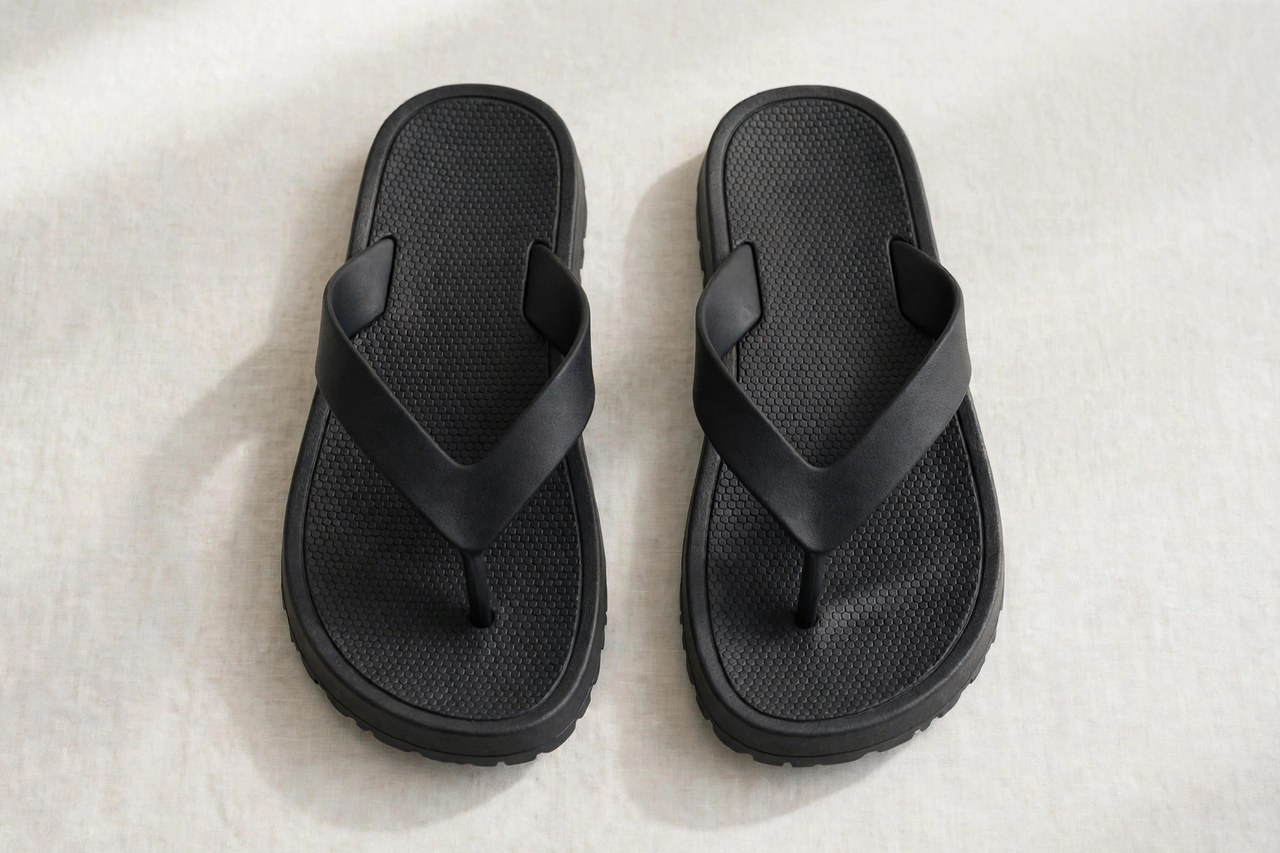
Men's flip flops are the minimal sandal: a thin, flat sole held to the foot by two straps that meet in a Y, joining between the big toe and the second toe. Nothing else is there - no heel cup, no arch structure, no ankle strap - and that simplicity is the entire point and the entire limitation of the design. The flip flop is warm-weather footwear reduced to its essence: a barrier between foot and ground for the beach, the pool, the shower and the short, easy walk, worn where shoes would be absurd and bare feet unwise. This guide walks through the choices that matter - style, fit, fabric and finish - with the practical detail a product listing rarely gives you, and closes with the care habits that keep the garment in service.
Styles and Construction
Materials set the tiers. The basic tier is molded rubber or EVA foam, light and waterproof and priced to be semi-disposable; the better tier keeps the same geometry but improves every part - a denser, slower-wearing outsole, a contoured footbed with a whisper of arch shape, straps of leather, woven textile or padded synthetic instead of thin rubber, and a toe post wrapped or molded smooth so it does not saw between the toes. Leather flip flops dress the design up to summer-smart; sport versions add tread and drainage for boats and beaches. Judge a pair by its sole density and its toe post, because those are the two parts that fail.
Judge footwear by attachment and compound: cemented soles are light and affordable, stitched or welted constructions cost more and can be repaired, and the outsole rubber decides grip against longevity - soft compounds bite, hard compounds endure. Linings decide comfort over hours, removable insoles decide whether your own supports can come along, and honest weight decides whether the pair disappears on the foot or taxes every mile of the day.
Fit and Sizing
Fit is exact because there is nothing to adjust: the heel should land inside the sole's back edge, not hang off it, the toes should end short of the front edge, and the straps should hold the sole to the foot without the toes needing to claw to keep it there - clawing is the sign the pair is too big or the straps too loose. Walk in them before committing: a correct pair stays quiet and stays on, a wrong pair slaps, twists on wet ground, or rubs the toe post raw within fifty steps. One size is this garment's whole fitting system, so the try-on is the tailoring.
Fit footwear late in the day in the socks you will actually wear, with roughly a thumb's width beyond the longest toe, the heel held without lift, and the foot's widest point meeting the shoe's widest point. Sizes are unstandardized between makers - trust your measured length and width over the printed number, and require no break-in argument: a shoe that needs excuses in the shop delivers them on the road.
Wearing and Care
Care is a rinse and a retirement plan. Hose off sand and salt, wash with mild soap when they begin to hold odor - the footbed's texture traps it - and dry in shade, since a foam sole left baking on hot concrete warps and hardens. Inspect the toe post's plug underneath the sole: when it thins or the straps loosen in their holes, the pair is finished, and a strap that pulls through mid-stride is how flip flops end. They are consumables with a season or two in them; buy the tier whose sole will still have tread when the straps give out.
Rotation is the first care rule: a day of rest between wears lets linings dry and cushioning rebound, and it doubles a rotation's life compared with daily wear of one pair. Clean after use, dry at room temperature away from radiators, hold shape with trees or paper, and condition leather on a schedule rather than when it looks thirsty. Reproof weather finishes when water stops beading, and resole stitched footwear before the wear reaches the welt.
Common Questions
Are flip flops bad for your feet?
For their intended use - short, flat, easy walking on sand, poolside and pavement - no. The problems start with mileage and terrain: a flat, unsupportive sole and a grip maintained partly by the toes are the wrong tools for long walks, hills, running or standing all day, where they encourage toe-clawing and offer no arch support or heel cushioning. The honest rule is distance: if the walk has a destination more than a few blocks away, wear the sandal or shoe built for walking.
What makes one pair of flip flops better than another?
Sole density and strap construction. A better pair uses denser EVA or rubber that resists compressing into a wafer, adds tread and a shaped footbed, and attaches padded leather or textile straps with a smooth, reinforced toe post. A cheap pair is soft foam and thin rubber straps that stretch, and its toe post is the first thing to tear through. The price gap between the tiers is small; the comfort and lifespan gap is not.
How should flip flops fit - should toes hang over?
No part of the foot should hang over the sole. The heel belongs fully on the footbed with a small margin behind it, the toes should end just short of the front edge, and the straps should be snug enough that the sole follows the foot without toe-clawing. Hanging over means the size is wrong, and with no straps to adjust, wrong-size flip flops cannot be made right - exchange them.
More in Men's Clothes Guide F
The Simplest Sandal
Flip-flops are a type of sandal — sandals being an open type of footwear, a sole held to the wearer’s foot by straps passing over the instep and sometimes around the ankle — and the modern flip-flop has a very simple design, consisting of a thin rubber sole with two straps running in a Y shape from the sides of the foot to the gap between the big toe and the one beside it. Everything else is what that simplicity costs and buys in practice. For more, see the sandal guide, the fisherman sandals page and the footwear guide.
More to Explore on Apparel Search
Looking for Men's Clothing Stores?
This guide explains men's flip flops. To browse where to buy, visit our men's clothing store directory, where you can find retailers that carry them.