Men's Shoes Guide
Men's shoes are the whole landscape of closed footwear: the constructed leather shoes of tailoring - oxfords, derbies, brogues, loafers and monk straps - the boots that share their benches, and the casual territory of sneakers, boat shoes and moccasins. This guide is the map of that landscape: how shoes are built, which pattern belongs to which occasion, and the fit discipline that makes any pair a good pair.
Shop Men's Shoes Now
Shop Men's Shoes on Amazon Shop Men's Shoes on eBayThe Amazon and eBay links on this page are affiliate links. If you make a purchase through them, Apparel Search may earn a commission.
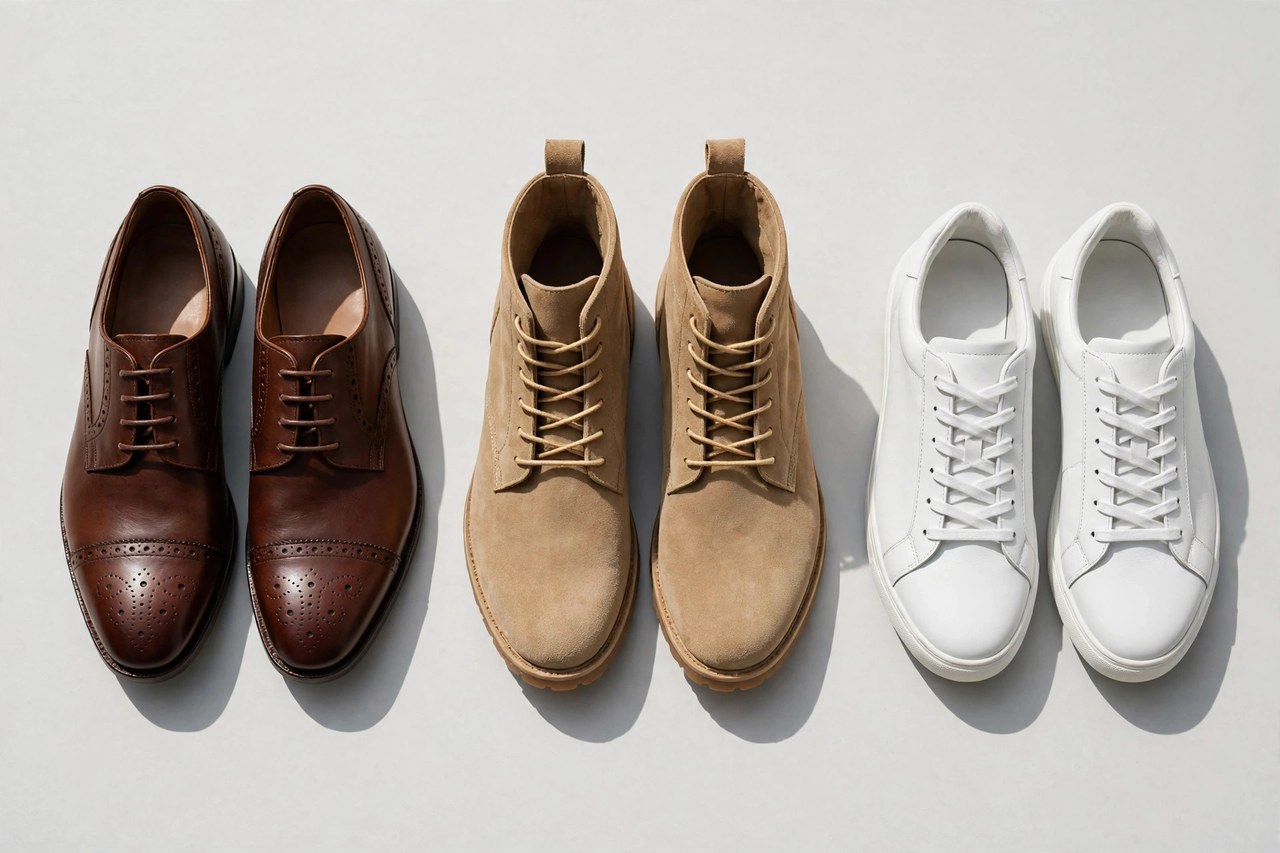
Men's shoes are the whole landscape of closed footwear: the constructed leather shoes of tailoring - oxfords, derbies, brogues, loafers and monk straps - the boots that share their benches, and the casual territory of sneakers, boat shoes and moccasins. This guide is the map of that landscape: how shoes are built, which pattern belongs to which occasion, and the fit discipline that makes any pair a good pair. This guide covers the styles worth knowing, the fit points that decide comfort, the fabrics and construction that separate a good buy from a regret, and the simple care that makes the garment last.
Construction and the Formality Map
Construction is the honest hierarchy. Goodyear-welted and stitched shoes can be resoled for decades and cost accordingly; cemented shoes are lighter, cheaper and disposable by design. Leather grades run from full-grain (the hide's real surface, ages beautifully) through corrected grains to bonded scraps wearing a leather name. Patterns carry the formality code: the closed-laced oxford is the dress summit, the open-laced derby relaxes it, broguing decorates and de-formalizes, and the loafer leaves laces behind entirely. Soles speak too - leather for the boardroom floor, rubber lugs for weather, and the modern hybrid sole that lets a dress pattern walk like a sneaker.
Judge footwear by attachment and compound: cemented soles are light and affordable, stitched or welted constructions cost more and can be repaired, and the outsole rubber decides grip against longevity - soft compounds bite, hard compounds endure. Linings decide comfort over hours, removable insoles decide whether your own supports can come along, and honest weight decides whether the pair disappears on the foot or taxes every mile of the day.
Fit and Sizing
Fit is the whole purchase: length with a thumb's width past the longest toe, width that meets the foot's widest point at the shoe's widest point, a heel held without lift or bite, and no reliance on break-in to fix a wrong last. Leather shoes give across the width with wear but never in length. Shop late in the day, in the socks of the occasion, and walk on hard floor - carpet in a shoe shop has flattered more bad fits than any salesman.
Fit footwear late in the day in the socks you will actually wear, with roughly a thumb's width beyond the longest toe, the heel held without lift, and the foot's widest point meeting the shoe's widest point. Sizes are unstandardized between makers - trust your measured length and width over the printed number, and require no break-in argument: a shoe that needs excuses in the shop delivers them on the road.
Wearing and Care
Rotation is the first law: leather shoes need a day's rest between wears, on cedar trees that hold the shape and drink the moisture. Brush after wear, condition when the leather looks dry rather than on a calendar, polish for protection as much as shine, and resole stitched shoes before the wear reaches the welt. Suede wants its own brush and a protector spray; all shoes want to be stored away from radiators and plastic bags.
Rotation is the first care rule: a day of rest between wears lets linings dry and cushioning rebound, and it doubles a rotation's life compared with daily wear of one pair. Clean after use, dry at room temperature away from radiators, hold shape with trees or paper, and condition leather on a schedule rather than when it looks thirsty. Reproof weather finishes when water stops beading, and resole stitched footwear before the wear reaches the welt.
Two classic styles worth knowing by name: saddle shoes, with their contrasting instep panel, and roomy bicycle toe shoes.
And one construction worth understanding before you buy: most modern shoes are cemented - glued rather than stitched together.
Common Questions
Oxford or derby - what is the difference?
The lacing. An oxford's eyelet tabs are stitched under the vamp (closed lacing), giving a sleeker, more formal shoe; a derby's tabs sit on top (open lacing), adjusting more easily over a high instep and reading a step more casual. Both come plain, capped and brogued. High insteps usually fit derbies better; formal occasions usually ask for oxfords.
Are expensive shoes worth it?
When they are stitched rather than glued, and full-grain rather than corrected, yes - in cost per wear. A welted shoe resoled twice serves a decade or more and molds to your foot; a cemented shoe is done when its sole is. The value case collapses if the fit is wrong, though: the most expensive fact in footwear is a beautiful shoe in the wrong last, so buy the construction only after the fit is proven.
How many pairs of shoes does a man need?
Fewer, better, rotated. A working minimum covers the occasions of a life: a dark dress shoe, a casual leather shoe or boot, a sneaker, and weather or activity footwear as your climate demands. Rotation doubles the life of every pair in it, which is why two good pairs outlast and out-dress four cheap ones worn in sequence.
More in Men's Clothes Guide S
The Shoe and Its Sizes
A shoe is an item of footwear intended to protect and comfort the human foot while doing various activities, and also an item of decoration, whose design has varied enormously through time and culture, with appearance originally tied to function. (The shoe photograph is in the gallery below.) A man can survive with one pair each of sneakers, boots and dress shoes. Sizing needs care: shoe size is an indication of fitting size, several different size systems are used worldwide, differing in what they measure and where size 0 or 1 is positioned - so try the shoes on before making a purchase.
Photos

More to Explore on Apparel Search
Looking for Men's Clothing Stores?
This guide explains men's shoes. To browse where to buy, visit our men's clothing store directory, where you can find retailers that carry them.