Men's Slip-On Shoes Guide
Men's slip-on shoes are the whole laceless category: every shoe that goes on without laces, buckles or straps being fastened - dress loafers, casual canvas slip-ons, gored casual shoes, moccasins and their many descendants. Our original guide introduced the family whole, and this rebuild keeps that scope: the slip-on is defined by its convenience, and its members divide by how dressy the convenience is dressed.
Shop Men's Slip-On Shoes Now
Shop Men's Slip-On Shoes on Amazon Shop Men's Slip-On Shoes on eBayThe Amazon and eBay links on this page are affiliate links. If you make a purchase through them, Apparel Search may earn a commission.
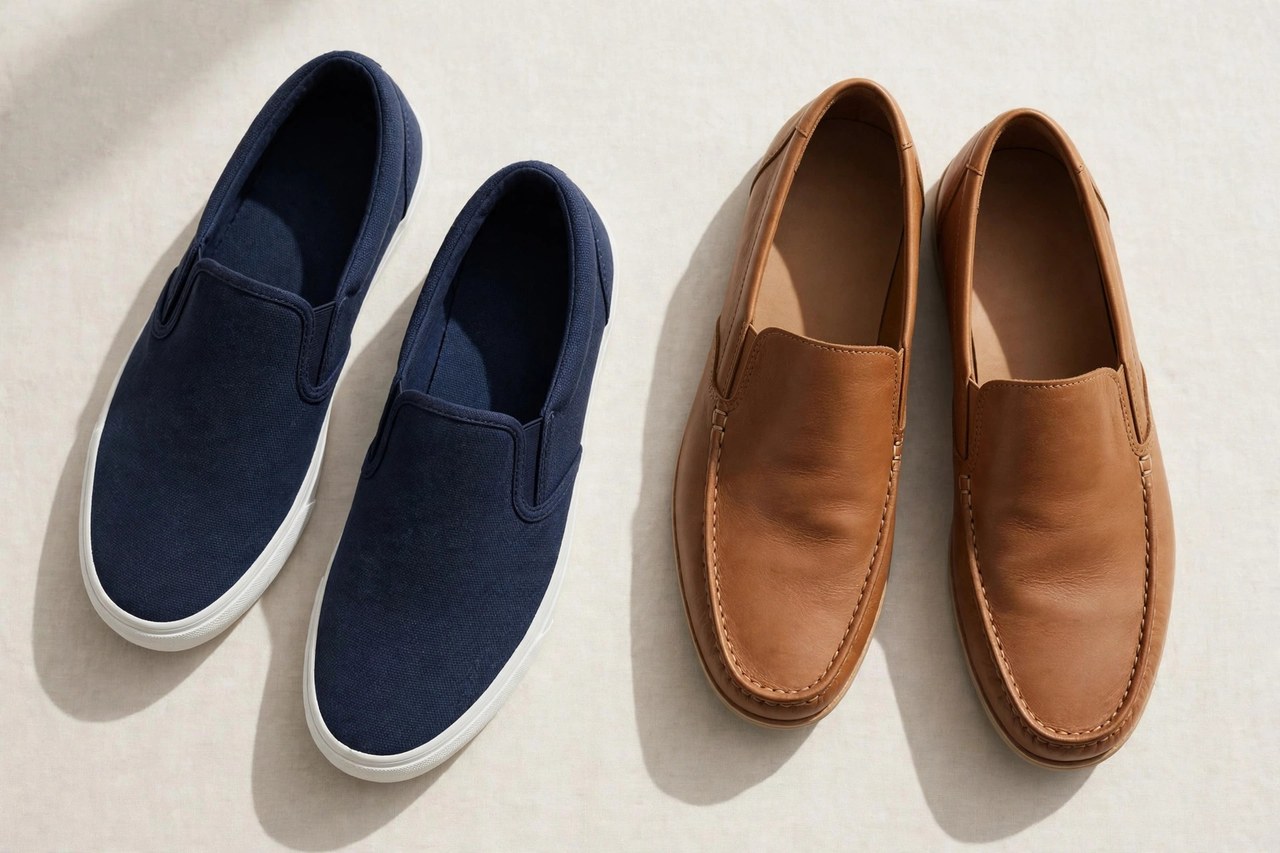
Men's slip-on shoes are the whole laceless category: every shoe that goes on without laces, buckles or straps being fastened - dress loafers, casual canvas slip-ons, gored casual shoes, moccasins and their many descendants. Our original guide introduced the family whole, and this rebuild keeps that scope: the slip-on is defined by its convenience, and its members divide by how dressy the convenience is dressed. This guide is built around the questions buyers actually ask: which style, which size, which fabric, and what will it look like after a year of real use - answered in order, with the trade-offs stated plainly.
Three Limbs of the Laceless Family
The family tree has three limbs. The leather limb is the loafer clan and its gored and monk-strapped cousins, running from suit-capable to business casual - covered in their own guides in this letter. The casual limb is the canvas and suede slip-on sneaker, elastic-gored and featherlight, the summer default with shorts and chinos. The comfort limb - moccasins, gored walking shoes and padded casual slip-ons - trades silhouette for all-day ease. They share one construction truth: the elastic gore or the shaped vamp is the only closure, so materials and last design carry the entire burden that laces carry elsewhere. A slip-on's quality is how it solves the holding problem without hardware.
Judge footwear by attachment and compound: cemented soles are light and affordable, stitched or welted constructions cost more and can be repaired, and the outsole rubber decides grip against longevity - soft compounds bite, hard compounds endure. Linings decide comfort over hours, removable insoles decide whether your own supports can come along, and honest weight decides whether the pair disappears on the foot or taxes every mile of the day.
Fit and Sizing
The fit rules are the category's constitution: heel held with minimal slip from new, instep wrapped without pressure, toes free, and the expectation that the shoe will relax - so new snugness is the correct purchase. Casual canvas slip-ons forgive the most (they are worn loose by design); leather dress slip-ons forgive nothing. Walk the shop's hard floor, flex the forefoot, and reject any pair that needs a finger hooked in the heel to stay home - that shoe is telling you its size, and it is not yours.
Fit footwear late in the day in the socks you will actually wear, with roughly a thumb's width beyond the longest toe, the heel held without lift, and the foot's widest point meeting the shoe's widest point. Sizes are unstandardized between makers - trust your measured length and width over the printed number, and require no break-in argument: a shoe that needs excuses in the shop delivers them on the road.
Wearing and Care
Care splits by limb: leather slip-ons get trees, rotation and conditioning; canvas slip-ons get air, a cool wash when grubby, and life measured in summers; all slip-ons get a shoehorn or a thumb's discipline at the heel, because the counter that laces would protect is crushed one hurried morning at a time. Elastic gores are the sacrificial part - once they tire, cobblers can often replace them, which is one more argument for buying the stitched tier when the budget allows.
Rotation is the first care rule: a day of rest between wears lets linings dry and cushioning rebound, and it doubles a rotation's life compared with daily wear of one pair. Clean after use, dry at room temperature away from radiators, hold shape with trees or paper, and condition leather on a schedule rather than when it looks thirsty. Reproof weather finishes when water stops beading, and resole stitched footwear before the wear reaches the welt.
Common Questions
What counts as a slip-on shoe?
Any shoe designed to be put on and held without fastening hardware: loafers of every pattern, elastic-gored shoes, moccasins, canvas slip-on sneakers, and laceless casual and comfort shoes. Monk straps sit on the border - they buckle, but wear like slip-ons once set. The defining fact is the unassisted on-off, which is why fit, not closure, is the category's whole craft.
Are slip-on shoes less supportive than lace-ups?
They can be, and construction decides. A laced shoe locks the midfoot mechanically; a slip-on relies on last shape and vamp tension, so cheap slip-ons feel loose and tiring by evening. Well-made slip-ons - with a shaped last, a proper shank and a held heel - support a full day's wear honorably. Judge by walking, not by category: your feet will grade the individual shoe within fifty steps.
How do I stop slip-ons from stretching out?
You cannot stop leather relaxing; you can refuse to help it. Buy snug, rotate pairs so each rests a day on trees, use a shoehorn every time, and never leave slip-ons by a radiator or in a hot car, which sets the stretched shape. Tongue pads and thicker socks recover small losses. A slip-on bought sloppy has no recovery path - prevention is the entire art here.
More in Men's Clothes Guide S
From Our Original Guide: No Lacings or Fastenings
Our original slip-on shoes page gave the category definition this guide preserves: slip-on shoes are those that you can slide onto your feet without the need of shoe laces or any other type of fastening - there are no lacings or fastenings - with slippers and loafers as good examples of the style. It catalogued the loafer kinds, including Penny, Tasseled, Kilted and Aurland patterns, alongside the less common elastic-sided shoes, and set the category inside the shoe’s larger story: an item of footwear to protect and comfort the foot, whose design has varied enormously through time and culture, appearance originally tied to function, and also made for aesthetic purposes. Its onward links are carried on this page.
Looking for Men's Clothing Stores?
This guide explains men's slip-on shoes. To browse where to buy, visit our men's clothing store directory, where you can find retailers that carry them.