Men's Penny Loafers Guide
A penny loafer is a laceless slip-on shoe whose defining detail is a leather strap across the vamp with a diamond-shaped cut-out - the slot where, in the style's best-known story, wearers kept a penny for a phone call. Loafers came from Norwegian farm shoes by way of American campuses, and the penny version became the default smart-casual shoe of the twentieth century: formal enough for a blazer, easy enough for a Saturday. This guide explains the construction under the slot, the leathers from polished calf to suede, and how a slip-on should fit when there are no laces to adjust it.
Shop Men's Penny Loafers Now
Shop Men's Penny Loafers on Amazon Shop Men's Penny Loafers on eBayThe Amazon and eBay links on this page are affiliate links. If you make a purchase through them, Apparel Search may earn a commission.
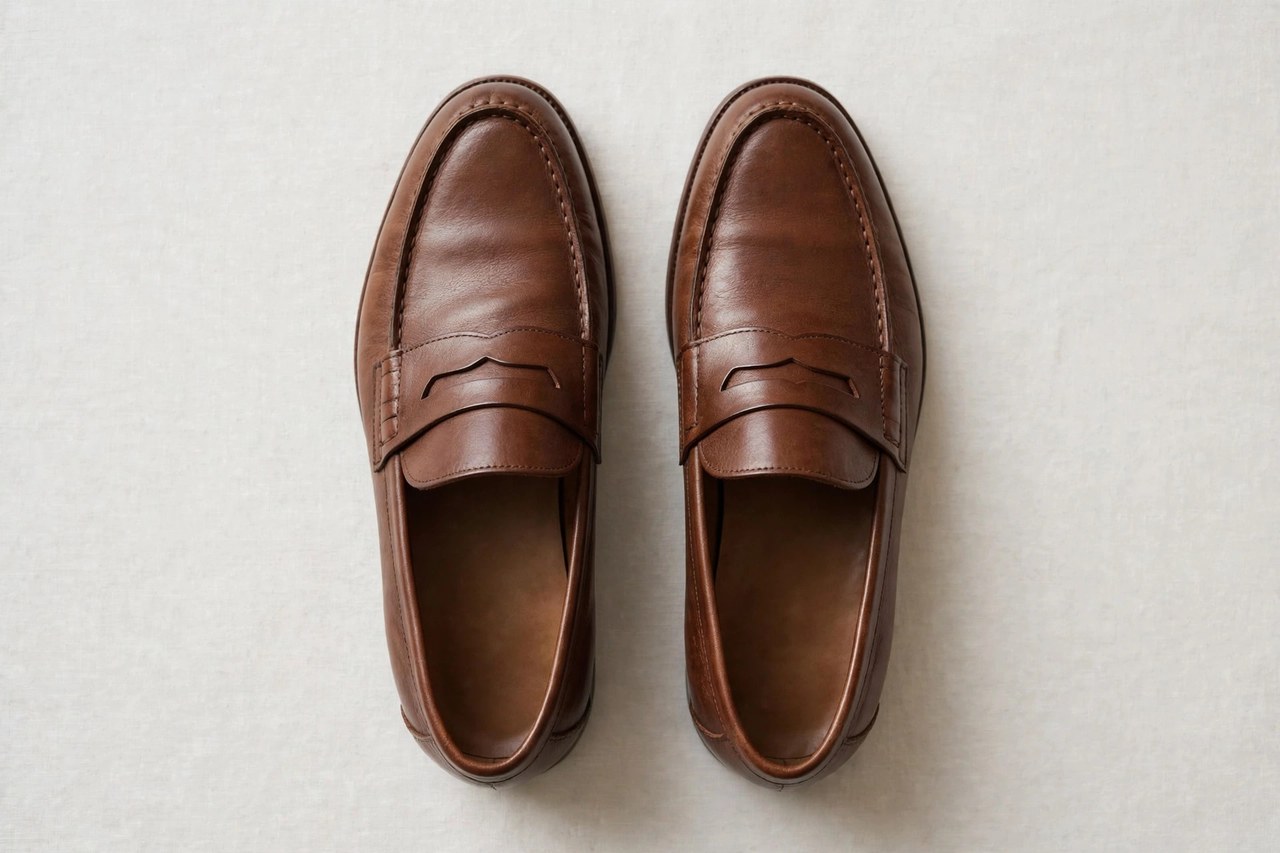
A penny loafer is a laceless slip-on shoe whose defining detail is a leather strap across the vamp with a diamond-shaped cut-out - the slot where, in the style's best-known story, wearers kept a penny for a phone call. Loafers came from Norwegian farm shoes by way of American campuses, and the penny version became the default smart-casual shoe of the twentieth century: formal enough for a blazer, easy enough for a Saturday. This guide explains the construction under the slot, the leathers from polished calf to suede, and how a slip-on should fit when there are no laces to adjust it. This guide walks through the choices that matter - style, fit, fabric and finish - with the practical detail a product listing rarely gives you, and closes with the care habits that keep the garment in service.
The Saddle Does the Holding
A loafer is its last and its sole. The classic penny loafer is moccasin-constructed or Blake-stitched on a low heel with a leather or rubber sole; leather soles dress up, rubber and lug soles step the shoe toward weather and walking. The strap - the saddle - should sit snug across the instep, because on a slip-on the strap and the heel counter do all the holding that laces do elsewhere. Leathers grade the formality: polished black or burgundy calf reads dressiest, brown calf and cordovan-toned leathers are the versatile middle, suede drops the shoe to casual, and pebble grain splits the difference. The penny slot itself is pure heritage - sized for a coin few now carry - but its proportions are a quality tell: a clean, centered cut-out and a strap stitched evenly at both ends mark a careful maker, and a skewed or raw-edged slot marks the opposite.
Judge footwear by attachment and compound: cemented soles are light and affordable, stitched or welted constructions cost more and can be repaired, and the outsole rubber decides grip against longevity - soft compounds bite, hard compounds endure. Linings decide comfort over hours, removable insoles decide whether your own supports can come along, and honest weight decides whether the pair disappears on the foot or taxes every mile of the day.
No Laces, No Forgiveness
Slip-on fit is unforgiving, so be strict. A penny loafer should hold the heel with no more than a whisper of slip when new - leather gives a little across the strap and at the heel, and a loafer bought loose becomes a loafer that flaps. The strap should press the instep gently and evenly; pain across the top of the foot means the last's volume is wrong, and no break-in fixes it honestly. Length keeps the usual thumb's width past the longest toe, and loafers are worn with thin or no socks in their classic register, so try them as you will wear them - a loafer fitted over thick socks will swim barefoot. Width matters more than in lace-ups: a wide foot in a narrow loafer has nowhere to go, since the shoe cannot be opened to accommodate it.
Fit footwear late in the day in the socks you will actually wear, with roughly a thumb's width beyond the longest toe, the heel held without lift, and the foot's widest point meeting the shoe's widest point. Sizes are unstandardized between makers - trust your measured length and width over the printed number, and require no break-in argument: a shoe that needs excuses in the shop delivers them on the road.
Trees Keep a Slip-On's Shape
Loafers live in rotation like all leather shoes: a rest day between wears, trees to hold the slip-on shape (which collapses faster than a lace-up's), and conditioning before the leather looks thirsty. Suede versions want a brush and a protector spray and to sit out heavy rain that calf would shrug off. Leather soles can be resoled when stitched; cemented soles end the shoe when they go, which is the economic case for the stitched construction once again. The classic care detail is the shine on the saddle and toe - the two places the eye lands - so polish there first. A well-kept calf penny loafer crosses decades of style cycles without ever looking out of date, which is more than most shoes in the closet can claim.
Rotation is the first care rule: a day of rest between wears lets linings dry and cushioning rebound, and it doubles a rotation's life compared with daily wear of one pair. Clean after use, dry at room temperature away from radiators, hold shape with trees or paper, and condition leather on a schedule rather than when it looks thirsty. Reproof weather finishes when water stops beading, and resole stitched footwear before the wear reaches the welt.
Common Questions
Why is it called a penny loafer?
For the slot in the strap. The penny loafer's saddle carries a diamond-shaped cut-out, and the enduring story is that American students in the phone-booth era kept a penny in each shoe - the price of a call - so the name stuck to the slot and then to the shoe. The detail is decorative now, but the strap itself is functional: on a laceless shoe, it is part of what holds the foot.
Should penny loafers slip at the heel?
Barely, and only when new. A new loafer may move a few millimeters at the heel; the leather will ease across the strap and seat with a few wears. More slip than that never improves - a slip-on cannot be tightened - so a loafer that flaps in the shop will flap forever. The strap should hold the instep with even, gentle pressure and the heel should be gripped, not clamped.
Can penny loafers be worn with a suit?
A polished calf penny loafer in black or deep burgundy can, in most modern offices and at most daytime formality - it has been the campus-to-boardroom shoe for generations. It sits one step below an Oxford in formality, so for the most formal suits, interviews and ceremonies, the laced shoe remains the safer choice. Suede and lug-soled loafers are casual shoes and should stay with chinos, denim and knitwear.
More in Men's Clothes Guide P
Weejuns and the Two Pennies
The penny loafer is a type of slip-on footwear — typically low, lace-less shoes, the style known as a loafer having a moccasin construction. In 1936 U.S. shoemaker G.H. Bass & Co. introduced its “Weejuns” penny loafers, and other companies followed with similar products. The term penny loafer has uncertain beginnings: one explanation is that American prep school students in the 1950s took to inserting a penny into the diamond-shaped slit on their Weejuns to make a fashion statement; another theory is that two pennies could be slipped into the slit, enough money to make an emergency phone call in the 1930s. Either way, the name stuck, and the practice continues among those committed to a classic, scholarly appearance.
Looking for Men's Clothing Stores?
This guide explains men's penny loafers. To browse where to buy, visit our men's clothing store directory, where you can find retailers that carry them.