Textile
Fabric Definitions — fabric and textile definitions from Apparel Search
Search Apparel Search
At a Glance
Definition: A textile is any kind of woven, knitted, knotted or tufted cloth, or a non-woven fabric of fibers bonded into cloth, and the word also covers the yarns, threads and wools from which cloth is manufactured.
Category: Fabric Definitions
A textile is any kind of woven, knitted, knotted (as in macrame) or tufted cloth, or a non-woven fabric — a cloth made of fibers that have been bonded into a fabric, such as felt. The word also refers to the yarns, threads and wools that can be spun, woven, tufted, tied and otherwise used to manufacture cloth. The production of textiles is an ancient art, whose speed and scale of production have been altered almost beyond recognition by mass production and modern manufacturing techniques: an ancient Roman weaver would have no problem recognizing a plain weave, twill or satin.
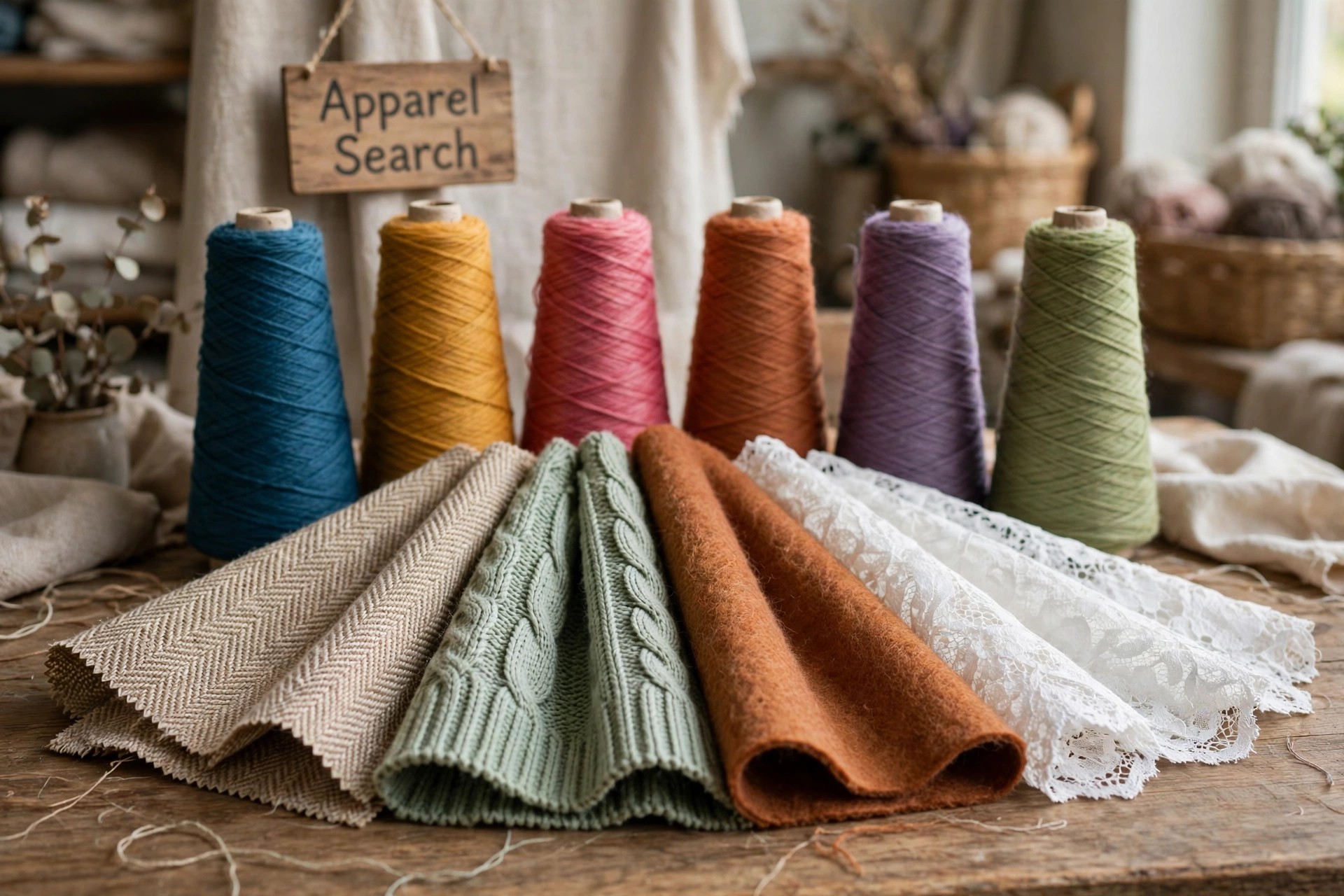
The Fibers Textiles Are Made From
Many textiles have been in use for millennia, while others use artificial fibers and are recent inventions; the range of fibers has increased in the last 100 years, and the first synthetics were made in the 1920s and 1930s. Of animal origin are alpaca, angora rabbit hair, camel hair, cashmere, mohair, silk, vicuña hair, and wool — wool itself divided into woollen and worsted.
Vegetable materials include bark cloth, used in sheets; coir, the fiber from coconuts; cotton; grass, rush and straw; hemp, mostly used in rope making; jute; kapok; linen, made from flax; nettle, processed in a similar manner to flax; ramie; seaweed, from which a water-soluble alginate fiber is produced and used as a holding fiber that is dissolved away once the cloth is finished, leaving an open area; and sisal. Paper is derived from plant products. Of mineral origin, asbestos now has very limited uses, glass fibers are used in textiles for insulation and other purposes, and metal fiber, metal wire and metal foil have some uses in textiles, on their own or with other materials — as in goldwork embroidery.
A vast range of man-made fibers can be used in textile manufacture, including acrylic fiber, Lurex, spandex, tactel, lycra and other stretch fabrics, nylon fiber, polyester fiber, polypropylene — sold under trade names such as Olefin or Herculon — and rayon fiber.
Ways of Making Textiles
The making methods are the taxonomy of the field. Braiding and plaiting interlace strands. Crochet is usually done by hand. Embroidery adds threads to the surface of a finished textile. Felt is made by matting fibers together to produce a cloth. Knitting is done by hand or on knitting machines. Knotting, including macrame, is used in making nets. Lace is made both by hand and by machine. Pile fabrics — carpets and some rugs, and velvet, velveteen, plush fabrics and similar — have a secondary set of yarns which provide a pile. And weaving prepares cloth on a loom, of which there are a number of types: some weaving is still done by hand, but the vast majority is machine made.
Each method gives a different cloth character from the same fiber, which is why 'textile' rather than a fiber name is the right umbrella term. A textile's identity is the sum of four choices — fiber, making method, process and finish.
Processes and Uses
Three processes recur across the field. Bleaching removes the natural or original colour of the textile with bleach. Dyeing adds colour: there is a vast range of dyes, natural and synthetic, some of which require mordants. And finishing adds waterproofing and other properties, alongside processes such as starching.
Textiles have been used in almost every possible context where their properties are useful: in cleaning; in bags and other means of carrying objects; in balloons, kites, sails, parachutes and other transport uses — early airplanes used cloth as part of their construction; in clothing; in flags; in furnishings, including towels and table cloths; in geotextiles; in industrial and scientific uses, including filtering; and in nets, rugs and carpets, and tents. Learn about textile recycling, the route by which used textiles re-enter that cycle.
Common Questions
What counts as a textile?
Any cloth made by joining fibers: woven, knitted, knotted, tufted or non-woven cloth, including felt. The word also covers the raw materials themselves — the yarns, threads and wools that can be spun, woven, tufted, tied and otherwise used to manufacture cloth.
What fibers are textiles made from?
Animal fibers such as alpaca, angora, camel hair, cashmere, mohair, silk, vicuña and wool; vegetable fibers including cotton, linen from flax, hemp, jute, kapok, ramie, sisal and coir; mineral fibers such as asbestos and glass; and a vast range of man-made fibers including acrylic, nylon, polyester, polypropylene, rayon and stretch fibers such as spandex.
How old is textile making?
Textiles are ancient: an ancient Roman weaver would have no problem recognizing a plain weave, twill or satin, and many textiles have been in use for millennia, while others use artificial fibers and are recent inventions — the first synthetics date to the 1920s and 1930s, and the range of fibers has increased greatly in the last 100 years.