Braiding
Miscellaneous Definitions — accessories, trims, tools and general fashion terms from Apparel Search
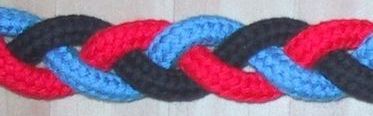
Braiding is interweaving or twining three or more separate strands of one or more materials in a diagonally overlapping pattern. As a noun, a braid is any object created by that weaving, particularly one that remains in a strand or rope-like form. Simple braids can be flat or tubular and generally contain an odd number of strands, while braided fibre yarn creates a strand or rope thicker and stronger than the strands would have been separately.
As a noun, braid refers to any object created by such weaving, particularly if it remains in a strand or rope-like configuration. Simple braids with more than three strands can be flat or tubular and generally contain an odd number of strands. Complex braids have been used to create hanging fiber artworks.
Braiding of fiber yarn creates a strand or rope that is thicker and stronger than the strands would have been separately. Braided ropes are preferred by arborists and rock climbers because they do not twist under load, as does an ordinary twisted-strand rope. These ropes consist of one or more concentric tubular braided jackets surrounding a single untwisted yarn of straight fibers.
Gold braid and silver braid are components or trims of many kinds of formal dress, including military uniform (in epaulettes, aiguillettes, on headgear).
As a verb, the term refers to the process of creating a braid, either a real one, as in braiding one's hair (example, French braid), or a metaphorical braiding such as He braided many different ideas into a new whole.
| The above article is licensed under the GNU Free Documentation License. From Wikipedia, the free encyclopedia (https://en.wikipedia.org/wiki/braiding). 5/30/06 |
 |
| Fashion Industry |
Three or More Strands, Diagonally OverlappedBraiding is defined by its pattern. Three or more separate strands of one or more materials are interwoven or twined so that each strand crosses the others diagonally, overlapping in turn rather than running straight alongside them or twisting around a single centre. That diagonal overlap is what separates braiding from simple twisting and from plain weaving. In weaving, warp and weft meet at right angles in a flat cloth; in braiding, all the elements move diagonally and the work grows as a narrow strand, cord, band or tube. The word works both ways in ordinary use: as a verb it is the process of creating a braid, as in braiding hair, and as a noun it is the object that process creates, particularly when it remains in a strand or rope-like configuration. Simple braids start with three strands, the familiar form used for hair, including styles such as the French braid, where additional hair is drawn in as the braid progresses. Braids with more than three strands can be flat or tubular, and they generally contain an odd number of strands, which keeps the diagonal pattern balanced as each element passes over and under its neighbours. Flat braids lie as bands or trims, while tubular braids form hollow or filled cords that close around themselves. Complex braids go further still and have been used to create hanging fibre artworks, where the interlacing itself is the visible structure and decoration at once. Recognising a braid in any of these forms depends on the same test: look for three or more strands crossing diagonally in a regular overlapping sequence. Strength, Rope and Formal TrimBraiding changes what the material can do. Braiding of fibre yarn creates a strand or rope that is thicker and stronger than the strands would have been separately, because the load is shared across interlocked elements rather than carried by one strand alone. Braided ropes are preferred by arborists and rock climbers because they do not twist under load, as an ordinary twisted-strand rope does, a practical advantage when a rope must hang straight and behave predictably. These ropes consist of one or more concentric tubular braided jackets surrounding a single untwisted yarn of straight fibres: the braided jacket provides the grip, protection and control, while the straight core provides the bulk of the lengthwise strength. The construction shows braiding at its most engineered, a tubular braid made to jacket another material. In clothing and dress, braid is most visible as trim. Gold braid and silver braid are components or trims of many kinds of formal dress, including military uniform, where they appear in epaulettes, aiguillettes and on headgear. There the flat or corded braid is valued for the opposite reason from rope: not for hidden strength but for a neat, raised, light-catching edge that can outline a cuff, a collar, a shoulder piece or a cap and signal rank or ceremony. The same diagonal interlacing that makes a rope can, in finer materials and metallic yarns, make decoration. The term also extends beyond physical work, as in braiding many different ideas into a new whole, but in textiles, hair and dress the meaning stays literal: strands interwoven diagonally to form a braid that holds together as one piece. Common QuestionsHow many strands does a braid need?Braiding uses three or more separate strands. Simple braids with more than three strands can be flat or tubular and generally contain an odd number of strands. Why are braided ropes preferred for climbing and tree work?Braided ropes are preferred by arborists and rock climbers because they do not twist under load, as an ordinary twisted-strand rope does. What is gold braid used for?Gold braid and silver braid are components or trims of many kinds of formal dress, including military uniform, where they appear in epaulettes, aiguillettes and on headgear. More to ExploreMore from Apparel Search: Miscellaneous Definitions | Clothing Industry Glossary | Fashion Terms | Apparel Search Home
|