Epaulette
Miscellaneous Definitions — the ornamental shoulder piece that carried rank, from Apparel Search
Search Apparel Search
At a Glance
Definition: An epaulette is an ornamental shoulder piece or decoration used as insignia of rank by military and other organisations, its placement, colour and bullion fringe signifying the wearer's rank, worn mainly on dress or ceremonial uniforms and borrowed by civilian coats as a shoulder strap or tab.
Pronunciation: EP-uh-let
Category: Miscellaneous Definitions
Word Origin
A French word meaning little shoulders, from épaule, referring to the shoulder — a plain description of where the piece sits.
An epaulette sits where a garment meets authority: on the shoulder, the most visible horizontal surface of a uniform, where a badge can be read at a distance and from the front. It is both clothing and communication — an ornamental shoulder piece whose placement, colour and fringe were a code that a trained eye read the way a modern reader reads stripes and pips. This page covers how that code worked and how it developed, why the full epaulette retreated to ceremonial dress, and how the same shoulder piece survives, its meaning dropped, on the trench coat and the safari jacket.
Little Shoulders That Carry Rank
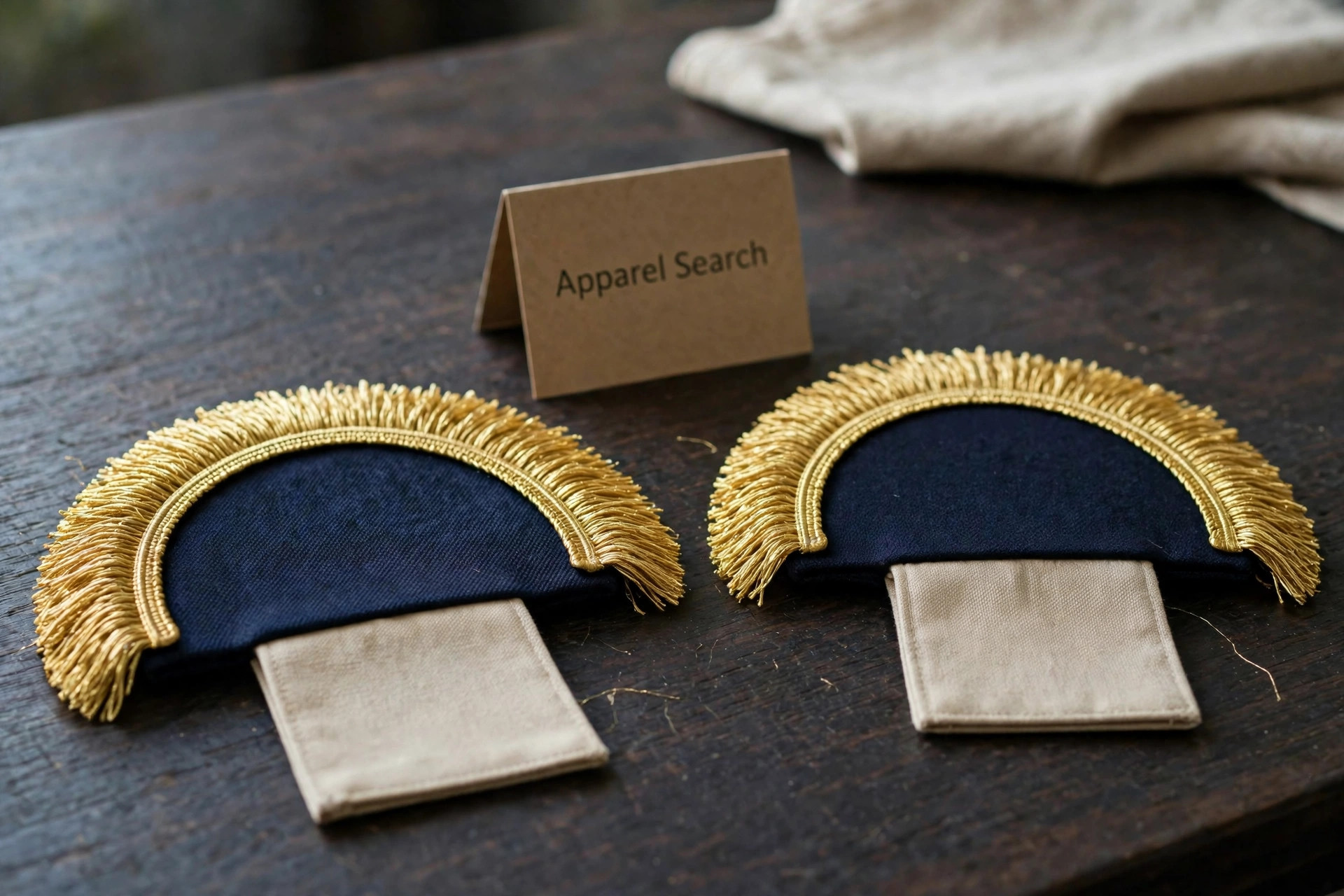
An epaulette is an ornamental shoulder piece or decoration used as insignia or rank by military or other organizations. Its information was carried in several channels at once: the placement of the epaulette, its color, and the length and diameter of its bullion fringe were used to signify the wearer's rank, so metal, colour, fringe and position were read together. Bullion fringe — the hanging twisted-cord fringe at the epaulette's outer edge — was not mere decoration: a longer, thicker fringe marked higher standing, and its movement and shine made the shoulder, and therefore the officer, conspicuous in a formation.
Although sometimes worn in the field, epaulettes are more common on dress or ceremonial uniforms, and that balance explains their modern position. In the field a large fringed shoulder piece is impractical and advertises the officer; on parade, exactly those qualities are the point, since the uniform is meant to display rank, branch and tradition at a glance.
How the Code Developed
The system's history shows insignia being invented step by step. Before rank insignia were devised, the rank of an officer was determined by whether one epaulette was on the left shoulder, or the right shoulder, or both — the bare count and side of the shoulder pieces were the code. Later a counter-epaulette, with no fringe, was given to those who wore only one, distinguishing the deliberate single epaulette from a missing one. Besides silver or gold for officers, epaulettes came in cloth for the enlisted men of various arms.
Branch was coded over rank. Officers of the United States Army at the time of the Civil War wore gold for artillery and silver for infantry. In Europe, some light infantry wore cloth counter-epaulettes; flying artillery wore wings, like an epaulette but with only a bit of fringe on the outside, which matched the shoulder seam; and heavy artillery wore small balls representing ammunition on their shoulders. Epaulettes have mostly been replaced by insignia pins and sleeve patches to denote rank — smaller, cheaper marks that survive field conditions. British uniform shirt cuffs were once decorated with buttons and colored patches to indicate the rank of officers, another sign of rank migrating to smaller marks.
From Uniforms to Civilian Coats
Civilian clothing borrowed the form and dropped the code. Epaulettes are also found on the trench coat, the safari jacket and other garments, where the shoulder piece appears as a buttoned strap or tab lying along the shoulder seam. On a trench coat the strap echoes the coat's military origin and can hold a bag strap or glove in place; on a safari jacket it sits on a field garment designed in the same military family; on fashion garments the shoulder tab gives the shoulder a structured, uniformed line.
In none of these civilian uses does the epaulette signify rank: its colour, fringe and placement, so meaningful on a uniform, become proportion and styling on a coat. The word itself keeps the memory of the shoulder it names — little shoulders in literal translation — whether the piece is gold-fringed ceremony or a plain cloth tab on a jacket.
Common Questions
What is an epaulette?
An epaulette is an ornamental shoulder piece or decoration used as insignia or rank by military or other organizations. The word is French, meaning little shoulders, from epaule, referring to shoulder.
How did epaulettes show rank?
The placement of the epaulette, its color and the length and diameter of its bullion fringe were used to signify the wearer's rank. Before rank insignia were devised, the rank of an officer was determined by whether one epaulette was on the left shoulder, the right shoulder, or both.
Where are epaulettes found besides uniforms?
Epaulettes are also found on the trench coat, the safari jacket and other garments. On civilian clothing the shoulder strap or tab is a decorative and practical detail descended from the military piece, rather than an insignia of rank.