Trench Coat
Clothing Definitions — definitions of garments and clothing terms from Apparel Search
Search Apparel Search
At a Glance
Definition: A trench coat is a long, double-breasted, belted raincoat of water-resistant cotton — classically gabardine — with military details such as epaulettes, cuff straps and belt D-rings, developed from the coats worn by British officers in the trenches of the First World War.
Category: Clothing Definitions
Word Origin
The name is literal: the coat was dubbed the trench coat by the soldiers who wore the modified officers' raincoat — epaulettes, straps and D-rings added — in the trenches of the First World War, and the name stayed when the coat came home.
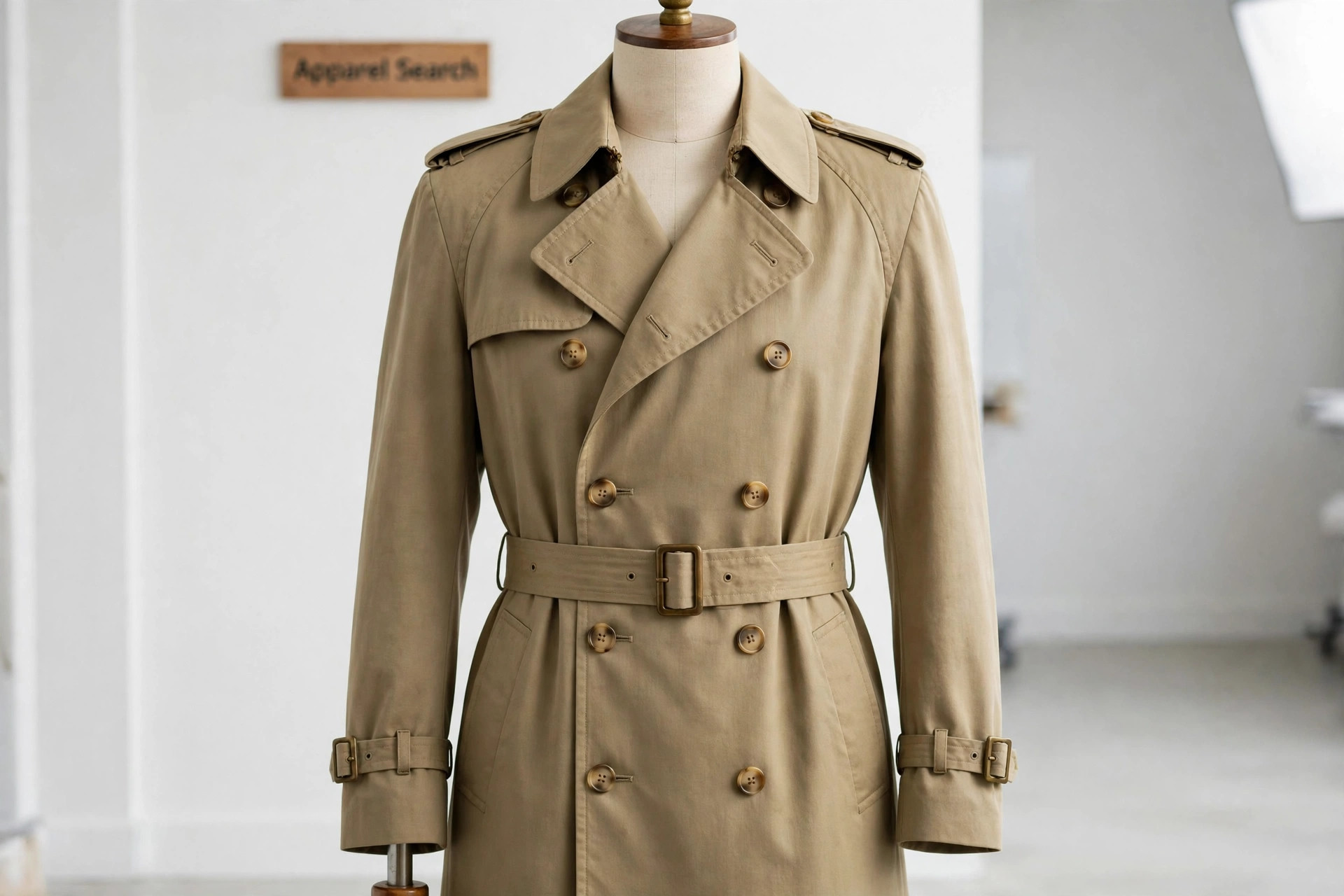
A trench coat is an enduringly popular item of clothing worn around the world: a long, belted, double-breasted raincoat in heavy-duty cotton, classically the tightly woven, weather-resistant gabardine, usually with a lining that can be removed as the weather changes. It descends from the heavy coats worn by British, Canadian and French soldiers in the First World War, and almost every detail of the modern coat — the epaulettes, the cuff straps, the D-rings on the belt — began as a piece of military equipment. This page describes the coat's design, its wartime origin, and the details that have kept it in the wardrobe for a century.
From the Trenches to the Wardrobe
The classical trench coat was a creation of Thomas Burberry, inventor of gabardine, who in 1901 submitted a design for an army officer's raincoat to the UK War Office. That raincoat became part of the service uniform of British officers. During the First World War the design was modified to include epaulettes, straps and D-rings, and that version was dubbed the "trench coat" by the soldiers in the trenches. It replaced the heavy serge coats soldiers had endured: gabardine itself was the breakthrough, a cotton woven so tightly and proofed so well that a long coat could stay light while turning rain.
Towards the Second World War, the trench coat became part of the kit of enlisted men and officers alike, especially in the American forces — the US Army, the US Army Air Corps and the US Marine Corps. Officers had bought their own coats, and after the war they took them home and kept wearing them. A garment that crosses from uniform to wardrobe without losing its name, its construction or its story is rare, and the trench coat is the standard example.
The Classic Design
The typical trench coat is a ten-buttoned, double-breasted long coat in tan, khaki, beige or black, made of heavy-duty cotton — drill or poplin as well as gabardine — with a lining that can be removed depending on the weather. It has cuff straps on the sleeves, epaulettes on the shoulders, originally used to hold gloves and folding service caps such as the Glengarry Bonnet, and a belt that may carry two small brass D-rings as a salute to its military heritage; the rings were originally used to secure grenades, sidearms and swords.
Most classic menswear carries a few military details; the trench coat is military detail from collar to hem, and the details survived because each one still works. The storm flap sheds rain from the chest, the belted waist closes the coat without relying on buttons alone, the raglan sleeve slides over a uniform or a suit, and the deep pockets and throat strap answer weather that civilians also meet. Modern versions vary the formula — shorter lengths, single-breasted cuts, colours beyond khaki and black, technical fabrics — but the reference design is unchanged enough that the trench coat needs no season to sell.
An Enduring Classic
Trench coats have remained fashionable over the years. Their genesis as clothing for army officers lent the coat a businesslike respectability, while fiction fixed the silhouette in the public mind — the detective, the correspondent, the traveller — and film heroes as diverse as Dick Tracy, Humphrey Bogart's Sam Spade and Peter Sellers' Inspector Clouseau kept the coat in the public eye. Fashion adopted a coat whose authority came from use.
The trench coat sits in the coat family between the purely functional raincoat and the tailored overcoat, and it is longer and more completely specified than a jacket. Its closest belted relative is the safari jacket, treated in the box below; its cold-weather neighbour in the same military line is the parka. Few garments can be identified from a silhouette alone at a hundred years' distance. The trench coat can, because its definition is a checklist — double breast, belt, epaulettes, straps, rings — and the checklist has not changed.
Wearing one today is a matter of choosing which parts of the formula to keep. The full classic — double-breasted, belted, knee-length or longer, in khaki gabardine — remains the reference, and shorter or single-breasted versions read as variations on it rather than as different coats. The removable lining is the practical heart of the design: with it, the coat serves through winter rain; without it, the same coat is a spring and autumn layer. A trench coat is bought by the decade, not the season, which is why its definition has stayed stable while the coats around it changed.
Not to Be Confused With
Two belted, khaki classics, built for opposite weather. A trench coat is a long, water-resistant raincoat made to shed rain, its belt, epaulettes and D-rings inherited from First World War military dress. A safari jacket is short, lightweight cotton — drill or poplin — made to breathe in heat, with four bellows pockets for carrying expedition gear. If the garment is long, double-breasted and proofed against weather, it is a trench coat, however it is styled.
Common Questions
Why is it called a trench coat?
The coat was modified for officers in the First World War with epaulettes, straps and D-rings, and that version was dubbed the trench coat by the soldiers in the trenches. By the Second World War it was part of the kit of enlisted men and officers alike, especially in the American forces.
What fabric is a trench coat made from?
Heavy-duty cotton — drill or poplin, and classically gabardine, the tightly woven, weather-resistant cotton Thomas Burberry invented. Burberry submitted his design for an army officer's raincoat to the UK War Office in 1901. A removable lining lets the same coat serve in different weather.
What are the classic features of a trench coat?
The typical trench coat is a ten-button, double-breasted, long coat in tan, khaki, beige or black, with cuff straps on the sleeves, epaulettes on the shoulders and D-rings on the belt. Each feature began as military equipment: epaulettes for rank insignia and held gear, straps to close the cuffs against weather, rings to carry equipment.