Coat
Clothing Definitions — definitions of garments and clothing terms from Apparel Search
Search Apparel Search
At a Glance
Definition: A coat is an outer upper-body garment; in tailoring it is specifically the upper part of a suit, while in everyday use it means the long, heavy outdoor layer worn over other clothing.
Category: Clothing Definitions
Word Origin
Coat comes through Old French cote from a Germanic word for a coarse woollen garment, and it has kept its essential meaning — an outer garment for the upper body — for roughly a thousand years, which is why so many older garment names, from tailcoat to petticoat, are built on it.
Few clothing words carry two meanings as stubbornly as coat. In tailoring, a coat is the upper part of a suit — the tailored garment worn with matching trousers — and everyday speech has renamed that garment a jacket, as in the dinner jacket. Meanwhile the long outdoor layer most people now call a coat, such as a trench coat, is in the tailor's strict vocabulary an overcoat, because it is worn over the coat. Both usages are correct in their own world, and this page keeps them separate.
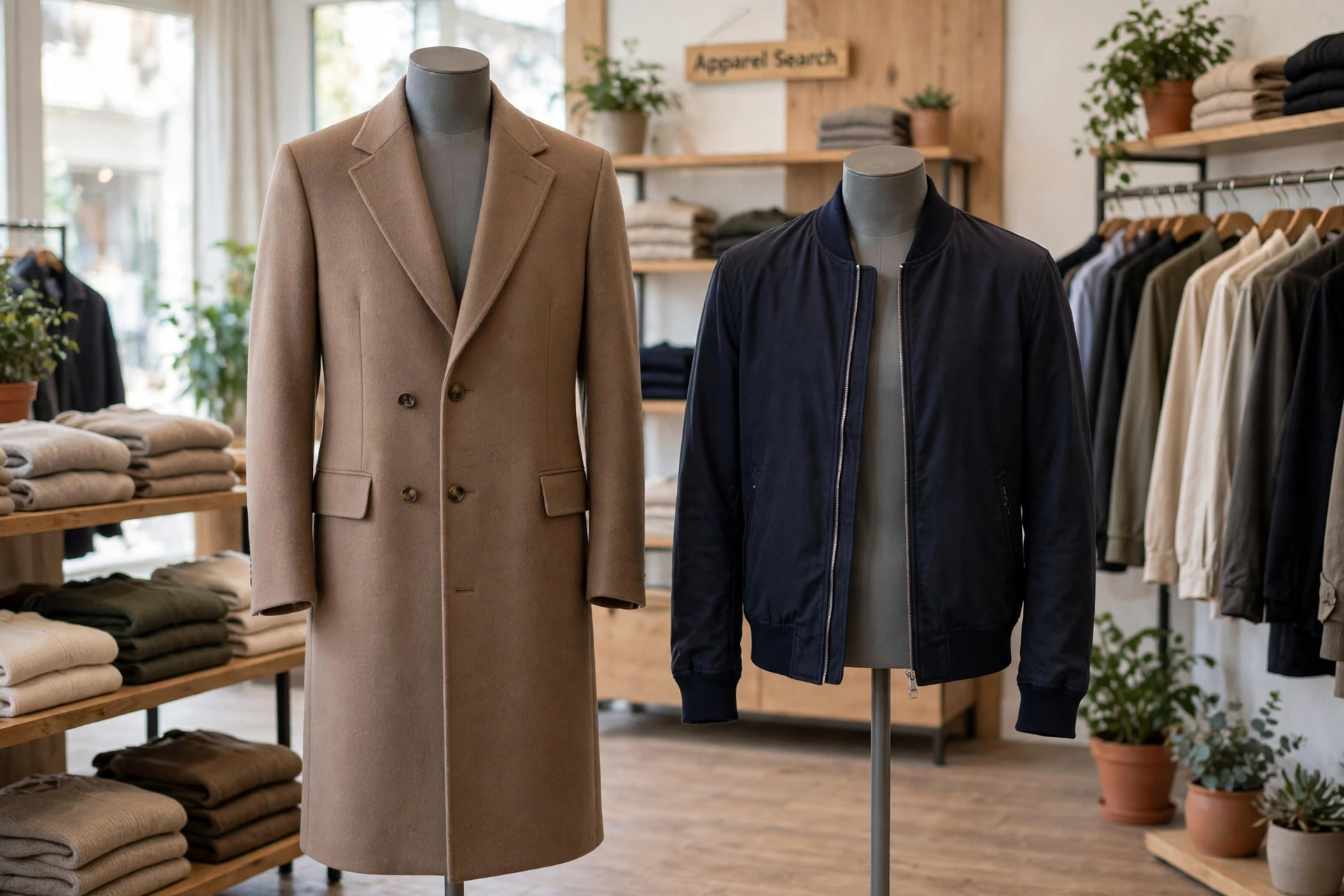
The Tailor's Coat and the Everyday Coat
The confusion is historical, not careless. For centuries the coat was the principal tailored upper garment of men's dress, and the vocabulary of formal wear still preserves that sense: the tailcoat, the frock coat and the morning coat are all suit coats in construction, whatever the weather outside. When lighter, shorter upper garments became everyday wear, ordinary speech reached for a different word — jacket — and applied coat instead to the heavy outdoor layer that had previously needed the distinguishing name overcoat.
The practical test is layering. A true overcoat is cut with enough room to fit over a suit coat without pulling, and long enough to cover it, usually reaching the knee or below. A coat worn as the top layer over knitwear can sit closer to the body. That layering logic — coat over coat, in the tailor's old sense — is the heart of the terminology, and it is why a well-cut overcoat is sized by the suit beneath it rather than by the wearer's shirt size alone.
The Named Coats
The named coats each answer a specific job. The trench coat is a belted, storm-flapped raincoat with military roots; the peacoat is the sailor's short, heavy, double-breasted coat; the parka and the anorak are hooded cold-weather coats; and the overcoat proper is the long tailored layer worn over a suit. At the formal end, the tailcoat and the morning coat are cut away at the front waist, and the frock coat — knee-length and closely fitted — was the standard formal day coat of the nineteenth century.
The family extends well beyond weather and formality. It includes the bekishe, the long coat of Hasidic dress; the historical mandilion, worn loose over armour-era dress; the duster, a long, loose driving and riding coat; and neighbours that share the tailored construction without the name — the blazer, the poncho at the untailored extreme, and even the straightjacket, a coat by construction if not by intent. The petticoat, despite the name, is not a coat at all but an underskirt — a reminder that coat in a compound word is not always the garment this page describes.
Where Coats Meet Jackets
The jacket family sits at the shorter, lighter end of the same construction. The jacket in modern use covers everything from the suit's upper piece to the ski jacket, the windbreaker and the flak jacket, with the sports coat and the safari jacket keeping tailored manners in casual settings, and the waistcoat completing the traditional three-piece suit beneath the coat. Retailers draw the coat/jacket line by length and weight rather than by tailoring history, which is why a hip-length insulated garment is sold as a jacket and its knee-length equivalent as a coat.
For the shopper, the terminology matters less than the fit logic behind it: decide what the garment must go over, how much weather it must answer, and how long it must be to do it. The word on the label — coat, overcoat or jacket — follows from those answers, in the trade's usage if not always on the high street.
Construction explains much of the price spread within the family. A tailored coat is built like the suit coat beneath it — canvas or fused interlining shaping the chest, a lining that lets it slide over layers, and hand-finished buttonholes at the better end — while a casual coat may be little more than shaped outer fabric with a zip. Materials follow duty: wool and wool blends for tailored warmth, waxed cotton and technical shells where rain is the enemy, and down or synthetic fill where weightless insulation matters more than line. Care follows the same division: tailored coats are brushed, aired and dry-cleaned sparingly, because their structure, not just their cloth, is what cleaning puts at risk.
Not to Be Confused With
In everyday speech the words overlap, but the working distinction is length and weight: a jacket is the shorter, lighter upper garment, while a coat is the longer, heavier outdoor layer. Tailoring keeps the older usage, in which the suit's upper part is itself called the coat — which is why a dinner jacket is a coat to a tailor. See also the Apparel Search Q&A on the difference between coats and jackets.
Common Questions
What is a coat in tailoring terms?
In tailoring, a coat is the upper part of a suit — the tailored upper garment worn with matching trousers, and optionally a waistcoat. Everyday speech now usually calls this garment a jacket, as in a dinner jacket, but the tailoring term survives in words like tailcoat, frock coat and morning coat.
What is the difference between a coat and an overcoat?
An overcoat is the outer layer worn over the suit coat for weather, such as a trench coat. Because it is worn over the coat, tailoring gives it its own name; everyday speech collapses the two layers and simply calls the outdoor garment a coat.
What is the difference between a coat and a jacket?
In modern everyday use the words overlap, but the working distinction is that a jacket is the shorter, lighter upper garment — including the suit's upper piece in casual speech — while a coat suggests the longer, heavier outdoor garment. Tailoring keeps the older usage, in which the suit's upper part is the coat.