Morning Coat
Clothing Definitions — definitions of garments and clothing terms from Apparel Search
Search Apparel Search
At a Glance
Definition: A morning coat is a single-breasted men's coat that fastens with one button at the waist, its fronts curving away from there into a pair of tails at the back.
Also known as: Cutaway (American usage)
Category: Clothing Definitions
Word Origin
Named for the morning hours, when gentlemen once rode or paid morning calls in it. Its other name, cutaway, describes the making literally: the fronts are cut away from the waist button so the coat clears the saddle and the legs.
The morning coat is the principal garment of morning dress, the most formal dress code for daytime. It is a coat of a very recognisable cut: single-breasted, closed by a single button at the waist, with peaked lapels, and with fronts that do not continue down in front but sweep away in a curve to form two long tails behind. It began as a practical riding coat, displaced the frock coat as formal day dress during the nineteenth century, and survives today almost entirely as ceremony — at weddings, formal funerals, race meetings and official occasions where the dress code still calls for it.
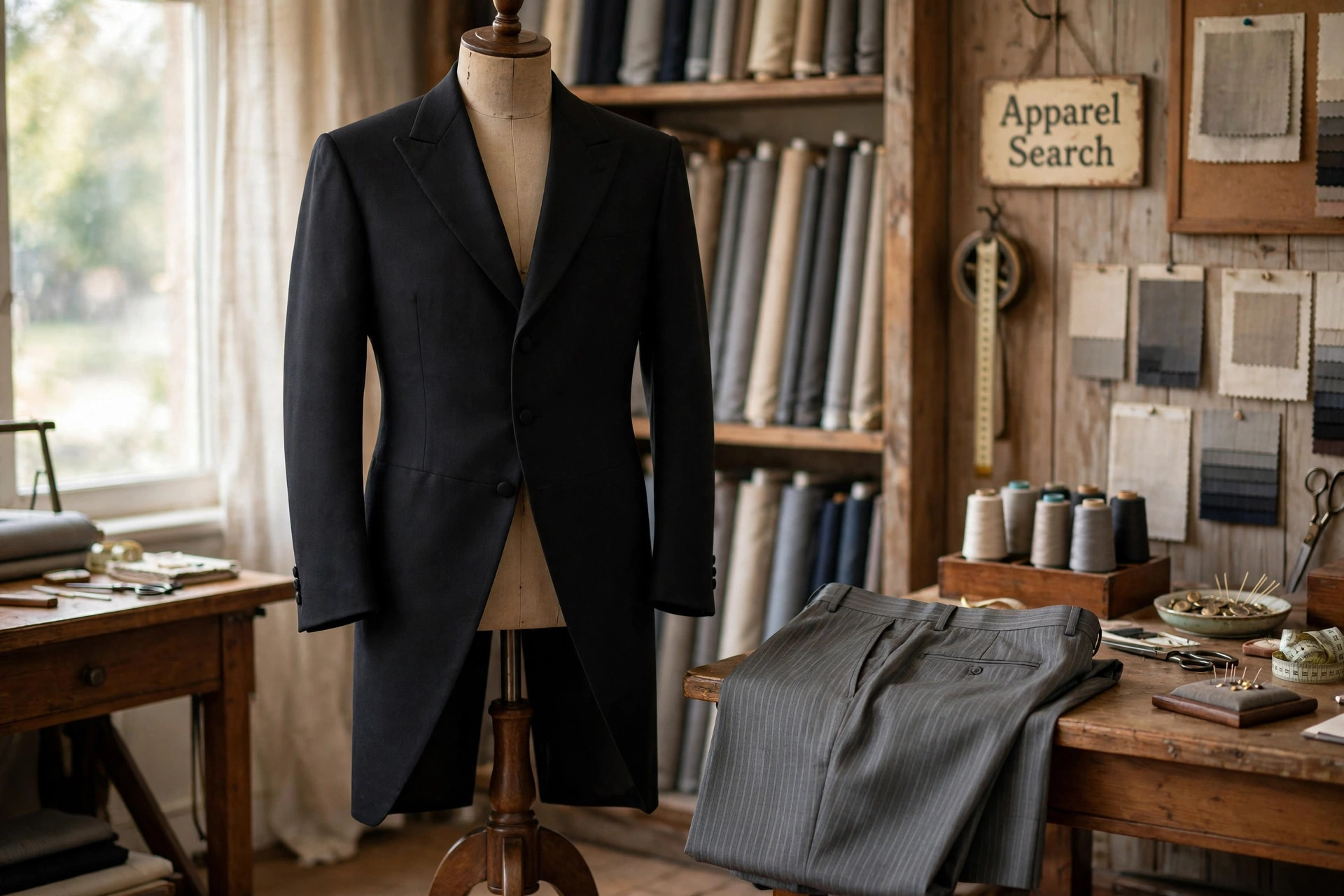
The Cut: One Button and a Pair of Tails
Everything about the morning coat follows from its front. The two fronts meet at a single button at the natural waist; below that button there is no front skirt at all. Instead each front edge curves away in a smooth, continuous sweep, passing the hips and lengthening into the tails, which fall behind the knees at the back. Two buttons sit at the back waist, a survival from the era when coat skirts were buttoned back for riding. The coat is cut with a waist seam, so the tailored body and the falling tails are made as separate pieces and joined — the construction that gives the tails their clean hang.
The details are as fixed as the silhouette. Lapels are peaked, not notched, because the coat belongs to formal dress. The cloth is a fine wool, plain black for the most formal wear or Oxford grey; a grey coat worn with matching grey trousers and waistcoat forms the all-grey morning suit described on the morning dress page. There are no flapped pockets to break the line. Worn correctly, the single button is fastened and the tails are left to fall — the coat is never worn open or buttoned further, because there is nothing further to button.
From Saddle to Ceremony
The shape began on horseback. A frock coat's skirt wrapped around the thighs, which bunched and interfered in the saddle, so riding coats had their fronts cut away from the waist. Through the early and middle nineteenth century that practical alteration was refined into a dress garment: the coat a gentleman wore for morning riding and morning calls became, by degrees, the standard of formal day dress, and by the end of the century it had taken the frock coat's place at weddings, at court levees and on racecourses.
The twentieth century reversed its fortunes. As the lounge suit became ordinary business dress, the morning coat retreated from daily life into ceremony, which is where it remains. It is required dress in the Royal Enclosure at Royal Ascot, standard for formal British weddings and funerals, and worn on state and civic occasions in several countries; in the United States it is seen at formal daytime weddings and, by long tradition, on the Solicitor General arguing before the Supreme Court. Because so few men need one more than occasionally, it is the garment men most often hire, and hire departments keep the whole outfit together for exactly that reason.
How It Is Worn
The coat is never worn alone: it is the centre of the morning dress outfit, and the rest of the ensemble is prescribed as carefully as the coat itself. With a black coat go formal trousers in a grey cashmere stripe; the waistcoat is buff, dove grey or black — black for funerals — and the shirt is white or pale with a turned-down or wing collar and a tie or cravat fastened, on the most formal occasions, with a pearl pin. Cufflinks close the double cuffs. Outdoors, a top hat and gloves complete the dress. The complete ensemble, sold and hired as one, is also covered by the site's guide to the morning suit.
Within the family of formal wear the morning coat marks the top of the daytime scale, as the tailcoat of white tie marks the top of the evening scale; the dinner jacket of black tie sits a step below each. It is, in the end, a suit coat only in the loosest sense — a ceremonial garment whose rules are precise precisely because the occasions that call for it are ceremonial, and correctness is part of the point.
Not to Be Confused With
The two coats are confused because both are formal, tailed and nineteenth-century in origin, but their fronts are opposites. A frock coat keeps a skirt all the way round, front and back, at about knee length. A morning coat has no front skirt at all: its fronts are cut away from the single waist button, curving back into tails. If the coat has a skirt in front, it is a frock coat; if the front is cut away, it is a morning coat. The morning coat is also one garment within a larger code — the whole daytime outfit it belongs to is morning dress.
Common Questions
What is a morning coat?
A morning coat, or cutaway, is a man's single-breasted coat with fronts that curve away from a single waist button into tails at the back. It is the principal garment of men's morning dress.
With what is a morning coat worn?
Morning dress pairs the morning coat with striped or checked formal trousers, a waistcoat, a shirt with a tie or cravat, and a top hat for the most formal occasions such as Royal Ascot.
Where does the morning coat come from?
The morning coat first appeared as an alternative to the frock coat in the 19th century. Its cutaway front developed from riding dress, where the fronts were cut away so the coat did not interfere with the saddle.