White Tie
Clothing Definitions — definitions of garments and clothing terms from Apparel Search
Search Apparel Search
At a Glance
Definition: White tie, also called evening dress or full evening dress, is the most formal dress code for civilians, prescribing a black tailcoat, white stiff-fronted shirt, white wing collar, white bow tie and white low-cut waistcoat for men, and a formal ball gown for women.
Also known as: Evening dress; full evening dress
Category: Clothing Definitions
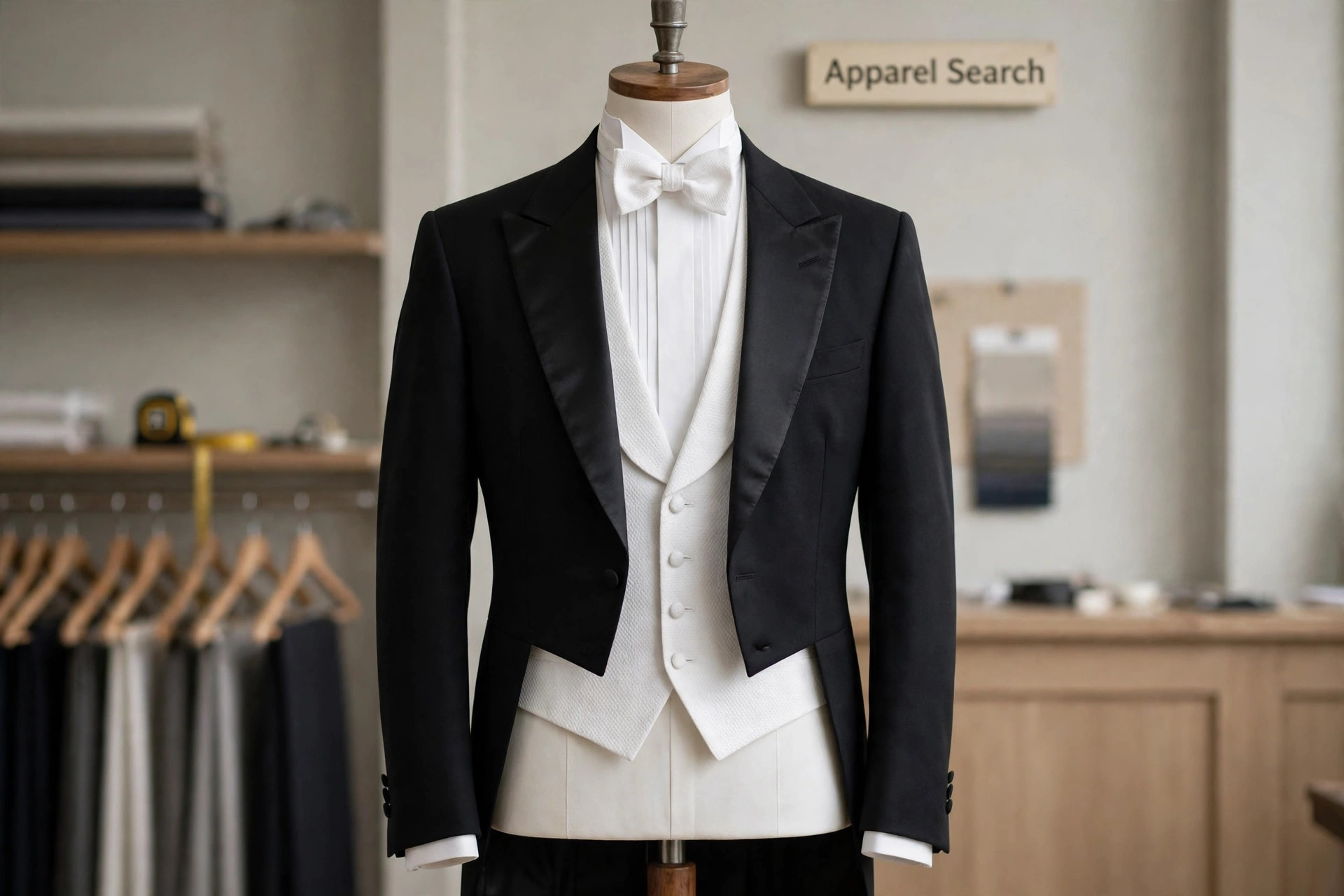
Evening dress, also known as full evening dress or white tie, is the most formal dress code that exists for civilians today. It has a semi-formal counterpart known as black tie and a formal daytime equivalent known as morning dress. Evening dress is more strictly regulated than other forms of dress: a black tailcoat with silk facings sharply cut away at the front, black trousers with two rows of braid, a white stiff-fronted shirt, a white stiff wing collar, a white bow tie and a white low-cut waistcoat — and, for women, a formal ball gown. For what to wear today, see our white tie attire guide.
The Specification
White tie is less a style than a specification, and properly consists of: a black tailcoat with silk facings — ribbed or satin — sharply cut away at the front; black trousers with two rows of braid down each leg; a white stiff-fronted shirt; a white stiff wing collar, attached to the shirt with collar studs; a white bow tie; a white low-cut waistcoat; black silk socks; and black patent leather shoes. Variation that would be flair in any other dress code is simply incorrect here.
Shirts, waistcoats and bow ties are now usually made of cotton marcella, although plain linen shirts and white or off-white silk ties and waistcoats are sometimes worn. Shirt studs and cufflinks should be silver or white, and a white handkerchief and flower may be worn. Outdoors a black silk plush top hat is appropriate, with an opera cloak or overcoat, even during the summer; white gloves, scarf and cane are optional extras. That rigidity is the point: at a state dinner or a May ball, the uniform correctness of the men's dress throws all individual expression onto the women's ball gowns, decorations and orders, which carry the ceremony's rank and colour.
When It Is Worn
Like black tie, evening dress is generally only worn after 6 p.m. Occasions that require white tie are increasingly rare, but in the United Kingdom these still include state dinners, such as dinners with visiting heads of state; commemoration balls and May balls at the universities of Oxford and Cambridge; hunt balls; and some balls during the London Season. In Austria and elsewhere in Continental Europe there are many balls where white tie is worn, and conductors of an orchestra or symphony playing classical music often are dressed in white tie.
At occasions of state, and in the presence of royalty, state decorations are worn by those who have been awarded them: miniature medals plus up to four breast stars, a narrow neck riband and a broad riband, or sash. Where state decorations are specified, tiaras are usually worn by those women who are married. One exception proves the code's seniority: at the most formal state occasions, such as the State Opening of Parliament, white tie is worn in place of civilian day court dress even though such occasions occur during the day.
The code governs the invitation as much as the outfit: when an invitation specifies white tie, it prescribes this full dress for every guest, and a lady must wear a formal ball gown when the dress is described as white tie. The strictness is social as well as sartorial — a white-tie occasion is one at which the host has asked for the highest grade of formality the civilian wardrobe contains, and the dress of the room, decorations and all, is part of the ceremony being staged.
Related Forms of Dress
White ties were historically worn by clerics and in the professions that formerly were filled by priests and minor clerics, and in various forms they are still worn as part of clerical dress, court dress in courts of law and in the Royal court, academic dress in the older universities such as Oxford, Cambridge and Durham, and choir dress. Together with formal wear generally, these survivals show white tie as the parent code from which institutional dress borrowed its gravity.
White ties are not worn with military mess dress, where black ties are worn even with the most formal variants. In the Royal Navy, mess dress — as opposed to mess undress — requires a white waistcoat but a black tie, a reminder that each code is a closed system: elements are not interchangeable between them, however similar they look to an untrained eye.
Not to Be Confused With
The two evening codes are not interchangeable, and invitations state the code precisely for that reason. White tie is the full code: a tailcoat with tails, a stiff-fronted shirt with a wing collar, a white bow tie and a white low-cut waistcoat; women wear a formal ball gown. Black tie is the semi-formal code below it: a dinner jacket without tails, a black bow tie, and a black waistcoat or a cummerbund. Arriving in black tie at a white-tie ball is underdressed in a way guests two centuries ago would have recognised instantly. Morning dress completes the ladder as the formal daytime equivalent, worn before evening.
Common Questions
What is white tie?
White tie, also called evening dress or full evening dress, is the most formal dress code that exists for civilians today. Its semi-formal counterpart is black tie, and its formal daytime equivalent is morning dress.
What does the white tie outfit consist of?
Properly: a black tailcoat with silk facings cut away at the front, black trousers with two rows of braid down each leg, a white stiff-fronted shirt, a white stiff wing collar, a white bow tie, a white low-cut waistcoat, black silk socks and black patent leather shoes. Outdoors, a black silk plush top hat is appropriate, with an opera cloak or overcoat.
When is white tie worn?
Like black tie, evening dress is generally worn only after 6 p.m. Occasions that still require it include state dinners, commemoration balls and May balls at Oxford and Cambridge, hunt balls, some balls during the London Season, and the many balls of Austria and Continental Europe. Orchestra conductors often wear it.