Tiara
Hat & Headwear Definitions — hats, caps, helmets and headwear terms from Apparel Search
A tiara is a form of crown, and the word can refer to two possible types. Traditionally it refers to a high crown, often with the shape of a cylinder narrowed at its top, made of fabric or leather and richly ornamented, used by kings and emperors of some ancient peoples in Mesopotamia. In modern times a tiara is generally a semi-circular band, often metal-made and decorated with jewels, worn as adornment.
A tiara (from Persian تاره tara adopted in Latin as 'tiara') is a form of crown. There are two possible types of crown that this word can refer to.
Traditionally, the word "tiara" refers to a high crown, often with the shape of a cylinder narrowed at its top, made of fabric or leather, and richly ornamented. It was used by the kings and emperors of some ancient peoples in Mesopotamia. The Assyrians used to include a pair of bull horns as a decoration and symbol of authority and a circle of short feathers surrounding the tiara's top. The Persian tiara was more similar to a truncated cone, without the horns and feathers but more jewels, and a conic-shaped tip at its top. In the Roman Catholic Church, the Papal Tiara is a high cap surrounded by three crowns and bearing a globe surmounted by a cross worn by the Pope during certain ceremonies, being the symbol of his authority. Since Pope Paul VI, set aside his tiara after the Second Vatican Council, the Papal Tiara has not been worn. Pope Benedict XVI even removed the tiara from his Coat of Arms, replacing it with a mitre (but with some symbolic reference to the symbolism of the tiara, still in use in the Holy See's coat of arms).
In modern times, however, a tiara is generally a semi-circular band, often metal-made and decorated with jewels, which is worn as a form of adornment and not as a symbol of rank. It is worn by women around their head or on the forehead as a circlet. They are frequently used to "crown" the winners of beauty pageants and are also sometimes worn by the bride as part of a wedding outfit. It is also often worn in romantic ballets. Queen Elizabeth II is said to have the largest and most valuable collection of tiaras in the world and is often seen wearing them on state occasions. Her Majesty's personal collection of tiaras is considered to be priceless and she received many of them through inheritance and gifts from foreign countries, for example, a diamond and aquamarine tiara she received as a present from the people of Brazil. The fictional super heroine Wonder Woman is usually depicted wearing a tiara; hers can be thrown as a weapon, as can that worn by the character known as Sailor Moon. In some western countries a tiara is worn by a bride on her wedding day; it is used to help create a captivating princess look.
Do you know who owns the most expensive and most beautiful tiara in the world? We think it may be the Princess of Fashion.
| The above article is licensed under the GNU Free Documentation License. From Wikipedia, the free encyclopedia https://en.wikipedia.org/wiki/tiara 5/26/06 |
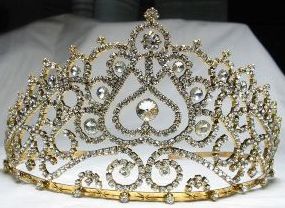 |
| Do you know who owns the most expensive and most beautiful tiara in the world? We think it may be the Princess of Fashion. |
| Headwear Definitions |
High Crowns of the Ancient World
The tiara began as a crown of rulers, and its oldest form is a tall one. The word comes from Persian tara, adopted in Latin as tiara, and traditionally it refers to a high crown, often with the shape of a cylinder narrowed at its top, made of fabric or leather, and richly ornamented. It was used by the kings and emperors of some ancient peoples in Mesopotamia. Fabric or leather, rather than solid metal, formed the body of these crowns, with ornament carrying the display, a construction that makes the ancient tiara closer to a magnificent cap of state than to the metal crowns later ages picture. Regional forms added their own symbols. The Assyrians used to include a pair of bull horns as a decoration and symbol of authority, and a circle of short feathers surrounding the tiara's top.
The Persian form moved in a different direction. The Persian tiara was more similar to a truncated cone, without the horns and feathers but more jewels, and a conic-shaped tip at its top. Comparing the two shows how one crown type expressed authority in local languages of ornament: Assyrian horns and feathers proclaiming power through emblems of strength, Persian jewels and a pointed tip proclaiming it through richness and height. In the Roman Catholic Church the tall tradition continued in a famous form of its own. The Papal Tiara is a high cap surrounded by three crowns and bearing a globe surmounted by a cross, worn by the Pope during certain ceremonies, being the symbol of his authority. That layered form, three crowns around one cap, made the tiara's meaning explicit, and its retirement was equally deliberate: since Pope Paul VI set aside his tiara after the Second Vatican Council, the Papal Tiara has not been worn, and Pope Benedict XVI even removed the tiara from his coat of arms, replacing it with a mitre, though some symbolic reference to the tiara's symbolism is still in use in the Holy See's coat of arms.
The Modern Tiara: Adornment, Not Rank
The modern tiara keeps the name and the jewelled display while changing almost everything else. In modern times a tiara is generally a semi-circular band, often metal-made and decorated with jewels, which is worn as a form of adornment and not as a symbol of rank. It is worn by women around their head or on the forehead as a circlet, sitting in front of the hair rather than covering the head like the ancient high crowns. That shift, from sovereign authority to personal adornment, explains all of its modern occasions. Tiaras are frequently used to crown the winners of beauty pageants, borrowing the crown idea for an evening's honour. They are also sometimes worn by the bride as part of a wedding outfit, and in some western countries a bride wears a tiara on her wedding day to help create a captivating princess look. Romantic ballets also often feature them, where a jewelled circlet completes a stage costume at a glance from the audience.
At the highest level, modern tiaras remain serious jewels with serious histories. Queen Elizabeth II is said to have the largest and most valuable collection of tiaras in the world, and she was often seen wearing them on state occasions. Her personal collection is considered priceless, received through inheritance and gifts from foreign countries, for example a diamond and aquamarine tiara she received as a present from the people of Brazil. Fiction borrows the form too: Wonder Woman is usually depicted wearing a tiara that can be thrown as a weapon, as can Sailor Moon's. The through-line across ancient Mesopotamia, the papal court, weddings and pageants is display concentrated at the head.
Common Questions
What did the traditional tiara look like?
Traditionally a tiara is a high crown, often with the shape of a cylinder narrowed at its top, made of fabric or leather and richly ornamented. The Assyrians added a pair of bull horns as a symbol of authority and a circle of short feathers, while the Persian tiara was more like a truncated cone with more jewels and a conic-shaped tip.
What is the Papal Tiara?
In the Roman Catholic Church, the Papal Tiara is a high cap surrounded by three crowns and bearing a globe surmounted by a cross, worn by the Pope during certain ceremonies as the symbol of his authority. Since Pope Paul VI set aside his tiara after the Second Vatican Council, the Papal Tiara has not been worn.
How is a tiara worn in modern times?
In modern times a tiara is generally a semi-circular band, often made of metal and decorated with jewels, worn by women around the head or on the forehead as a circlet. It is worn as adornment rather than as a symbol of rank, to crown winners of beauty pageants, by brides, and in romantic ballets.