Bow Tie
Clothing Definitions — definitions of garments and clothing terms from Apparel Search
Search Apparel Search
At a Glance
Definition: A bow tie is a neckwear accessory made from a ribbon of fabric tied around the collar so that the two ends form a symmetrical bow.
Category: Clothing Definitions
Word Origin
The bow tie descends from the cravat, the neck cloth worn by Croatian mercenaries in 17th-century Europe to hold the openings of their shirts closed. French high society adopted the style — the word cravat itself comes from the French form of "Croat" — and neckwear centred on the throat, rather than hanging from it, remained the rule until the long necktie developed out of it in the late 19th century.
The bow tie is the compact member of the neckwear family: a short ribbon of fabric worn around the collar and tied so that its two ends form loops, like a shoelace bow that stays at the throat. It is a fashion accessory most often paired with formal attire — suits and dinner jackets above all — and it carries a formality the long necktie does not: where a necktie says business, a bow tie says occasion.
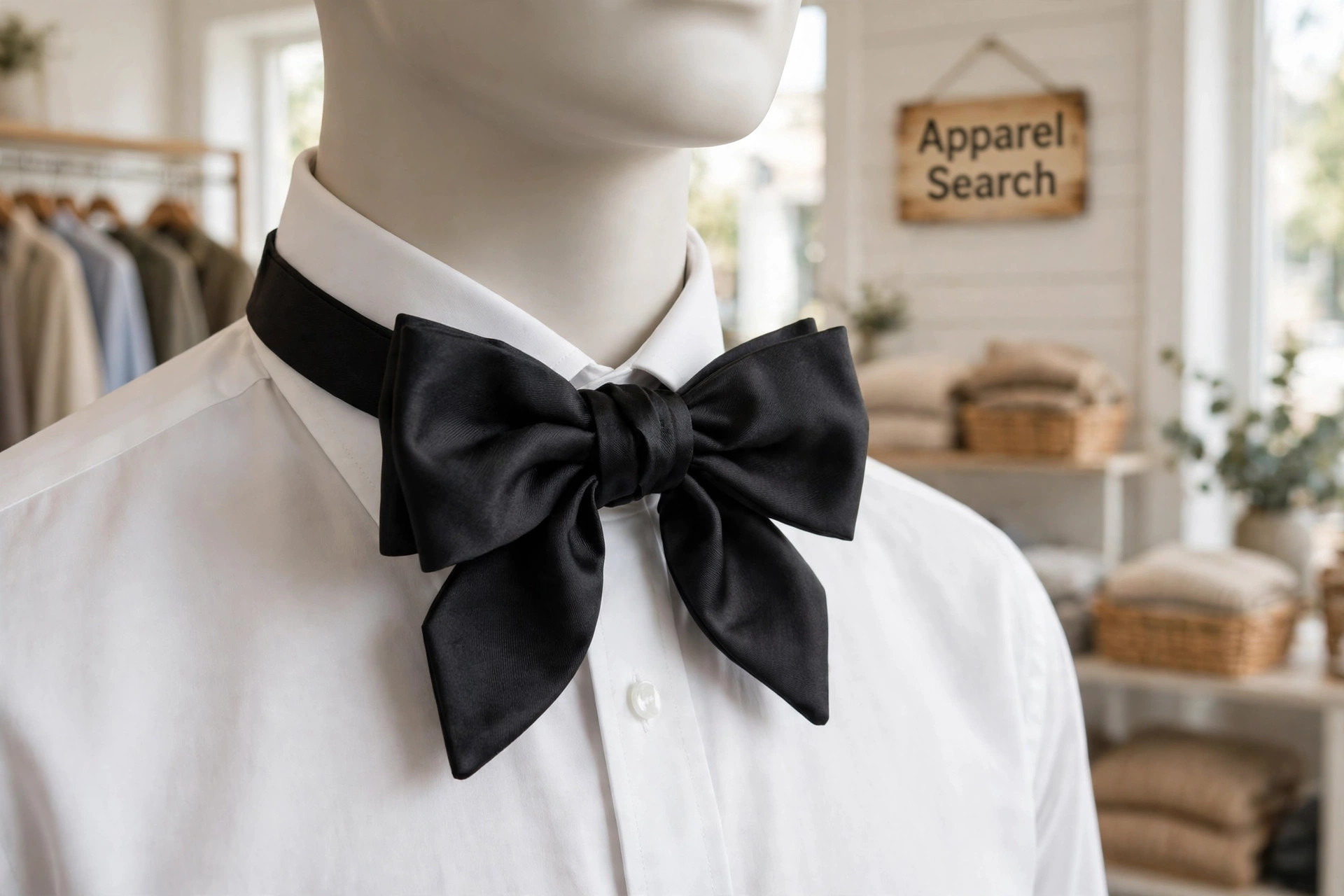
Self-Tie, Pre-Tied and Clip-On
A bow tie is sold in three constructions. The self-tie (or tie-it-yourself) version is a single shaped strip of cloth that the wearer knots by hand; it is the traditional form, and its slight irregularity is part of its character — a hand-tied bow never looks stamped out. Learning the knot is a small rite of passage in formal dressing, and our step-by-step guide shows how to tie a bow tie; the general principles sit alongside our other guides under How to Tie Neckwear.
Pre-tied bow ties have the bow sewn permanently into shape, mounted on an adjustable band that fastens around the neck. Clip-on versions dispense with the band altogether and grip the collar directly. Both are convenient and entirely serviceable for most settings, but formal tradition favours the self-tie: it can be untied at the end of the evening and left hanging, a small signal that the bow was real. In military mess dress the rule is strict — the bow must be self-tied, and a clip-on is treated as a serious faux pas.


The Main Shapes
The classic shape is the butterfly, whose wide, rounded wings produce a full, generous bow; it is the standard partner for black tie. The batwing narrows the wings to straight, slim ends and ties into a smaller, neater bow that sits well with an ordinary suit. Between and beyond them sit the thistle or modified butterfly, the pointed diamond-point, whose ends finish in points rather than flat edges, and oversized novelty shapes worn for effect rather than formality.
Proportion is the governing rule: the finished bow should be roughly the width of the wearer's face and should not extend beyond the outer edges of the collar it sits between. Fabric follows the outfit. Silk satin and grosgrain belong to evening wear, matching the facings of a dinner jacket; matte cotton, linen, wool and knitted silk suit daytime dress and smart-casual jackets. Patterned and coloured bow ties are a long-standing way of adding one deliberate note of personality to otherwise strict dress.
Dress Codes: Black Tie and White Tie
Two dress codes are named after this accessory's family. Black tie — the tuxedo code — calls for a black bow tie, traditionally of silk to match the jacket's lapel facings, worn with a white dress shirt and a vest or cummerbund; despite the name, deep midnight blue is an accepted classic, and contemporary invitations sometimes relax the colour further. White tie, the most formal evening code of all, requires a white bow tie of cotton piqué, matching the shirt front and waistcoat.
Outside those codes the bow tie has kept two strongholds: professions that value a neckwear that cannot dangle into the work — medicine, food service, architecture studios — and popular culture, where it reads instantly as a mark of the polished eccentric, from fictional spies to scientists and entertainers who made it a personal signature. A scarf worn at the neck is its informal ancestor and occasional substitute, but only the tied bow carries the dress-code weight.
Choosing and Wearing One Well
Choose the construction first: self-tie for formal wear and for anyone who wears a bow tie often, pre-tied for occasional use where convenience matters more than tradition. Size the band to the collar measurement — adjustable bands fit most necks, while fixed-size bands, ordered to the shirt size, sit cleanest under a wing or turndown collar. The bow itself should be centred, level, and snug enough to stay against the collar without strangling it.
Care is simple: untie a self-tie bow after wearing rather than leaving the knot in, let silk rest between wearings, and press only lightly, since hard pressing flattens the loops the style depends on. Worn well, the bow tie does what the best accessories do — it finishes an outfit in a single, unmistakable gesture.
Not to Be Confused With
A bow tie and a necktie start from the same place — a band of fabric at the collar — but finish differently. The bow tie is tied into two loops that sit flat against the collar and leave the shirt front bare; the necktie is knotted so its ends hang down the chest. With a tuxedo, the bow tie remains the traditional and expected choice, while a necktie is the everyday business standard.
Common Questions
How do you tie a bow tie?
A self-tie bow tie uses the same basic knot as a shoelace bow: drape the strip around the collar with one end slightly longer, cross the ends, form a loop with one side, fold the other side through the gap behind the loop, then pull and adjust both loops and ends until the bow is even and snug.
What is the difference between a butterfly and a batwing bow tie?
The butterfly has wide, rounded wings and ties into a full bow; it is the standard shape for black tie. The batwing has narrow, straight-edged wings and makes a smaller, slimmer bow that suits daytime suits and a more understated look.
Are pre-tied bow ties acceptable for formal wear?
They are convenient and acceptable in many settings, but traditional black-tie dressing expects a self-tied bow. A hand-tied bow has a natural slight irregularity and can be untied at the end of the evening, which pre-tied and clip-on versions cannot imitate.