Ball Gown
Clothing Definitions — definitions of garments and clothing terms from Apparel Search
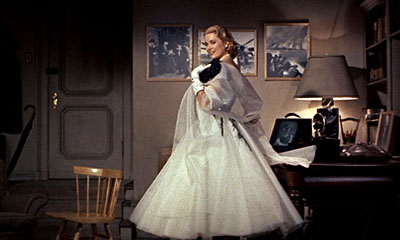
A ball gown is the female attire for social occasions where white tie is specified on the invitation. It is traditionally a full-skirted gown reaching at least to the ankles, made of luxurious fabric and delicately and exotically trimmed, with most versions cut off the shoulder with décolleté necklines. This page explains the complete outfit — the stole, the jewellery, the opera-length gloves, dancing shoes and clutch evening bag that accompany the gown — and its fabrics, and notes that the ball-gown shape has changed little since the mid-19th century.
 A
Ball
gown
is the female
attire for
social occasions
where
white tie
is specified
on the invitation.
It is traditionally
a full-skirted
gown
reaching
at least
to the ankles,
made of
luxurious
fabric,
delicately
and exotically
trimmed.
Most versions
are cut
off the
shoulder
with decollete
necklines.
Such
gowns
are typically
worn with
a stole
(a formal
shawl in
expensive
fabric), "good"
(couture
or vintage)
jewellery
and opera-length
gloves.
Standard
accessories
are dancing
shoes and
a clutch
style evening
bag. Where "state
decorations"
are to be
worn, they
are on a
bow pined
to the chest,
and married
women wear
a
tiara
if they
have one.
The ball-gown shape has changed little since the mid-19th century. Although man-made fabrics are now sometimes used, the most common fabrics are satin, silk, taffeta (Apparel Search note: visit our label definition page to learn about taffetta in regard to garment labels) and velvet with trimmings of lace, pearls, sequins, embroidery, ruffles and ruching.
Learn about different types of Gown.
| The above article is licensed under the GNU Free Documentation License. From Wikipedia, the free encyclopedia ( https://en.wikipedia.org/wiki/ball_gown ). 8/5/05 |
An Unchanging Silhouette
Few garments in fashion can claim the ball gown's stability: its shape has changed little since the mid-19th century. The formula — a fitted, often off-the-shoulder bodice with a décolleté neckline above a full skirt falling at least to the ankles — survives because the occasion it serves has also stayed stable. White tie events ask for ceremony, and the ball gown answers with volume, luxurious fabric and elaborate trimming rather than novelty. Designers work within the formula through fabric and finish: satin for sheen, silk for drape, taffeta for crisp structure, velvet for depth, and lace, pearls, sequins, embroidery, ruffles and ruching for the delicate, exotic trimming the definition calls for.
Wearing the Complete Outfit
The ball gown is properly one part of an ensemble, and the accessories are prescribed rather than optional. The stole covers the shoulders the décolleté neckline leaves bare; opera-length gloves match the formality of the exposed arm; dancing shoes are chosen for an evening that may literally include dancing; and the clutch evening bag carries the minimum. Jewellery should be genuinely good — couture or vintage — because the simplicity of the rest of the code throws attention onto it. State decorations, when worn, go on a bow pinned to the chest. A wearer preparing for a white tie event should assemble the whole outfit together rather than the gown alone, since the effect depends on every element meeting the same standard.
Choosing a Ball Gown
Choosing begins with the invitation: a ball gown is the answer to white tie, the most formal code, so the gown should be full-skirted and at least ankle-length, in a fabric with genuine luxury — satin, silk, taffeta or velvet — rather than a lighter party dress. The off-the-shoulder cut and décolleté neckline are traditional, and they dictate the rest of the planning: the stole for the shoulders, opera-length gloves for the arms, and jewellery of a standard to hold its own in a simple, formal setting. Fit the gown for movement as well as appearance, since dancing shoes are part of the outfit for a reason; a skirt that cannot be danced in fails the occasion. Fitted and accessorized as a complete ensemble, the ball gown does what it has done since the mid-19th century: it makes ceremony visible.
Common Questions
When is a ball gown worn?
A ball gown is worn for social occasions where white tie is specified on the invitation, the most formal dress code. Where state decorations are to be worn, they are worn on a bow pinned to the chest, and married women wear a tiara if they have one.
What accessories go with a ball gown?
Standard accessories are a stole — a formal shawl in expensive fabric — good jewellery, whether couture or vintage, opera-length gloves, dancing shoes and a clutch style evening bag. Together with the gown they make up the complete white-tie outfit for women.
What fabrics are ball gowns made from?
Although man-made fabrics are now sometimes used, the most common ball gown fabrics are satin, silk, taffeta and velvet. Trimmings include lace, pearls, sequins, embroidery, ruffles and ruching, in keeping with the gown's luxurious and exotic finish.
More to Explore
- Ball gown
- white tie
- gown
- gloves
- tiara
- satin
- silk
- label definition
- velvet
- lace
- sequins
- embroidery
- Skirts and Dresses
- Hobble Skirt
- Artistic Dress Movement
- Frock
- Court Dress
- Pant Definition
- Trouser Definition
- Petticoat
- Clothing Definitions
- GNU Free Documentation License
- https://en.wikipedia.org/wiki/ball_gown