Cufflinks
Miscellaneous Definitions — accessories, trims, tools and general fashion terms from Apparel Search
A cuff link, cufflink or cuff-link is a decorative fastener used to fasten or link the two portions of a French cuff, typically on a shirt or blouse, and cuff links are predominantly worn by men. The visible part of the cufflink is often monogrammed or decorated in some way, and an almost unlimited variety of designs and construction details may appear on a cuff link.
A cuff link, cufflink or cuff-link is a decorative fastener used to fasten or link the two portions of a french cuff, typically on a shirt or blouse. Cuff links are predominately worn by men. These fasteners may be of very simple design, consisting of a post -- a short cylindrical portion -- connecting two disc-shaped parts, one of which is sized to fit through the button-hole of the cuff, the other, which is positioned on the most visible side of, is wider. The visible part of the cufflink is often monogrammed or decorated in some way.
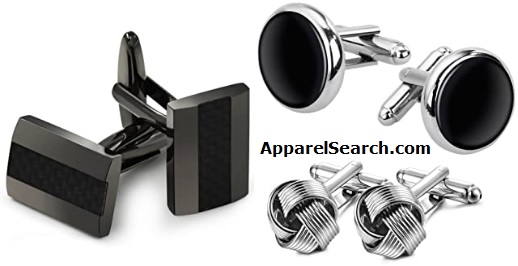
Cuff link designs vary widely, as do many fashion accessories. An almost unlimited variety of designs and construction details may appear on a cuff link. For example, the 'hidden' side of a cuff link may be have a portion which swivels on the central post, aligning with the post while the link is threaded through the button-hole, and swiveling into a position at right angles to the post when worn.
Research cuff link styles in the retail market.
|
The above article is licensed under the GNU Free Documentation License. From Wikipedia, the free encyclopedia (https://en.wikipedia.org/wiki/cufflink). 5/2/05 |
| Fashion Industry |
A Decorative Fastener for the French CuffA cufflink exists because a French cuff has no button. The French cuff folds back and presents aligned buttonholes through both layers, and something must pass through those holes and hold the two portions of the cuff together. The cuff link is that something, and it is defined as a decorative fastener: it does the mechanical job of a button while being a separate, removable piece of jewelry. Cuff links are typically worn on a shirt or blouse and are predominantly worn by men, as part of formal and business dress. Because the fastener is not sewn to the shirt, one shirt can take many different characters depending on the links chosen, and the links themselves can be kept, collected and given as gifts in a way a sewn button never can. That separateness is the source of their appeal and of their variety. The basic construction is simple and ingenious. These fasteners may be of very simple design, consisting of a post, a short cylindrical portion, connecting two disc-shaped parts, one of which is sized to fit through the buttonhole of the cuff, while the other, which is positioned on the most visible side, is wider. The post spans the folded layers of the cuff, the small end passes through the holes, and the wide visible face sits outside, holding the assembly in place and presenting the design. A common refinement solves the problem of a disc that must pass through a hole and then refuse to come back out: the hidden side of a cuff link may have a portion which swivels on the central post, aligning with the post while the link is threaded through the buttonhole, and swiveling into a position at right angles to the post when worn, forming a T-bar lock behind the cuff. Designs, Monograms and How Cufflinks Are WornCuff link designs vary widely, as do many fashion accessories, and an almost unlimited variety of designs and construction details may appear on a cuff link. The visible face is a small disc of metal or other material that works like a miniature canvas or coin. It is often monogrammed or decorated in some way, with engraved initials, enamel color, stone settings, crests, textures and novelty motifs all appearing on that one small surface. Materials and finish set the register: plain polished metal for conservative business wear, dark enamel or onyx-style faces for evening formality, and brighter or humorous designs for personal expression within an otherwise formal outfit. Because the cufflink sits at the wrist, where hands gesture over documents, tables and handshakes, these small designs are seen at close range and read as deliberate details of the wearer's presentation. Wearing cufflinks correctly is mostly a matter of matching the fastener to the cuff and the occasion. Only a cuff made for them, a French or double cuff with holes rather than a sewn button, can take a cufflink, so the shirt choice comes first. The link is threaded through all the aligned holes of the folded cuff so the two portions are linked evenly, the decorated face outward, and the closing portion secured behind. Cufflinks are the natural companions of the other small formal components of a shirt front: shirt studs, which close a formal shirt's front through holes in the same spirit, collar stays, bow ties and waistcoats all belong to the same dressed register. For a shopper comparing styles in the retail market, the practical checks are the security of the swivel or fixed post, the smoothness of the edges that will sit against fabric, and whether the design's formality matches the shirts and occasions it will actually be worn with. Common QuestionsWhat is a cufflink?A cuff link, cufflink or cuff-link is a decorative fastener used to fasten or link the two portions of a French cuff, typically on a shirt or blouse. Cuff links are predominantly worn by men. How does a cufflink work?A simple cufflink consists of a post, a short cylindrical portion, connecting two disc-shaped parts. The smaller disc fits through the buttonhole of the cuff, while the wider, decorated part sits on the most visible side; on some designs the hidden portion swivels on the post to lock at right angles once threaded through. What designs do cufflinks come in?An almost unlimited variety of designs and construction details may appear on a cuff link. The visible part is often monogrammed or decorated, and cufflinks range from plain metal discs to enameled, jeweled and novelty forms. More to ExploreMore from Apparel Search: Miscellaneous Definitions | Clothing Industry Glossary | Fashion Terms | Apparel Search Home
|