Cuff
Miscellaneous Definitions — the turned-back band at the end of a sleeve or pant leg, from Apparel Search
Search Apparel Search
At a Glance
Definition: A cuff is the lower edge of a sleeve (or pant leg) turned back to show an ornamental border, or finished with an addition of lace or trimming — in modern use, chiefly the stiff band at the end of a shirt sleeve.
Category: Miscellaneous Definitions
A cuff is the lower edge of a sleeve, or of a pant leg, turned back to show an ornamental border, or finished with an addition of lace or trimming. The word is now used chiefly of the stiff bands of linen worn under the coat sleeve, either loose or attached to the shirt. Typical shirt cuffs consist of French cuffs and button cuffs, also called barrel cuffs. This page covers the turned-back edge in sleeves and trousers, the two shirt cuff types, and why the cuff is studied alongside the shirt collar.
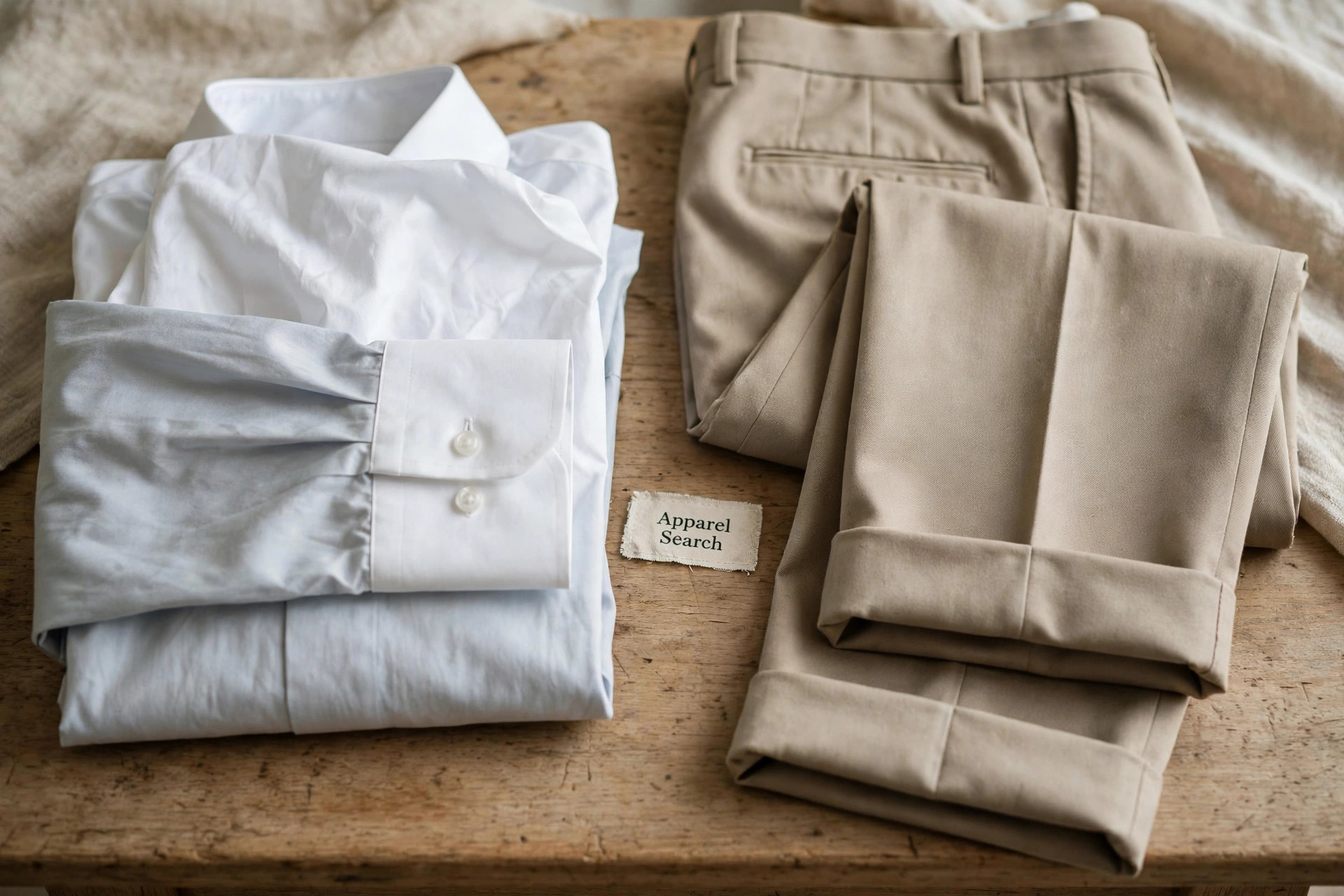
The Turned-Back Edge of a Sleeve or Leg
A cuff begins as an edge treatment. Turning the lower edge back does several things at once: it finishes the raw end of the cloth with a doubled layer that wears better than a single thickness, it creates a distinct band that frames the hand or the shoe, and it gives the maker a defined place to add decoration, from a border pattern in the turned section to lace or trimming applied to it. On a sleeve the cuff sits at the wrist, one of the most visible points of a garment because hands move constantly and draw the eye. On a pant leg it sits at the ankle, where its horizontal band grounds the line of the leg and adds a little weight that helps the trouser hang straight.
In modern dress the word is used chiefly in the narrower shirt sense: the stiff bands of linen worn under the coat sleeve, either loose or attached to the shirt. That shirt cuff is a small piece of engineering. It must wrap the wrist closely enough to stay in place and present a clean edge beyond the jacket sleeve, yet open wide enough for the hand to pass through when dressing — which is why shirt cuffs need a fastening of their own, such as a button or a cuff link, rather than being simple closed bands. The stiffness matters too: a shirt cuff holds its shape against the wrist and shows a smooth, firm band below the coat sleeve, and the small amount of cuff left visible beyond the jacket is a long-standing detail of tailored dress.
French Cuffs, Barrel Cuffs and Pant Cuffs
Typical shirt cuffs consist of two main types. French cuffs are doubled: the cuff folds back on itself and is closed through aligned holes with cuff links or silk knots, giving a thicker, more formal band with a decorative fastening displayed at the wrist. Button cuffs, also called barrel cuffs, are single cuffs that wrap the wrist in a barrel shape and close with a button sewn directly to the cuff, which makes them simpler, quicker to fasten and the everyday standard for most dress and business shirts. The choice between them is a reliable formality signal, and many wardrobes keep both, reserving the folded cuff for the most polished wear.
The pant-leg cuff follows the same turned-back principle with a different effect. A cuffed trouser hem is turned up and pressed as a permanent band rather than a temporary roll, and it is most at home on pleated, fuller-cut trousers in the tailored tradition, where its weight helps the leg drape and its band completes the classic line. Plain hems without cuffs give a cleaner, longer look and are the usual partner for flat-front, slimmer trousers. In both sleeves and trousers, then, the cuff is never only decoration: it is a doubled, finished edge that protects the end of the garment, carries its fastening or its decoration, and signals how formal the garment intends to be. It belongs to the same dressed details as the bow tie and the collar it is so often studied with.
Common Questions
What is a cuff?
A cuff is the lower edge of a sleeve or pant leg turned back to show an ornamental border, or with an addition of lace or trimming. On shirts it is the stiff band at the end of the sleeve that closes around the wrist.
What are the typical types of shirt cuff?
Typical shirt cuffs consist of French cuffs and button cuffs, also called barrel cuffs. French cuffs fold back and close with cuff links or silk knots, while barrel cuffs close with a button sewn to the cuff itself.
Can a pant leg have a cuff?
Yes. A cuff is also the lower edge of a pant leg turned back, forming a visible band at the hem. On trousers the turned-back cuff adds weight and a finished horizontal line at the ankle.