Blouse
Clothing Definitions — definitions of garments and clothing terms from Apparel Search
Search Apparel Search
At a Glance
Definition: A blouse is a tailored women's top, usually of woven cotton or silk, with or without a collar and sleeves, distinguished from knit tops by its construction and details such as ruffles, pintucks and embroidery.
Pronunciation: BLOWZ — rhymes with "browse"; the final sound is a soft z, not an s
Category: Clothing Definitions
Word Origin
Blouse is French: the loose smock worn by French workmen and peasants, itself possibly from Provençal liso or from the idea of a garment made of un-dyed wool. English borrowed the word in the nineteenth century, first for work smocks and soldiers' tunics, then for the women's garment that took the smock's loose, comfortable cut and refined it.
The blouse is the tailored half of the women's top wardrobe: not a knit, not a T-shirt, but a woven garment with a collar or a finished neckline, sleeves or a considered sleeveless cut, and fastenings that actually fasten. Most commonly the word means a woman's shirt — though it survives in one masculine corner, as the name of certain men's military uniform shirts. Its details, its fabrics, and one famous reversed-button puzzle are the subject of this page.
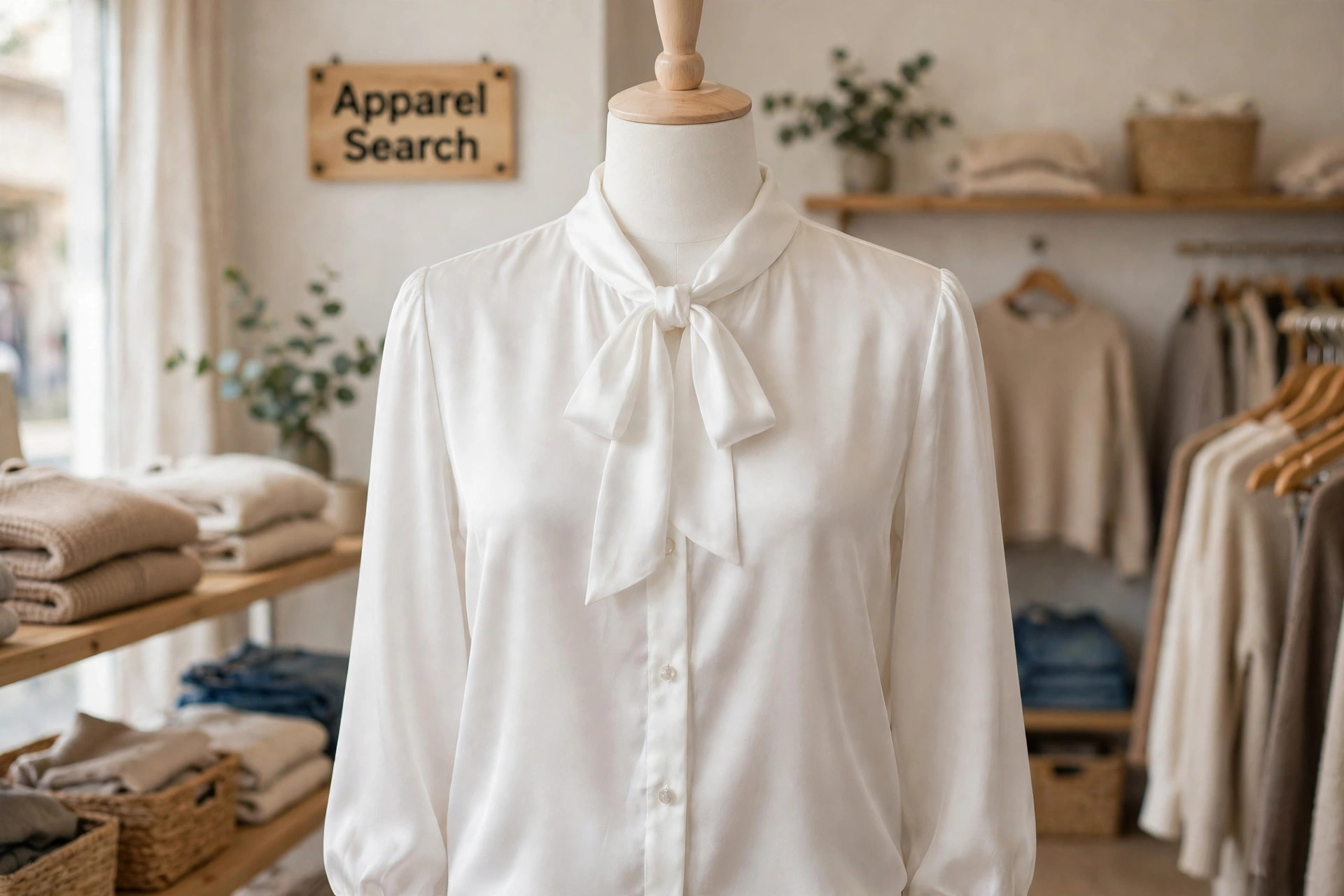
A Woven, Tailored Top
What makes a blouse a blouse is construction. It is cut from woven cloth rather than knitted fabric, which gives it shape that a knit top gets only from stretch. It may or may not include a collar, and it may be sleeved or sleeveless, but it is always finished like a garment rather than a layer: seams are enclosed, fronts are faced, and openings close with buttons or other real fastenings. That tailoring is why blouses sit above simple knit tops in formality and why they anchor work wardrobes.
Within that construction, the design freedom is wide. Necklines run from a standard shirt collar through Peter Pan and sailor shapes to soft ties and bows at the throat. Sleeves range from sleeveless and cap sleeves to full-length sleeves ending in buttoned cuffs — the point where a blouse borrows the shirt's cufflink-and-button hardware. Decoration does the rest of the talking: ruffles, pintucks, lace inserts and embroidered decoration can move one basic pattern from plain office wear to occasion dress.
Fabrics: Cotton for Day, Silk for Dress
Two fibres dominate. Cotton blouses are crisp, breathable and washable — the everyday workhorse, in poplins, lawns and voiles that hold a collar and take a press. Silk blouses drape rather than stand, sliding under jackets and softening a tailored skirt or trousers; they are the dressier choice and the more delicate to care for. Between them sit cotton-silk blends and modern synthetics that imitate silk's fluidity at a lower price and with easier washing.
Fabric choice decides how a blouse behaves in an outfit. A structured cotton blouse keeps its own line worn loose over trousers; a silk blouse is usually better tucked or half-tucked, since its drape reads as untidy rather than relaxed when it hangs free. Sheerness is the other practical variable: pale silk and voile blouses often need a camisole beneath, a layering point worth checking before purchase rather than after.
The Reversed Buttons
Blouses button in reverse to men's shirts: the buttons are normally on the wearer's left-hand side and the buttonholes on the right. The custom is universal in women's tailoring and its origin is genuinely unsettled. One suggestion is commercial — that launderers introduced the difference so they could tell women's shirts from men's at a glance, and charge accordingly. Another reaches back to the age of personal servants: maids fastened their mistresses' gowns, and buttons arranged for the dresser's hands, rather than the wearer's, made the daily job easier, so the reversed arrangement stuck.
A third explanation points to wealth display: in periods when a long row of buttons was itself a status symbol, the arrangement that suited a right-handed servant dressing a lady was the one that survived. None of the theories is proven, and the honest summary is that the convention is centuries old, self-perpetuating — makers cut women's fronts the way women's fronts have always been cut — and now simply one of the quiet codes by which the trade tells a blouse from a shirt.
Wearing, Fitting and Caring for Blouses
The blouse earns its staple status by pairing across the wardrobe: tucked into trousers or a skirt for work, worn loose over jeans for a softer line, or layered under a jacket or cardigan. The neighbouring tops mark its borders — the crop top shortens the same idea, the tank top removes its sleeves and tailoring — but the blouse itself stays the dressed option among tops. Our women's blouses guide covers current styles and shopping in depth.
When buying or sewing, three fit points matter. The shoulder line should sit on the shoulder, since a blouse cannot be pulled into place like a knit. Bust ease must let the front close without gaping between buttons — the classic blouse fault. And sleeve length should meet the wrist with the arm bent, not just hanging. Care follows fabric: cotton presses hot and washes freely, silk wants gentle washing and shade drying, and embroidered or ruffled fronts should be turned inside out in the wash to protect the detail that makes the garment.
Not to Be Confused With
A blouse is a kind of shirt, and in speech the words overlap — but in the trade they divide by construction. A shirt, in the classic sense, is the tailored button-front garment modelled on menswear, with a yoke, a structured collar and buttoned cuffs. A blouse is the softer women's counterpart: cut with more ease, often in fluid fabrics, and free to use necklines — bows, drapes, Peter Pan collars, no collar at all — that a shirt does not. A knit top such as a T-shirt or a tank top is neither: the blouse is a woven, tailored garment, and that woven construction is what defines it.
Common Questions
What is a blouse?
A blouse is most commonly a woman's shirt, usually made of cotton or silk cloth, with or without a collar and sleeves. Blouses are generally more tailored than simple knit tops and may include details such as ruffles or embroidered decorations.
Why do blouses button on the opposite side to men's shirts?
On a blouse the buttons are normally on the wearer's left-hand side and the buttonholes on the right, the reverse of a men's shirt. The reasons are unclear: one suggestion is that launderers introduced the difference to distinguish women's shirts from men's, and another traces it to the era when servants fastened their mistresses' gowns.
Is the word blouse used for men's clothing?
Yes, in a narrower sense: the term is also used for some men's military uniform shirts. In everyday use, though, blouse refers to the women's garment described on this page, which is how the word is understood in fashion retail and sewing.