Frock Coat
Clothing Definitions — definitions of garments and clothing terms from Apparel Search
A frock coat is a men's coat introduced in the early nineteenth century, characterized by knee-length skirts all around, in contrast to tail coats and cutaways. Some styles have a seam at the waist, and frock coats usually button only to the waist, sometimes decorated with a pair of buttons at the back waist. This page explains the frock coat's cut, why its waist seam flatters the figure, its place in military uniforms, and its occasional modern use as formal wear.
A frock coat is a men's coat introduced in the early nineteenth century characterized by knee-length skirts all around, in contrast to tail coats and cutaways. Some styles of frock coat have a seam at the waist.
Frock coats usually button only to the waist, and may be decorated with a pair of buttons a the back waist.
The term derives from frock, an ancient word for a loose outer garment, which is also the source of modern frock for a priest's robe or a woman's dress.
Military wear
The cut of a frock coat with a waist seam flatters a man's figure, as opposed to a sack coat, and such frock coats remain part of some twentieth century military uniforms. They can either be single-breasted as in army uniforms, or double-breasted as in navy uniforms.
Formal and western wear
In America, frock coats (usually with matching trousers) are occasionally worn as formal wear, especially for weddings. Frock coats are also worn as a formal coat with western wear.
Socks - rhymes with smocks...
| The above article is licensed under the GNU Free Documentation License. From Wikipedia, the free encyclopedia (https://en.wikipedia.org/wiki/frock_coat) 8/5/05 |
Photos
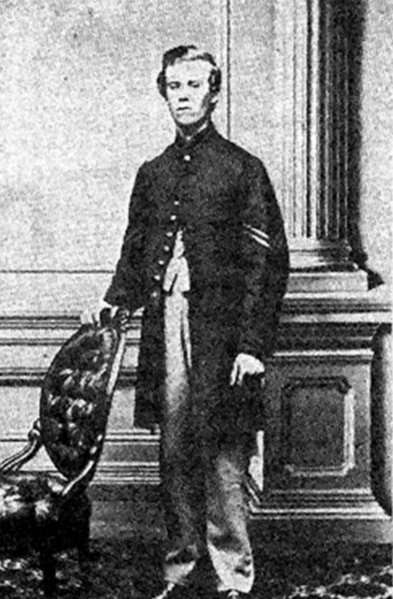
The Nineteenth Century's Standard Coat
For much of the nineteenth century the frock coat was the respectable man's default: formal enough for business, ceremony and mourning, plainer than court dress, and cut to flatter — the waist seam, where fitted styles have one, shapes the body as a sack coat does not. Its all-round skirt is the diagnostic feature. The tail coat sacrifices the front skirt to tails; the cutaway, or morning coat, slopes away; the frock coat keeps a level, knee-length skirt in front and behind, buttoning to the waist so the skirt falls from the fastened waist.
Armies adopted the same logic. The waist-seamed frock coat became a standard military tunic form, single-breasted for army uniforms and double-breasted for navy, and remained in some twentieth-century uniforms long after civilian fashion moved to the lounge suit. Its civilian survival is ceremonial: in America, frock coats with matching trousers are still worn occasionally as formal wear, especially for weddings, and as a formal coat with western wear, where the long skirt suits the style. The name itself is a history in miniature — frock, the ancient word for a loose outer garment, applied to the most structured coat of its century.
Common Questions
What is a frock coat?
A frock coat is a men's coat introduced in the early nineteenth century characterized by knee-length skirts all around, in contrast to tail coats and cutaways. Frock coats usually button only to the waist and may have a pair of buttons at the back waist.
How does a frock coat differ from a tail coat?
A tail coat is cut away at the front with tails behind. A frock coat's skirts run all around at knee length, and some styles have a seam at the waist.
Where are frock coats still worn?
The waist-seamed frock coat remains part of some twentieth-century military uniforms, single-breasted in army and double-breasted in navy forms, and in America frock coats with matching trousers are occasionally worn as formal wear, especially for weddings, and with western wear.