Mandilion
Clothing Definitions — definitions of garments and clothing terms from Apparel Search
A mandilion or mandelion is a loose men's hip-length pullover coat or jacket, open down the sides, worn in England in the later sixteenth century. It was fashionable to wear the mandilion turned so that its sleeves hung unused down the back or front, the body put on crosswise like a tabard. The garment began as a practical soldier's and labourer's loose coat and was taken up, in finer fabrics, as a fashion. This page explains the mandilion's cut, its two ways of wearing, and its Elizabethan context.
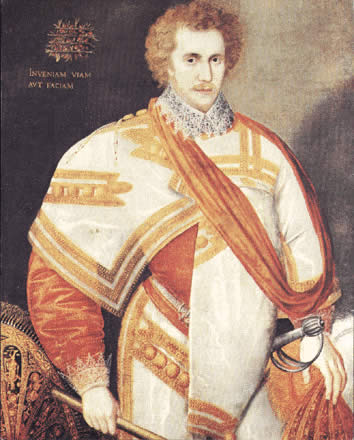 A mandilion or mandelion is
a loose men's hip-length pullover
coat or jacket,
open down the sides, worn in England in
the later sixteenth century.
It was fashionable to wear the mandilion colly-westonward or Colley-Weston-ward, that is, rotated 90 degrees so that the front and back were draped over the arms and the sleeves hung down in front and behind.
- "...sithence such is our mutability that to-day there is none to the Spanish guise, to-morrow the French toys are most fine and delectable, ere long no such apparel as that which is after the high Almaine fashion, by-and-by the Turkish manner is generally best liked of, otherwise the Morisco gowns, the Barbarian fleeces, the mandilion worn to Colley-Weston ward, and the short French breeches make such a comely vesture that, except it were a dog in a doublet, you shall not see any so disguised as are my countrymen of England." - William Harrison, The Description of Elizabethan England (1577), 'Of Our Apparel and Attire'.
Why the fashion was named after the small village of Collyweston in Northamptonshire remains uncertain.
| The above article is licensed under the GNU Free Documentation License. From Wikipedia, the free encyclopedia (https://en.wikipedia.org/wiki/mandilion). 1/13/06 |
A Coat Worn Two Ways
The mandilion's oddity is in its pattern. It is essentially a wide, short poncho-like coat with sleeves attached, open down both sides below the armholes, and put on by pulling it over the head. Worn straight, its sleeves are on the wearer's arms and the open sides are closed over the hips by the belt or simply overlap. Worn fashionably, the whole garment is turned a quarter-circle, so the neck opening still sits at the neck but the sleeves hang empty at the front or back as loose drapery, and the side openings fall at front and back. Contemporary images show young Elizabethan men in the rotated style over doublets, and moralists of the period complained about it, which is usually a sign a fashion was widespread.
In finer versions the mandilion was cut in rich fabrics and trimmed, but its shape never lost its working origin: no fastenings beyond buttons at the neck, no fitted waist, nothing that required a tailor's structure. It belongs with the loose overgarments of its century, before the fitted, buttoned coat took over men's dress, and it survives mainly in inventories, portraits and costume history, where its two wearing styles must both be described for the garment to make sense.
Common Questions
What is a mandilion?
A mandilion, or mandelion, is a loose men's hip-length pullover coat or jacket, open down the sides, worn in England in the later sixteenth century.
Why was the mandilion worn with its sleeves hanging?
It was fashionable to wear the mandilion rotated on the body so the sleeves hung unused as drapery. The style copied soldiers, who slung their loose coats that way, and turned a work garment into a deliberate fashion.
What was a mandilion made for originally?
The mandilion began as a loose, practical overcoat for soldiers and working men: hip-length, open at the sides and pulled on over other clothes for warmth and weather protection.
More to Explore
- coat or jacket
- sleeves
- Jacket
- Ski Jacket
- Windbreaker
- Sportscoat
- Waistcoat
- Flak Jacket
- Safari Jackets
- Trench Coat
- Parka Definition
- Anorak
- Overcoat
- Poncho
- Petticoat
- Frock Coat
- Morning Coat
- Bekishe
- Blazer
- Strightjacket
- Clothing Definitions
- GNU Free Documentation License
- https://en.wikipedia.org/wiki/mandilion