Doublet
Clothing Definitions — definitions of garments and clothing terms from Apparel Search
A doublet is a man's snug-fitting buttoned jacket that was worn in medieval and Tudor times. Originally it was a mere stitched and quilted lining — a doubling — worn under a hauberk or cuirass to prevent bruising and chafing. Then, like many originally practical items in the history of men's wear, from the late 15th century onward it became elaborated enough to be seen on its own, worn with hose and a codpiece as the standard upper garment of a gentleman. This page explains that evolution from armour lining to fashionable jacket, and how the padded doublet shaped the Tudor silhouette. Other senses of the word doublet — in gemstones and in language — are noted at the end of the definition.
A doublet is a man's snug-fitting buttoned jacket that was worn in medieval and Tudor times. Originally it was a mere stitched and quilted lining ("doubling"), worn under a hauberk or cuirass to prevent bruising and chafing. Then, like many other originally practical items in the history of men's wear, from the late 15th century onward it became elaborated enough to be seen on its own. In the early 1580s, Sir Philip Sidney, when governor of Flushing in the Low Countries, chose to be portrayed in his doublet, but still in a gorget, as if he were caught in the act of setting aside his armour to institute a civil government. (See portrait at Sir Philip Sidney.)
A doublet in gemstones is a fake gem composed in two sections, such as a garnet overlaying green glass, with the join hidden by the mount, giving the effect of a fine emerald. Similarly a layer of opal may be glued to a jet foil, giving the impression of a rare black opal.
A doublet is also one of two or more words of the same language that come from the same root. Doublets may be nearly synonymous, for example English pyre and fire; may have fairly different meanings, for example aperture and overture (the commonality behind the meanings is "opening"); or may even develop meanings that are in a sense opposites, for example host and guest. Doublets also vary with respect to how far their forms have diverged. For example, the resemblance between levy and levee is obvious, whereas the connection between sovereign and soprano is harder to guess from the forms of the words alone.
In quantum mechanics, a doublet is a quantum state of a system with a spin of 1/2, such that there are two allowed values of the spin component, -1/2 and +1/2. See also triplet.
| The above article is licensed under the GNU Free Documentation License. From Wikipedia, the free encyclopedia (https://en.wikipedia.org/wiki/doublet). Modified by Apparel Search 11/13/04 |
Photos
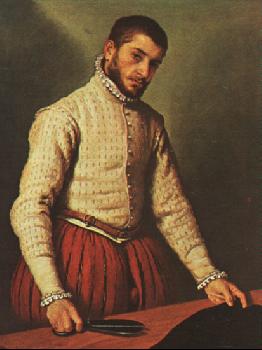
The Doublet and the Tudor Silhouette
Once the doublet emerged from under the armour, tailors made it carry the fashion. Quilting and padding that had once only cushioned a breastplate were redirected to shape the chest and shoulders, fronts were cut to a point at the waist, and sleeves — often detachable and tied in with points, or laces — became a showpiece in contrasting fabric. Because the doublet buttoned snugly, it defined the male torso of its era as surely as the corset defined the female one in later centuries, and sumptuary detail — slashing that showed a contrasting lining, embroidery, jewelled buttons — concentrated on it.
The doublet's long life, roughly two centuries as the standard jacket, ended as coats lengthened in the 17th century, but its construction survives in the idea of the tailored, padded, buttoned jacket itself. In historical dress study it remains the key garment for understanding how medieval and Tudor men were dressed layer by layer.
Common Questions
What is a doublet in clothing?
A doublet is a man's snug-fitting buttoned jacket worn in medieval and Tudor times. It began as a stitched and quilted lining worn under armour, and from the late 15th century became elaborated enough to be worn on its own as the fashionable upper garment.
Why is it called a doublet?
The name records its origin as a doubling: a doubled, quilted layer of cloth worn under a hauberk or cuirass to prevent bruising and chafing from the armour. Like many practical items in menswear history, the lining was gradually decorated until it could be seen by itself.
How was the doublet worn?
By Tudor times the doublet was worn buttoned closely over the torso, with hose below and often a codpiece at the front, and a gown, jerkin or armour over it as occasion required. Sir Philip Sidney was portrayed in the early 1580s in his doublet with a gorget, as if caught setting aside his armour.