Codpiece
Clothing Definitions — definitions of garments and clothing terms from Apparel Search
Search Apparel Search
At a Glance
Definition: A codpiece is a flap or pouch attached to the front of men's trousers or hose to cover the genitals, an important and increasingly decorative item of European dress in the 15th and 16th centuries.
Pronunciation: KOD-pees
Category: Clothing Definitions
Word Origin
Codpiece is Middle English codpece: cod, a bag (from Old English codd, a bag — the same word that gives the cod's pouch-like belly and the peascod, or pea pod), plus pece, a piece. The name is bluntly descriptive: a bag-piece.
The codpiece is the clearest example in clothing history of a practical fix becoming a fashion statement. It is a flap or pouch attached to the front of the crotch of men's trousers, providing a covering for the genitals and held closed by string ties, buttons or other fastenings. For roughly a century, in 15th- and 16th-century European dress, it was an important and increasingly conspicuous item — first a matter of modesty, then of emphasis, and occasionally of storage.
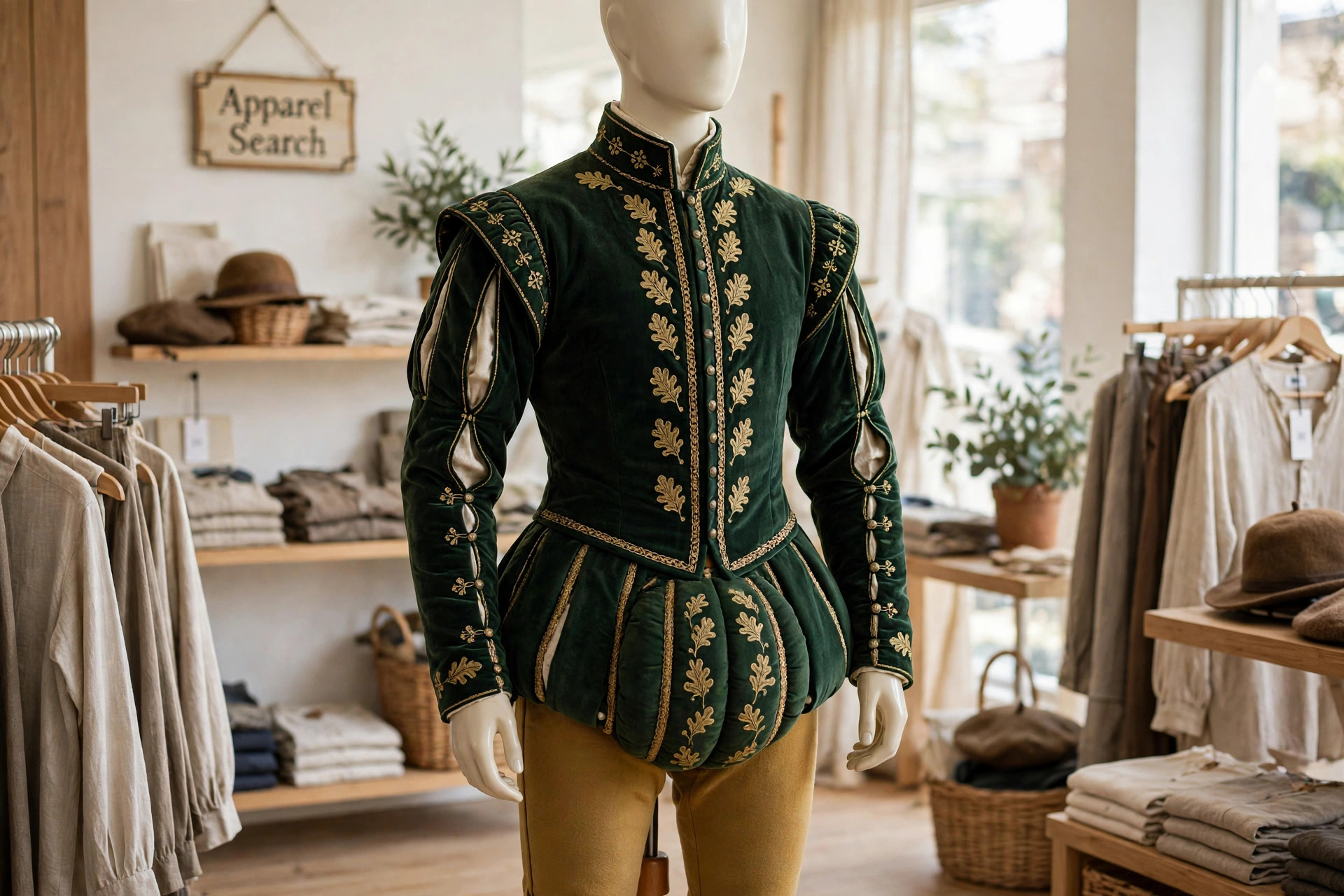
A Practical Beginning: Hose, Doublets and Modesty
The codpiece began as engineering, not display. Men's hose of the period were typically very snug on the legs and open at the crotch, with the genitalia simply hanging loose beneath the doublet, the fitted upper garment of the day. While doublets were long, the arrangement was decent. As fashion shortened the doublet, exposure became a real problem, and the codpiece — a covering flap fastened across the opening — came into being to solve it. There are other versions of the garment's origin, but the shortening-doublet explanation is the one the surviving garments support: early codpieces are plain, functional triangles of cloth.
Construction stayed simple even as the fashion grew. The codpiece attached at the front of the hose or breeches and closed with ties, buttons or hooks, so it could be opened without undressing — a necessary feature in a garment worn all day under layers of dress. It was, in modern terms, the fly of its century, built as a separate piece because the hose it served were separate leg coverings rather than a joined garment.
From Covering to Emphasis — and a Pocket Besides
Once the codpiece existed, fashion did what fashion does. Codpieces were shaped to emphasise the male genitalia rather than merely cover them, and eventually often became padded and elaborately shaped — decorated, jewelled and sized well beyond any practical need. Portraits of the period, Henry VIII's among them, show the codpiece as a deliberate focal point of male dress, part of a silhouette that projected vigour and status.
The padded pouch also went to work: codpieces often doubled as pockets, handy carrying places for coins, handkerchiefs and other small items at a time when fitted garments offered few other places to put them. Armour followed civilian fashion, as it usually did, and for a time armoured codpieces were a prominent addition to the finest full harnesses; few survive in evidence today, though the Metropolitan Museum of Art in New York has one on display.
The surviving evidence is unusually visual. Because the codpiece sat at the centre of the fashionable male silhouette, portraitists recorded it faithfully, and the painted record — kings, courtiers and merchants alike — shows the full arc from flat flap to padded prominence within a few decades. Surviving garments tell the construction side: linen and silk shells, stuffing of wool or horsehair, and tie points positioned so the piece could be exchanged between pairs of hose, since it was an accessory of the outfit rather than a permanent part of any single garment. That interchangeability also explains its pocket role — a detachable pouch is a natural place to keep what its owner wanted on his person all day.
Decline and Afterlife
The codpiece faded as the garments beneath it changed. Joined hose developed into breeches with a proper front opening, the doublet lengthened and softened, and by the early 17th century the emphasised pouch looked absurd to a generation dressing for a different silhouette. It survived longest as a joke — which is largely the form in which modern culture keeps it.
Its afterlife is almost entirely theatrical and comic: the Goblin King's costume in the film Labyrinth, the bright red codpiece worn by the lead singer of Cameo in performance, the white uniforms of Alex and his gang in A Clockwork Orange, and a long line of stage and screen gags since. Historical reenactors and museum collections keep the serious version in view, but for most modern readers the codpiece is met first as costume — a useful reminder that a garment now played for laughs was, for a hundred years, simply what the front of a man's trousers looked like.
For the modern reader, the codpiece is most useful as a dating tool. Because its size and shape changed so quickly and were recorded so faithfully, costume historians can date a portrait or a surviving garment surprisingly closely from the codpiece alone — a flat flap suggests the early decades of the fashion, a large padded and decorated pouch its height, and its absence, on a garment of the right cut, the years of decline. Few single accessories carry that much chronological information.
Common Questions
What is a codpiece?
A codpiece is a flap or pouch attached to the front of the crotch of men's trousers, providing a covering for the genitals and closing with string ties, buttons or similar fastenings. It was an important item of European clothing in the 15th and 16th centuries.
Why did men start wearing codpieces?
At first, for modesty. Men's hose were typically very snug on the legs and open at the crotch, with the genitalia hanging loose under the doublet; as doublets shortened, the genitalia were often exposed, so the codpiece came into being to cover them.
Did codpieces have other uses?
Yes. As time passed, codpieces were shaped to emphasise the wearer's anatomy and often became padded and elaborately shaped, and they also often doubled as pockets — handy carrying places for a variety of small items. Armour of the 16th century followed civilian fashion, adding armoured codpieces to fine full harnesses.