Breeches
Clothing Definitions — definitions of garments and clothing terms from Apparel Search
Search Apparel Search
At a Glance
Definition: Breeches are trousers covering the body from the waist down with separate coverings for each leg, ending at or just below the knee, where they fasten with buttons, a buckle or ties.
Also known as: knee-breeches; britches (casual spelling); breeks (Scots)
Pronunciation: BRICH-iz
Category: Clothing Definitions
Word Origin
Breeches comes from Old English brec, the plural of broc, a garment for the legs and loins — originally an undergarment, which is why the word is grammatically plural, like trousers and pants. The spelling britches is not a different word but the same one written as it is pronounced, and Scots breeks is its northern cousin.
Breeches are the garment that dressed the Western world's legs for three centuries: a bifurcated lower-body clothing item — separate coverings for each leg, like pants — that stops at the knee instead of the ankle. From the late 1500s to the early 1800s, knee-breeches were simply what men wore, fastened below the knee and completed by stockings; today the word survives most actively in the riding school, where the same fitted, knee-length cut still does its original job.
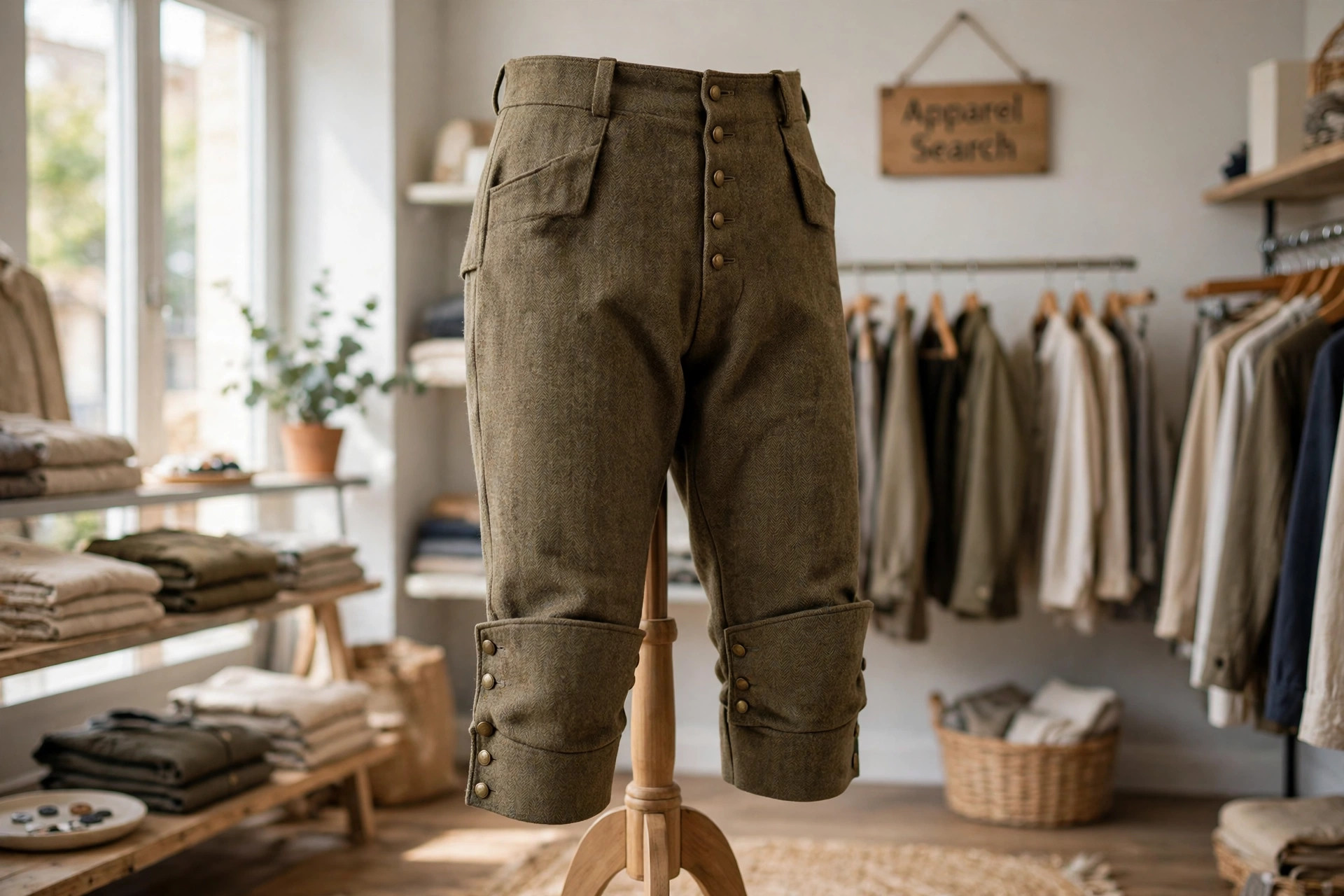
The Knee-Length Standard, 1550–1800
Breeches took over as the general English term for men's lower garments in the later 16th century, displacing hose — the fitted leg coverings that had gone before — and held the position for roughly 250 years. Through that long reign the silhouette moved with fashion. Mid-17th-century petticoat breeches were cut enormously full, gathered at the knee, and looked so much like a petticoat that contemporaries named them for the resemblance. By the 18th century the fashionable line had reversed completely: breeches were tailored close to the thigh, made in cloth, leather or knit, and finished with a neat knee band.
Construction details mark the period. The fall front — a panel or flap covering the front opening, buttoned up at each corner — was the standard fastening before fly fronts took over. At the knee, buttons, buckles and straps closed the band over the top of the stocking, and the lower leg below belonged to hose: silk stockings for dress wear, wool for everyday, gartered or drawn up over the breeches' knee. Servants in livery kept knee-breeches into the early 20th century, long after fashion had moved on — one reason the style still reads as formal and historical.

From Breeches to Trousers
Around the turn of the 19th century, long trousers — until then associated with working dress and sailors — became respectable, and breeches retreated to the places that kept older dress on principle: royal courts, formal livery, the hunting field and ceremonial uniforms. The exchange was total enough that the word itself changed meaning in ordinary speech: where a man of 1750 said breeches for his everyday lower garment, his grandson said trousers, and breeches narrowed to the historical and sporting senses it holds now.
The word's older breadth survives in phrases and in dialect. Breeches began in Old English as a word for an undergarment — drawers worn by both sexes — and words for such garments have always slid between underwear and outerwear, as underwear history shows repeatedly; the 18th- and 19th-century breech-cloth named the apron-like loincloths worn by some Native American peoples. The spelling britches records how the word is actually said, and in casual speech it can still mean trousers generally.
The change was about more than length. Breeches belonged to a dressed system — stockings, buckled shoes, a tailored coat — in which the knee was a designed junction, finished with a band and a buckle meant to be seen. Trousers dissolved that junction and put the visual weight at the ankle instead. That is why breeches in a portrait or a period drama instantly date the scene: for three centuries the fastened knee was as ordinary, and as carefully made, as a shirt cuff is today.
Riding Breeches: The Living Form
Riding kept breeches in daily use on purely practical grounds. A rider's lower leg works inside a tall boot, so cloth below the knee is wasted; what the saddle needs is a close-fitting thigh and knee that grip without bunching, reinforced where boot and stirrup leather rub. Traditional riding breeches answered with a fitted cut flared slightly at the hip for the seat, fastening at the knee, and modern versions keep the silhouette while changing the technology: four-way stretch fabrics, grip patches or full seats of suede-like material at the inner knee and seat, and hook-and-loop or zip closures at the ankle or calf.
Modern riding breeches also stretch the old definition in one respect — many now run to the ankle as a fitted legging-style garment (often sold as breeches or jodhpurs depending on length and cuff), while the true knee-length form remains standard in the hunting field and in traditional turnout. Either way, the recognisable formula is unchanged from the 18th century: shaped to the leg, finished at or below the knee, and worn into a tall boot. Few garments in the modern wardrobe can claim so direct a line of descent — or so little need to change.
Not to Be Confused With
Breeches end at the knee; trousers continue to the ankle — that single difference is what separated the two garments when trousers took over everyday dress around 1800. Knickers (knickerbockers) are also knee-length, but they are cut loose and gathered or banded below the knee, where tailored breeches of the 18th century were close-fitting; in British use knickers also names women's underwear, which breeches never does. Shorts end higher, above the knee, and belong to the 20th century.
Common Questions
What are breeches?
Trousers with separate coverings for each leg that end at or just below the knee, where they fasten with buttons, a buckle, a strap or ties. Knee-breeches were the standard men's lower garment from the late 16th century until the early 19th, worn with stockings below.
How were historical breeches worn?
With stockings covering the lower leg, a waistcoat and coat above, and shoes or boots below. Early styles could be full and gathered at the knee; by the 18th century the fashionable cut was close-fitting, often with a fall front — a buttoned flap — and a snug knee band.
Where are breeches still worn today?
For horseback riding, where the fitted knee-length leg works with tall boots and grips the saddle without spare fabric. Related forms survive in traditional and ceremonial dress, some uniforms and livery, and as plus-fours in golf and shooting dress.