Knickers
Clothing Definitions — definitions of garments and clothing terms from Apparel Search
In the English-speaking world, in particular the United Kingdom, Ireland and some Commonwealth countries, and occasionally in the United States, knickers is a word used to describe women's underpants. In American use the same word has also named a loose-fitting trouser gathered at the knee, worn for golf and other sports. This page explains both garments, why one word covers them, and how the underwear meaning developed from the earlier trouser meaning.
|
|
In the English speaking world, in particular United Kingdom, Ireland, some Commonwealth countries, and occasionally in United States, knickers is a word that is used to describe women's and occasionally (but quite rarely) men's underpants and undergarments, women's lingerie, and for sports pants sportswear. In the United States it more commonly used as a short form for Knickerbockers, a type of golfing pants, also called Plus fours.
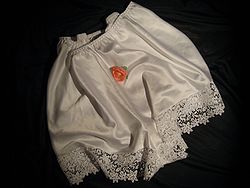
The word carries a naughty or playful connotation, which keeps it in use in the media. The word has entered the English language in many ways. The phrase 'Knickers to you' has evolved into a favourite way of telling someone that one doesn't care about them or their opinion. The phrase 'Don't get your Knickers in a twist' is in common usage, as a way of telling someone to 'calm down' and 'don't get angry'. The phrase 'Fur coat and no knickers' describes a woman who looks rich and glamorous, but is in fact not so classy. 'Oh Knickers' is a favourite expletive, which is used when something has gone wrong. French knickers describe a loose fitting boxer like underpants, which may be made of silk or satin, typically with a lace trim.
In older usage knickers referred to men's garments such as knickerbockers, also known as plus twos or plus fours in British English. The term knickerbockers has become historic in British English but is used in North America. The term "knickers" is still used to refer to knickerbockers in American English. However, the adoption of the term "knickers" to denote a women's undergarment in British English has caused the expression, along with "knickerbockers" to become historic.
George Cruikshank, whose illustrations are classic icons for Charles Dickens's works, also did the illustrations for Washington Irving's droll History of New York (published in 1809) when it was published in London. He showed the old-time Knickerbockers, Irving's fictitious Dutch colonial family, in their loose knee-length Dutch breeches. By 1859 relatively short loose ladies' undergarments, a kind of abbreviated version of pantalettes or pantaloons, were known as "knickers" in England, but this is often used as a general term for all women's underwear. There are now many names for women's undergarments that are sometimes called knickers, such as panties, thongs, g-strings, briefs, shorts, tangas and others.
You may also want to learn about French Knickers:French Knickers are a type of lingerie and are sometimes called "tap pants", i.e. tap-dancing pants. The term is predominantly used in the UK to describe a type of underwear worn from the hip. They cover the hip, most of the upper thigh and all of the buttocks, and are denominated by the 'open leg' style, or loose fitting leg. They do not have elasticated leg cuffs, but allow a pleated, more comfortable fit. The style may have straight cut leg cuffs with or without trimming, or the leg cuffs may be bias cut to a degree.
They are not to be confused with "hipsters' or "briefs", or "bikini bottoms" and "boyshorts", all of which feature elasticated leg openings and much snugger fit to the body.
The french knickers should only be worn with A-Line type skirts and free-flowing dresses, which require freedom of movement without the visible panty line (VPL), because the french knickers would give a smooth appearance underneath the fabric of the clothing aforementioned, therefore suitable for day wear or evening outfits for this reason.
History of French Knickers
French knickers may have been so called since they were mimicry of the 'visible' underwear associated with Parisienne dancing, notably the Can-Can. The French themselves do not use this term for this style. The English began to associate the term with naughty or risque activity due to the connection to Montmartre and Pigalle, but in reality these knickers evolved into their final form from bloomers, the baggy, shapeless long-legged underwear of the Victorian era. By the 1950s French knickers were almost the standard for British women and by the sixties this style was mass-produced in the 'new' nylon and other synthetic fabrics. A more practical design of French knickers had arrived, and proved very popular.
In the mid to late 1970s French Knickers, designed by Janet Reger and others, brought erotic and exotic style to lingerie. Of course major manufacturers through the 1980s to present day latched on to the trends.
Since the nineties, this style of lingerie has given ground in the marketplace to more aggressive styles for younger consumers. It becomes harder for major manufacturers to justify annual production, so they do not appear in shops at all often. They continue to hold the affection and attention of the generation who grew up with them, and as a result have transitioned back into the 'naughty' side of lingerie.
| The above article is licensed under the GNU Free Documentation License. From Wikipedia, the free encyclopedia (https://en.wikipedia.org/wiki/french_knickers). Modified by Apparel Search October 2, 2010 |
Learn more about undergarments.
Learn more about women's underwear.
Are you interested in comfortable underwear? Try the comfy undies website.
Other clothing definitions of interest:
Photos
Common Questions
What are knickers in British use?
In the United Kingdom, Ireland and some Commonwealth countries, knickers are women's underpants. The word is the everyday British term for the garment called panties in American English.
What are knickers in American use?
In the United States, knickers have also meant loose, full trousers gathered and banded just below the knee, worn historically for golf, cycling and other sports, and as part of boys' suits.
Where does the word knickers come from?
The word is shortened from knickerbockers, the Dutch-style knee breeches associated with New York's early Dutch settlers, from which both the knee trouser and, later, the undergarment took their name.
More to Explore
- United Kingdom
- Ireland
- United States
- undergarments
- lingerie
- sportswear
- French knickers
- pantalettes
- panties
- thongs
- g-strings
- briefs
- shorts
- boyshorts
- A-Line type skirts
- underwear
- bloomers
- Victorian era
- GNU Free Documentation License
- https://en.wikipedia.org/wiki/french_knickers
- women's underwear
- comfortable underwear
- Long Underwear
- Clothing Definition