Long Underwear
Clothing Definitions — definitions of garments and clothing terms from Apparel Search
Search Apparel Search
At a Glance
Definition: Long underwear is a two-piece underwear set with long sleeves and long legs, worn next to the skin in cold weather as an insulating base layer under other clothing.
Also known as: Long johns; thermal underwear
Category: Clothing Definitions
Long underwear usually refers to a style of two-piece underwear with long arms and long legs that is worn during cold weather. Also known as long johns or thermal underwear, it is worn today as the base layer under clothing for work, winter sports and outdoor activity. Modern long underwear is a comparatively recent innovation, largely supplanting the older one-piece union suit. This page explains how a base layer insulates, the fabrics and weights it is made in, and how the two-piece set differs from the union suit it replaced.
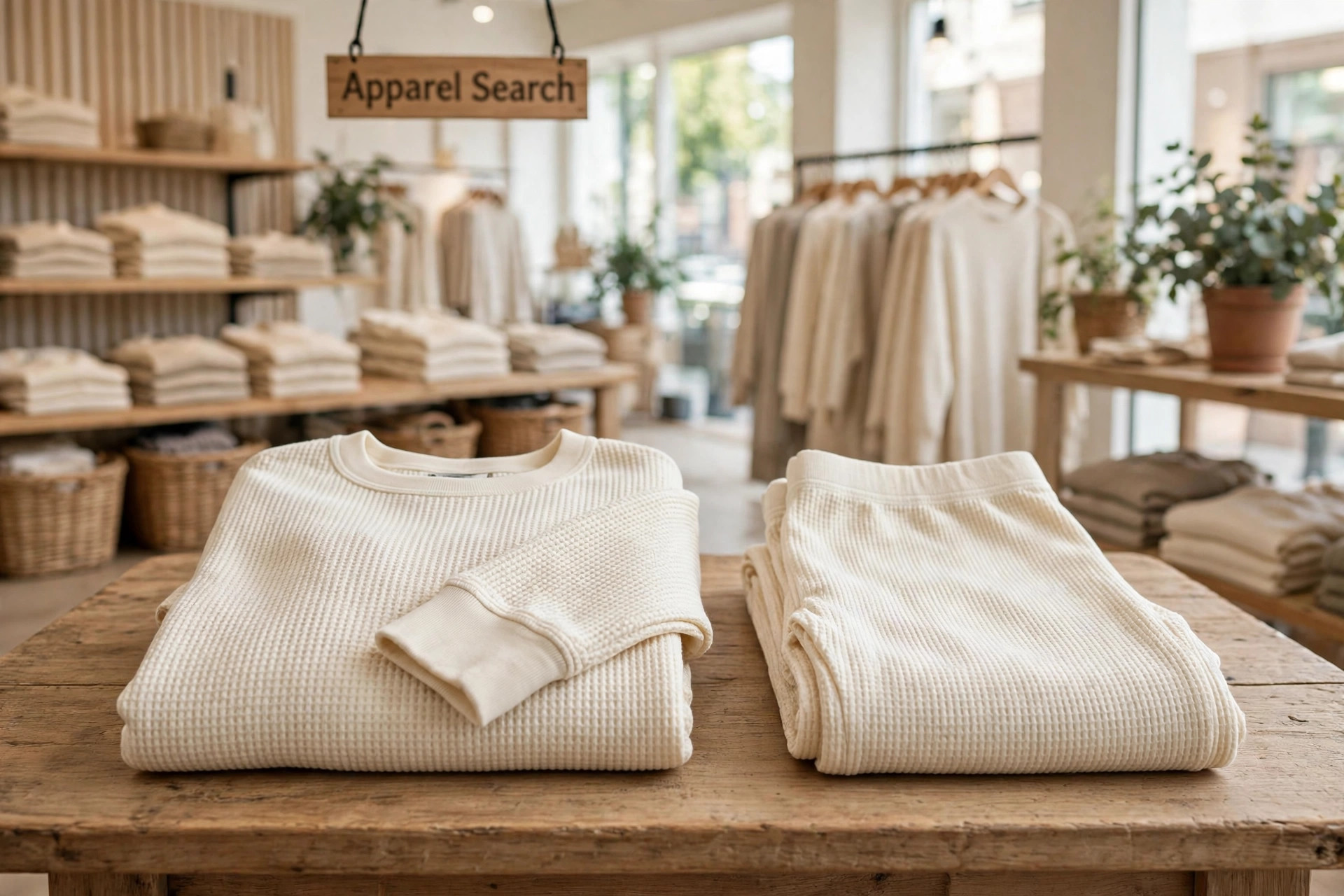
How a Base Layer Keeps Warmth In
Long underwear does not generate heat; it slows its loss. A close-fitting layer traps a thin film of warmed air against the skin, and the fabric's structure — especially the waffle or box-weave and rib knits used in thermal underwear, and the brushed or two-layer constructions of heavier sets — holds more still air in its pockets. Fit therefore matters: too loose, and movement pumps the warm air away; too tight, and the knit is stretched thin and the air layer with it.
Worn under mid-layers and a shell, the base layer is also the part of the clothing system that manages moisture, moving sweat away from the skin so it cannot chill the wearer when activity stops. That is why, among undergarments, long underwear is specified like equipment — by fibre and by weight — rather than simply by size.
Fabrics and Weights
Traditional long johns were made of cotton, wool, or cotton flannel, and cotton sets remain a budget choice for low-activity cold. Their weakness is moisture: cotton holds sweat and loses most of its insulation when wet. Merino wool and modern synthetics such as polyester do the insulating and wicking jobs best — wool insulates even when damp and resists odour, synthetics dry fastest — which is why they dominate ski, mountaineering and workwear ranges. Silk appears in lightweight luxury sets, valued for a smooth feel under tailored clothes.
Modern ranges grade sets by weight — lightweight, midweight and expedition — so a wearer can match the garment to temperature and exertion instead of owning one set for all winter. Either piece can be worn alone: the bottoms under trousers on a cold day, the top under a shirt or sweater. A dedicated example is the women's cotton long underwear in this guide's clothing pages, sold for everyday winter wear rather than sport.
From the Union Suit to Long Johns
The union suit, the one-piece ancestor, was standard nineteenth-century underwear in cold climates, buttoned up the front and fitted with a rear flap for practicality, and worn almost exclusively by men. Two-piece sets displaced it because they fit better under changing outer clothes, are easier to launder, and let either half be worn on its own. The name long johns is often linked to the boxer John L. Sullivan, who was said to have fought in similar garments, though the connection is folklore rather than record.
Long underwear is also distinct from its close-fitting neighbours. Tights cover the legs only and are hosiery, not an insulating layer; a leotard is a one-piece torso garment for dance and gymnastics; a unitard extends that one-piece form over the legs. Long underwear is defined by its job — warmth next to the skin — and by its two-piece, long-sleeved and long-legged cut. The Not to Be Confused With box below sets it against the union suit, its own one-piece form.
Choosing and Caring for Long Underwear
Choose by activity first: high-exertion cold calls for a lightweight wicking synthetic or merino set, while standing work outdoors in deep cold calls for midweight or expedition fabric, possibly over a light base. Check the waistbands and cuffs, whose elastic recovery keeps the close fit that makes the layer work, and prefer softer, non-itch fabrics for children and older wearers. For outdoor workers a spare dry set is the standard advice, since a dry base layer restores warmth faster than adding another outer coat.
Care is straightforward: wash synthetics and wool blends cool to protect elastic and fibres, avoid fabric softener on wicking synthetics, where it coats the fibres the moisture movement depends on, and dry flat or on low heat. Stored clean and dry through the summer, a good set keeps its fit — and therefore its warmth — for many winters.
Not to Be Confused With
The two are the same garment in two constructions. Long underwear (long johns) is a two-piece set: a long-sleeved top and separate long-legged bottoms, either of which can be worn alone. A union suit is the older one-piece form, covering torso and legs in a single garment, traditionally buttoned up the front with a rear access flap. The union suit is a form of long underwear, not a different garment — the two-piece set simply displaced it.
Common Questions
What is long underwear?
Long underwear is a style of two-piece underwear with long sleeves and long legs, worn next to the skin during cold weather as an insulating base layer. It is also known as long johns or thermal underwear.
What is the difference between long johns and a union suit?
Long johns are two separate pieces, a long-sleeved top and long-legged bottoms. A union suit is the older one-piece version covering the whole body, traditionally with a buttoned placket and a rear access flap.
What is long underwear made from?
Long underwear is made in cotton, wool (especially merino), silk and synthetic fibres such as polyester. Wool and synthetics insulate even when damp and are preferred for active use; cotton is inexpensive but loses warmth when wet.