Unitard
Clothing Definitions — definitions of garments and clothing terms from Apparel Search
A unitard is a skin-tight one-piece garment with long legs and sometimes long sleeves. It differs from a leotard in that a leotard does not have long legs. Unitards are worn by acrobats, gymnasts, dancers and circus performers, as well as others, and in costume use the same kind of one-piece stretch garment is usually referred to as a catsuit.
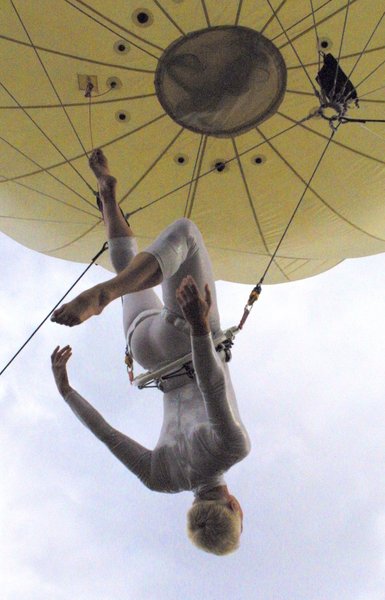 A unitard is a skin-tight one-piece garment with long legs and sometimes long sleeves. It differs from a leotard in that a leotard does not have long legs.
Unitards are worn by acrobats, gymnasts, dancers and circus performers, as well as others.
Unitards can also be worn as lingerie and are eroticised by some people, often as part of a wider spandex fetishism.
In erotic or costume use, they are usually referred to as catsuits.
| The above article is licensed under the GNU Free Documentation License. From Wikipedia, the free encyclopedia (https://en.wikipedia.org/wiki/unitard). 8/3/05 |
Built for Movement
The unitard solves a performer's problem: how to cover the body completely without giving fabric anything to catch, flap or ride up during movement. A one-piece stretch garment moves exactly with the body, so a gymnast's line stays clean, an acrobat's partner can grip without grabbing loose cloth, and a dancer can be costumed over the top — with a skirt, tunic or character pieces — while keeping a smooth, modest base layer underneath. Stretch knits with elastane do the work that once required careful cutting: the garment fits a range of bodies closely without restricting a split, a lift or a backbend.
Coverage choices follow the discipline. Sleeveless unitards with full legs suit warm studios and aerial work where bare arms aid grip; long-sleeved versions serve stage lighting, character costume and modesty requirements. Footed, stirrup and cropped-leg finishes each trade coverage against contact with the floor or apparatus.
Unitard, Leotard, Catsuit
The family names describe coverage, not different constructions. A leotard covers the torso and ends at the hip. Add full-length legs and it is a unitard. The same one-piece idea in costume and fashion contexts is usually called a catsuit, often in shinier or more decorative fabrics. Under all three names the engineering is the same: a single stretch garment, pulled on, that stays exactly where it is put — which is why the form keeps reappearing wherever bodies perform.
Care follows the fabric: stretch knits are washed cool and dried away from heat so the elastane keeps its recovery, and a unitard that has lost its snap no longer does the staying-put job it was bought for.
Common Questions
What is a unitard?
A unitard is a skin-tight one-piece garment with long legs and sometimes long sleeves. It is worn by acrobats, gymnasts, dancers and circus performers.
How does a unitard differ from a leotard?
The difference is the legs: a unitard has long legs, while a leotard does not. Both are skin-tight one-piece garments; the leotard ends at the hip like a swimsuit, the unitard covers the full leg.
What is a catsuit?
In costume use, a one-piece stretch garment of the unitard type is usually referred to as a catsuit. The terms overlap, with unitard the usual word in dance and gymnastics and catsuit the usual word in costume contexts.
More to Explore
- one-piece garment
- leotard
- lingerie
- spandex fetishism
- catsuits
- bodystocking
- swimsuit
- Leggings
- Ballerina Skirt
- Dancewear
- Dance Costumes
- Hosiery
- Pantyhose
- Skin-tight Clothing
- Garters
- Socks
- Underwear
- Clothing Definition
- Corset
- Stockings
- Tights
- GNU Free Documentation License
- https://en.wikipedia.org/wiki/unitard