One-Piece Garment
Clothing Definitions — definitions of garments and clothing terms from Apparel Search
Search Apparel Search
At a Glance
Definition: A one-piece garment is a garment that forms a complete outfit in a single piece, with no separate top and bottom, ranging from draped cloths such as the toga and sari to skin-tight stretch garments such as the leotard and wetsuit.
Category: Clothing Definitions
A one-piece garment is a garment that forms a complete outfit in one piece. One-piece garments may be worn as lingerie or as outerwear: some are skin-tight garments, others are loose garments, and many of the older ones are draped garments. This page explains what the single-piece construction means in practice, and how the loose, draped and skin-tight families differ.
Why One Piece Matters
Building an outfit as a single piece removes the waistline join, and that one fact drives most of the garment types on this page. With no gap between a top and a bottom, there is no waistband to snag, ride up or let in draughts, dirt or water. Protective and working dress therefore takes one-piece form again and again: the boiler suit and coverall protect street clothes and skin in one continuous layer, the flight suit gives aircrew a single garment with no loose junction, and the ski suit keeps snow out at the waist.
The same continuity serves in water and in movement. The wetsuit and the diveskin cover torso and limbs in one insulating skin, and in sport and dance the leotard and unitard leave nothing to come untucked, ride up or catch while the body is working. Wherever a two-piece outfit's join is a weakness, a draught, a snag point, a gap in protection, the one-piece form is the answer that recurs.
Loose One-Piece Garments: The Tailored Family
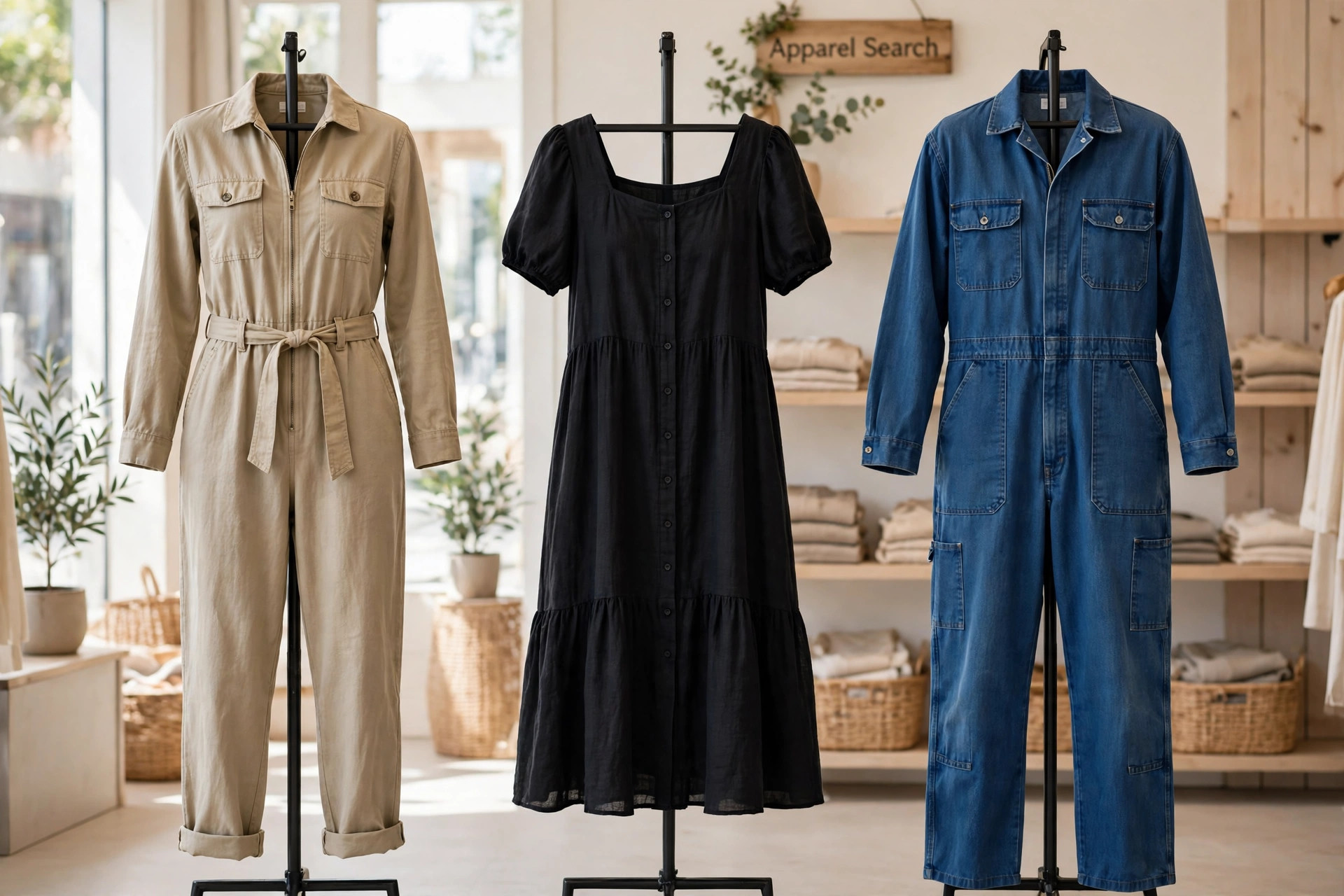
The tailored family is cut and sewn to a body shape and fastened with buttons, zips or ties. Its working members are the boiler suit and coverall described above and the jumpsuit, the tailored one-piece of a joined top and trousers that moves between workwear, utility dress and fashion. Its dress member is the dress itself, the standard one-piece of women's dress, and its smallest member is the romper suit, the short-legged one-piece made for babies and worn as summer dress by older wearers.
One-piece pyjamas belong to this family too, but as the exception in their own category, since the vast majority of pyjamas are two-piece sets. At the edge of the family sit the makeshift one-piece garments: a bath robe or dressing-gown, or even a towel, serves as a complete single covering when going to and from the shower, which is why robes are so often grouped with the tailored one-piece garments in practice.
Draped Garments: The Older Family
The draped family is older and simpler. Its members are lengths of cloth arranged on the body and held by folding, tucking, belting or pinning rather than by sewn seams: the toga of Rome, the sari of South Asia and the sarong of Southeast Asia and the Pacific. A draped garment has no fixed torso length and almost no sizing, because the wearer's own wrapping decides the fit each time it is put on.
The simplest draped form of all is the loincloth, a single length of cloth passed between the legs and held at the waist, which is also one of the oldest garments known. Between the draped and tailored families the difference is construction, not coverage: both can cover the whole body in one piece, but one is shaped by the cloth and the wearer's hands, the other by the cutter's pattern and the sewer's seams.
Skin-Tight Garments, Fit and Care
The skin-tight family is cut close to the body, usually in elastic knits, so the single piece stays smooth without belts or separate fastenings: the catsuit, the leotard, the unitard, the one-piece swimsuit and the wetsuit and diveskin. Stretch is what makes this family possible, because a close woven garment in one piece could hardly be put on at all.
Fit is judged differently on any one-piece garment, because the torso length is fixed by the pattern. A two-piece outfit forgives a long or short back by adjusting where the top ends and the trousers begin; a one-piece cannot, so torso length, the shoulder-to-hip measure, is the critical fitting point for jumpsuits, boiler suits, swimsuits and leotards. Loose woven one-piece garments allow for body length with a fuller cut or an elasticated or drawstring waist. Care follows the fabric rather than the form: a one-piece garment is washed as a single item, which is convenient, but a stain or repair takes the whole outfit out of use at once, one reason two-piece dress remains the everyday default and one-piece dress dominates where its continuity is the point, in protection, water, sport and ceremony.
Not to Be Confused With
The names inside this family are often used loosely. A one-piece garment is the whole class: any complete outfit made as a single piece. A jumpsuit is one member of it, a tailored one-piece with a joined top and long trousers. A romper is the short-legged member of the same tailored family, a one-piece with shorts-length legs, worn as summer dress and for babies and toddlers. Every jumpsuit and romper is a one-piece garment; not every one-piece garment, a toga or a wetsuit for example, is either.
Common Questions
What is a one-piece garment?
A one-piece garment forms a complete outfit in one piece, with no separate top and bottom to match or fasten together. One-piece garments may be worn as underwear or as outerwear, and they range from loose draped garments to skin-tight stretch garments.
What are examples of loose one-piece garments?
Loose one-piece garments include the boiler suit, dress, flight suit, jumpsuit, coverall, one-piece pyjamas, romper suit, sari, sarong, ski suit and toga. A bath robe, dressing-gown or towel serves as a makeshift one-piece garment going to and from the shower.
What are examples of skin-tight one-piece garments?
Skin-tight one-piece garments include the catsuit, diveskin, leotard, one-piece swimsuit, unitard and wetsuit. These are cut close to the body, usually in stretch fabrics, so the single piece stays smooth without belts or separate fastenings.