Leotard
Clothing Definitions — definitions of garments and clothing terms from Apparel Search
A leotard is a skin-tight one-piece garment that covers the torso and body but leaves the legs free, worn for dance, gymnastics, acrobatics and skating. It may be sleeveless or have short or long sleeves, and it is made of stretch fabric so the body's line stays visible while movement is unrestricted. The garment is named after the French acrobat Jules Leotard, who performed in such a garment in the 19th century. This page explains the leotard's construction, its uses across dance and sport, and its related garments.
| If you are really into dancing, you may also wish to review the available books about dance. |
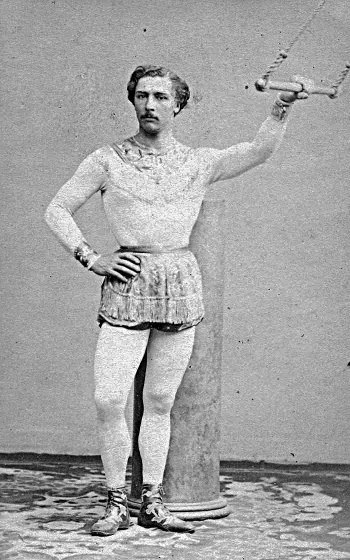 A leotard is a skin-tight one-piece garment that covers the torso and body but leaves the legs free. It was made famous by the French acrobatic performer Jules Léotard (1839-1870), about whom the song "The daring young man on the Flying Trapeze" was written.
The name "leotard" was applied retroactively; Léotard himself apparently called the garment a "maillot".
Leotards are worn by acrobats, gymnasts, dancers and circus performers both as practice garments and performance costumes. They are often worn together with tights.
Leotards are entered through the neck. (Constrast with bodysuits, which generally have snaps at the crotch, allowing the garment to be pulled on over the head.) Scoop-necked leotards have wide neck openings and are held in place by the elasticity of the garment. Others are crew-necked or turtle-necked and close at the back of the neck with a zipper or snaps.
There are sleeveless, short-sleeved and long-sleeved leotards. A variation is the unitard, which also covers the legs.
Leotards can also be worn as lingerie and are eroticized by some people, often as part of a wider spandex fetishism.
| The above article is licensed under the GNU Free Documentation License. From Wikipedia, the free encyclopedia ( https://en.wikipedia.org/wiki/leotard ). 8/3/05 |
Why Performers Wear a One-Piece Garment
A leotard solves three problems at once. First, nothing can come untucked: however far a dancer or gymnast bends, jumps or turns, the one-piece garment stays in place, where a separate top would ride out of shorts or a skirt. Second, the body's line stays visible to teachers, coaches and judges, whose corrections and scores depend on seeing the exact position of the torso, hips and shoulders. Third, the stretch fabric moves with the body without loose ends to catch on apparatus, partners or the floor. Those are the same reasons the garment, devised for a trapeze artist, spread to ballet studios, where it became the standard practice uniform, usually worn with tights and a skirt or shorts over it for class.
Construction is simple but exact. The body is cut from a four-way stretch knit, traditionally cotton with elastane and now often nylon or polyester blends that hold colour and resist chlorine or sweat. Leg openings are cut high, medium or low depending on the activity, and necklines range from the plain scoop of a class leotard to the decorated bodices of competition gymnastics, where sleeves, crystals and mesh panels are part of the presentation. Fit is close by design but should not restrict breathing or shoulder movement, which is why sizing follows torso length, the girth measurement, rather than dress size alone.
Common Questions
What is a leotard?
A leotard is a skin-tight one-piece garment that covers the torso and leaves the legs free, with or without sleeves. It is worn by dancers, gymnasts, acrobats, skaters and other athletes.
Who was the leotard named after?
The garment is named after Jules Leotard, the 19th-century French acrobat and inventor of the flying trapeze act, who performed in a close-fitting one-piece garment.
What is the difference between a leotard and a unitard?
A leotard covers the torso only, leaving the legs bare. A unitard covers the legs as well in the same one-piece stretch garment, and a bodysuit is the fashion counterpart, usually with a snap fastening.