Costume
Clothing Definitions — definitions of garments and clothing terms from Apparel Search
Search Apparel Search
At a Glance
Definition: Costume is dress in general, the characteristic style of dress of a people, class or period, or clothing worn to portray a character other than the wearer.
Also known as: Fancy dress (British usage, for party costume)
Category: Clothing Definitions
Word Origin
Costume comes through French costume from Italian costume, meaning custom or habitual practice, itself from Latin consuetudo, custom. The word travelled from “the customary way of dressing” to “the dress characteristic of a people or period” and then to dress worn to represent a character — a history that still shows in all three modern senses of the term.
Costume is one of the broadest words in the clothing vocabulary, and it carries three related meanings at once. In its widest sense it is simply wardrobe and dress in general. In its historical sense it is the distinctive style of dress of a particular people, class or period — the sense used when a museum labels a display “costume of the 1890s.” In its most familiar modern sense it is clothing worn to present the wearer as a character or type of character other than their everyday self, on stage, at a fancy dress party or for a seasonal celebration. This page works through all three senses, the work costume does in the theatre, and the place of costume in national identity and the festival calendar.
On This Page
The Three Senses of Costume
The general sense is the oldest in everyday use: a person’s costume can mean their whole outfit, and costume history is the standard name for the study of dress across periods and cultures. In that study the word does precise work, because the dress of a period is evidence — cut, cloth and ornament record wealth, trade, technology and belief in a way few other artefacts can. A history of costume is therefore also a history of the societies that wore it, which is why the term anchors so much of this definitions section, alongside the broader clothing terminology and the apparel definition.
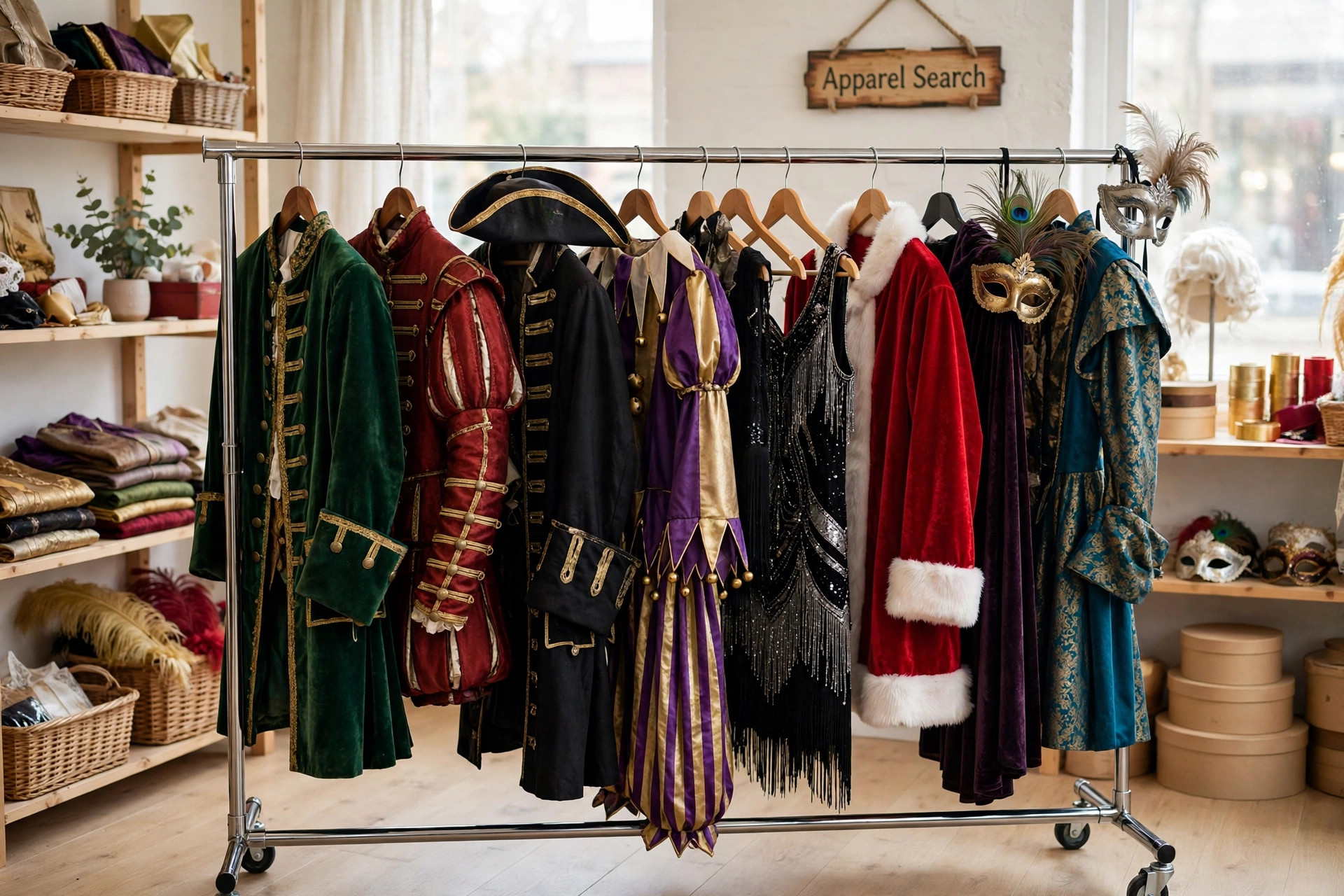
The character sense is the one most people meet first. Costume in this meaning is dress chosen to portray: a witch at Halloween, a soldier in a pageant, a bride in a folk festival, a superhero at a convention. The test is intention. Ordinary clothing presents the wearer as themselves; costume presents the wearer as someone or something else — a specific character, a type such as a pirate or a jester, or a figure from another time. That is also why costume can be assembled from perfectly ordinary garments: it is the portrayal, not the fabric, that makes it costume.
Costume in the Theatre
The theatrical sense is the most developed, because the stage makes demands no other setting does. In combination with lighting, set and the other elements of a production, costume tells the audience who a performer is before a word is spoken: age, gender role, profession, social class and personality can all be read from silhouette, colour, condition and detail at a distance, in poor light, in the first seconds of an entrance. The costume designer’s craft is to make that reading instant and accurate, which is a different discipline from dressing a person well.
Designers work two ways, sometimes in the same production. One approach is faithful reconstruction — researching what the character would actually have worn and reproducing it as closely as materials and budget allow. The other is deliberate stylisation, exaggerating one aspect of a character — bulk, shabbiness, grandeur, menace — so the trait reads clearly to the back row. Exaggeration in stage costume is not a failure of realism; it is a tool, used because the theatre rewards legibility over literal accuracy. Related performance dress is covered in our dance costumes definition, where the costume must also survive movement, lifts and quick changes.
Film extended the same craft to the camera. Screen costume must read in close-up as well as at distance, survive continuity across scenes shot weeks apart and out of order, and be built in multiples so a garment can be aged, damaged or destroyed on cue. The costume designer’s credit — and the awards that go with it — recognises what theatre designers always knew: in visual storytelling, costume is characterisation, and the audience believes the clothes before it believes the dialogue.
National Costume and Identity
National costume, or regional costume, is the distinctive traditional dress of a people or place. It is costume in the historical sense worn in the present: garments whose cut, embroidery, colour and accessories identify a valley, an island, a trade or a nation, kept in use for festivals, weddings, dance and ceremony long after everyday dress has converged on international styles. Because the garments announce belonging, national costume can express local identity with unusual force — including the identity of exiled or displaced communities, for whom wearing the dress of home is a public statement that the culture survives.
National costume also shows how the senses of the word overlap. To the community that owns it, the dress is heritage clothing, worn as oneself. On a stage, in a parade abroad or in a folk-dance performance, the same garments function as costume in the theatrical sense — a portrayal of a people for an audience. Neither use cancels the other; the garment carries both meanings at once, which is part of why traditional dress is guarded so carefully by the communities it represents.
Festival and Holiday Costume
Seasonal celebration is where costume reaches the widest public. Halloween costumes traditionally take the form of supernatural creatures — ghosts, vampires, witches and angels — together with the year’s film, television and comic characters; our guides to Halloween costume shopping and Halloween costumes cover the current ranges. Mardi Gras costume runs to jesters and other fantasy figures in the festival’s purple, green and gold, while Christmas and Easter costumes portray mythical holiday figures such as Santa Claus and the Easter Bunny, and national holidays bring out figures such as Uncle Sam for the Fourth of July. In every case the logic is the same as the stage’s: the costume announces the celebration and the wearer’s temporary character in it.
Household costume follows its own practical rules. Fit matters more than fidelity — a costume worn for an evening of walking, dancing or trick-or-treating must allow movement, sight and breathing, and children’s costumes in particular should be flame-resistant, visible in the dark and free of trip hazards; our dedicated guides cover women’s costumes, children’s costumes and men’s costumes in detail. Costumes are also worn for private celebration and play, including erotic dress-up, which most people regard as harmless fun between consenting adults. Whether the occasion is a stage, a street festival or a party, the costume succeeds when the portrayal is clear and the wearer can still enjoy the event inside it.
Costume Versus Clothing
The working distinction designers draw is that clothing is what a person wears as themselves, while costume is dress that presents a character, a period or an identity other than the wearer’s everyday one. The same physical garment can cross the line in both directions. A genuine historical dress in a museum case is clothing preserved; worn by an interpreter at a historic site, it becomes costume; copied for a stage production, it is costume by design from the first stitch. Conversely, a theatrical costume retired to a wardrobe rail and worn as ordinary vintage dress has crossed back into clothing.
That is why costume is best defined by purpose rather than by any feature of cut or cloth. Ask what the dress is doing: if it is presenting the wearer as themselves, it is clothing; if it is presenting a character, a period, a people or a celebration, it is costume. The full survey of the category begins at our Clothing Definitions hub.
Not to Be Confused With
A uniform identifies the wearer’s real role — it tells the world what the wearer actually is, and it is prescribed by the organisation the wearer belongs to. A costume does the opposite: it presents a character, period or identity other than the wearer’s own, and it is chosen for an occasion, a performance or a celebration. The same coat can be either — worn on duty it is uniform; worn to a party to play the part, it is costume.
Common Questions
What does costume mean?
Costume has three related meanings: wardrobe and dress in general; the distinctive style of dress of a particular people, class or period; and clothing worn to portray a character or type of character other than the wearer's regular persona, in the theatre or at an event such as a fancy dress party.
What do theatrical costumes do?
Theatrical costumes help portray the performers' age, gender role, profession, social class and personality. Sometimes they mimic what the designer thinks the character would actually wear; often stylised costumes exaggerate some aspect of a character so it reads clearly to the audience.
What is national costume?
National costume, or regional costume, is the distinctive traditional dress of a people or place. It can express local — or exiled — identity and emphasise uniqueness, and it is kept in use for festivals, weddings, dance and ceremony.