Corset
Clothing Definitions — definitions of garments and clothing terms from Apparel Search
Search Apparel Search
At a Glance
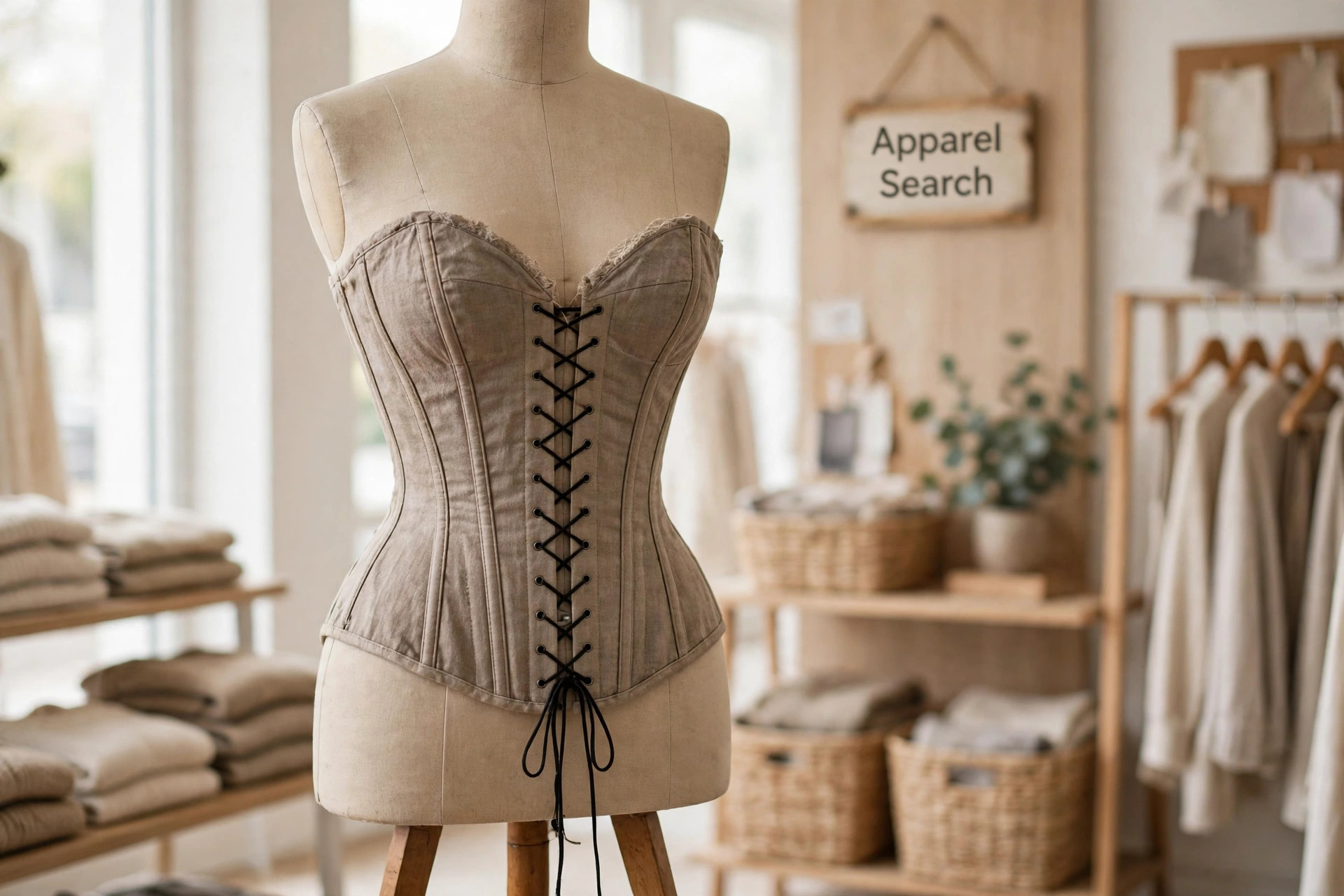
Definition: A corset is a close-fitting undergarment that encloses the torso from under the arms to the hips, stiffened with boning and tightened by lacing to mould the body to a desired shape.
Also known as: stays (historical name)
Pronunciation: KOR-sit
Category: Clothing Definitions
Word Origin
Corset is the Old French diminutive of cors, the body — from Latin corpus. A corset is, by its name, a little body: a second, shaped body worn over the real one. Its older English name, stays, names the boning that does the work.
A corset is a garment worn to mould the torso into a desired shape, for aesthetic or orthopaedic purposes — either for the duration of wearing it, or, with sustained wear, with a more lasting effect. Both men and women have worn and still wear corsets. The garment encloses the torso, usually extending from under the arms to the hips, and its shaping power comes from its construction: a flexible shell stiffened with boning and drawn in by lacing. This page explains how a corset is built and laced, how it differs from a waist cincher, a bustier and a bodice, and how a garment once treated as everyday underwear became costume, fashion statement and specialist equipment.
On This Page
How a Corset Is Built: Boning, Busk and Lacing
A corset is typically constructed of a flexible material such as cloth or leather, stiffened with boning — also called ribs or stays — inserted into channels sewn in the cloth or leather. The bone entry covers that stiffening in detail: in the Victorian period steel and whalebone were favoured, plastic is now the most commonly used material, and steel is preferred for high-quality corsets, with ivory, wood and cane among the historical alternatives. At the front, most corsets close with a busk, a two-part steel fastening that lets the wearer put on and remove a corset that is already laced to size.
The shaping itself is done by lacing, usually at the back. Tightening or loosening the lacing produces corresponding changes in the firmness of the corset and the size of the waist it creates. It is difficult, although not impossible, for a wearer of a back-laced corset to do their own lacing: in the Victorian heyday a well-to-do woman would be laced by her maid and a gentleman by his valet, women who could not afford servants might be helped by a sister or husband or might wear a front-lacing corset, and present-day wearers are usually laced by spouses and partners. A shorter kind of corset, covering only the waist area from below the ribs to just above the hips, is called a waist cincher. Some corsets extend over the hips and, in very rare instances, reach the knees, and a corset may include garters to hold up stockings, although a separate garter belt may be worn for that purpose instead.
What goes under the corset matters as much as the corset. In the past, a woman's corset was usually worn over a chemise or shift, a sleeveless, low-necked garment made of washable material, usually cotton or linen. It absorbed perspiration and kept both the corset and the gown clean — important, because a boned corset cannot simply be thrown in the wash. In modern times an undershirt or corset liner serves the same purpose.

Shaping the Silhouette, Then and Now
The most common use of corsets across their history is to slim the body and make it conform to the fashionable silhouette of the time. For women this has most frequently meant emphasising a curvy figure by reducing the waist and thereby exaggerating the bust and hips. In some periods, however, corsets have been worn to achieve the opposite — a tubular, straight-up-and-down shape, which involves minimising the bust and hips. For men, corsets are more customarily used to slim the figure, although from around 1820 to 1835 an hourglass figure, a small nipped-in waist, was also desirable for men and was sometimes achieved by wearing a corset.
By wearing a tightly laced corset for extended periods — a practice known as tightlacing — wearers can learn to tolerate extreme waist constriction and reduce their natural waist size. Tightlacers usually aim for waists of 40 to 43 cm (16 to 17 inches), and the record books list two women who reduced to 13-inch waists, Ethel Granger and Cathie Jung, with others such as Polaire claiming similar reductions. These are extreme cases, and they should be read as such: corsets were and are usually designed for support, with freedom of body movement an important consideration, and present-day wearers usually tighten only enough to reduce the waist to somewhere between 18 and 24 inches. Anyone considering sustained tightlacing should treat it as the specialist, gradual practice it is, and a properly fitted corset should be comfortable — a badly fitting one can chafe, impede digestion and even pinch nerves.
The comfort question has a longer history than the caricature suggests. Moderate lacing is not incompatible with vigorous activity: during the second half of the nineteenth century, when corset wearing was common, there were sport corsets specifically designed for bicycling, playing tennis and horseback riding, as well as corsets for maternity wear. Victorian writers on sensible or hygienic dress very rarely condemned corsets outright; they protested against the misuse of corsets for tightlacing and recommended sensible styles instead. Modern wearers in historical reenactment and living-history groups commonly wear corsets as part of period costume without complaint, and some wearers with back problems, and some large-breasted women who find the weight of the breasts better carried by a whole corset than by a brassiere's shoulder straps, choose corsets for support — one reason the garment's older name, stays, described support rather than squeezing.
Decline, Revivals and the Modern Corset
The corset fell from fashion in the 1920s in Europe and America, replaced as everyday shaping by girdles and elastic brassieres, but it survived as an article of costume. Originally an item of lingerie, it also became a popular item of outerwear in fetish and goth subcultures. There was a brief revival in the late 1940s and early 1950s in the form of the waist cincher, used to give the hourglass figure dictated by Christian Dior's New Look; the revival stayed largely within haute couture, most women continued to use girdles, and it faded as the New Look gave way to a less dramatically shaped silhouette.
Since the late 1980s the corset has experienced periodic revivals, usually originating in haute couture and occasionally reaching mainstream fashion, and these revivals focus on the corset as an item of outerwear rather than underwear. The strongest came in the autumn 2001 collections, coinciding with the film Moulin Rouge!, whose costumes featured many corsets. A caution applies to every revival: the majority of garments sold as corsets in fashion seasons cannot really be counted as corsets at all. They often feature lacing and boning and mimic a historical style, but they have very little effect on the shape of the wearer's body — they are corset-styled tops, closer to the bustier than to the structured garment this page defines.
The genuine article survives in specialist hands. The best corsets are custom-made, because the more closely a garment clings to the body, the more carefully it must be fitted to look and feel right — and in modern times, when labour costs much more than materials, custom clothing of this kind can be extremely expensive, and even finding a competent corsetière can be difficult. That economics, more than any argument about comfort, is why the true corset moved from every woman's wardrobe to the ateliers, the reenactment field and the specialist shop.
Not to Be Confused With
A bustier is a short, lightly boned top that shapes mainly the bust and ends at or above the waist; a corset runs from under the arms to the hips and is laced to shape the waist itself. A bodice — see the bodice definition — is simply the upper part of a dress, which may be corset-laced as a style detail without doing a corset's shaping work. If the garment's job is waist reduction by lacing, it is a corset, whatever the label says.
Common Questions
What is a corset?
A corset is a garment that molds the torso into a desired shape for aesthetic or orthopaedic purposes. It encloses the torso from under the arms to the hips, is made of cloth or leather stiffened with boning set into channels, and is tightened by lacing, usually at the back.
What is corset boning made from?
In the Victorian period steel and whalebone were favored for boning. Plastic is now the most commonly used material, while steel is preferred for high-quality corsets; ivory, wood and cane have also been used.
What is a waist cincher, and what is worn under a corset?
A waist cincher is a shorter kind of corset covering only the waist area, from below the ribs to just above the hips. In the past a corset was usually worn over a chemise or shift — a washable cotton or linen undergarment that absorbed perspiration and kept the corset and gown clean; a corset liner serves the same purpose today.