Fashion in the 1850s
Fashion Definitions — fashion history, brands and industry terms from Apparel Search
Fashion in the 1850s in European and European-influenced clothing is characterized by an increase in the width of women's skirts supported by crinolines or hoops, and the beginnings of dress reform. In the 1850s the domed skirts of the 1840s continued to expand, made fuller by flounces stiffened with horsehair braid.
1850s fashion in European and European-influenced clothing is characterized by an increase in the width of women's skirts supported by crinolines or hoops, and the beginnings of dress reform.
Women's Fashion
In the 1850s, the domed skirts of the 1840s continued to expand. Skirts were made fuller by means of flounces (deep ruffles), usually in tiers of three, gathered tightly at the top and stiffened with horsehair braid at the bottom.
Early in the decade, bodices of day dresses featured panels over the shoulders that were gathered into a blunt point at the slightly dropped waist. These bodices generally fastened in back by means of hooks and eyes, but a new fashion for a jacket bodice appeared as well, buttoned in front and worn over a chemisette. Wider bell-shaped or pagoda sleeves were worn over falso undersleeves or engageantes of cotton or linen.
Evening dresses were very low-necked, falling off the shoulders, and had short sleeves.
The introduction of the steel cage crinoline in 1856 provided a means for expanding the skirt still further, and flounces gradually disappeared in favor of a skirt lying more smoothly over the petticoat and hoops. Pantalettes were essential under this new fashion for modesty's sake.
Outerwear
Coats were impractical over the very wide skirts, and the fashionable outer garment was an Indian shawl or one woven in Paisley, Renfrewshire in a paisley pattern in imitation of Indian styles. Hooded cloaks were also worn.
Hairstyles and headgear
Hair was dressed simply, in a chignon with the sides puffed out over the ears or with clusters of curls to either side in imitation of early 17th century fashions. Deep bonnets were worn outdoors.
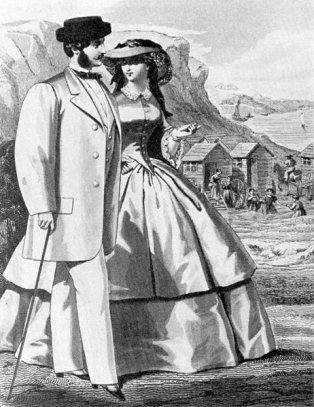
1859 fashion plate from the "Gazette of Fashion", showing both male and female daywear, with sea bathing scene in the background (including bathing machines). Scanned by H. Churchyard
The above article is licensed under the GNU Free Documentation License. From Wikipedia, the free encyclopedia https://en.wikipedia.org/wiki/1850s_in_fashion 1/13/06
Designer Definition (from U.S Department of Labor)
Learn about another era in fashion:
1980's Fashion History / 1980's Fashion Term (terms section)
Width Built from Layers, Then from Steel
At the start of the decade, width was achieved the laborious way. The domed skirt inherited from the 1840s was made fuller with flounces — deep ruffles usually in tiers of three, gathered tightly at the top and stiffened with horsehair braid at the bottom — worn over layered petticoats. The effect was magnificent and heavy, and it set the problem the decade would solve. The steel cage crinoline of 1856 replaced much of that weight with a light framework of hoops: the skirt could expand further while asking far less of the wearer's hips and legs, and its surface could settle smooth instead of breaking into tiers. Flounces faded because they were no longer needed to fake fullness. The cage did not make dress modest or practical by modern standards — pantalettes remained essential underneath, since a hoop can tilt — but it changed the engineering of fashion and made the great bell skirt of the late 1850s and 1860s possible.
Printed to Fit the Dress
Fabric design adapted ingeniously to the flounced skirt. Special dress fabrics were printed a la disposition, with a small figured print over most of the cloth and an elaborate coordinating border print down one selvage. The dressmaker cut the fabric so the border decorated the flounces and parts of the bodice or sleeves, meaning the pattern was designed for the garment's construction rather than simply repeated across it. Borders landed exactly where the eye was meant to go: at the hem of each tier and at the edges of sleeves and bodice. It is a useful reminder that the wide skirt was not only a silhouette but a canvas, planned at the printing stage.
The First Stirrings of Dress Reform
Alongside expansion, the decade saw the beginnings of dress reform — criticism of fashionable dress for its weight, restriction and impracticality, and early attempts at alternatives. Reform made little immediate dent in the fashionable silhouette, which grew wider after 1856, not narrower. Its importance in the 1850s is as an argument that would keep returning: that women's clothing should answer to health and movement, not only to display. Hair and headwear, by contrast, stayed comparatively simple: hair in a chignon with sides puffed over the ears or in clusters of curls, and deep bonnets outdoors, framing the face above the wide dress below.
Above the wide skirt, dress was carefully zoned by time of day and degree of formality. A new fashion for a jacket bodice, buttoned in front and worn over a chemisette, offered a neater, more tailored daytime alternative to bodices that fastened in back with hooks and eyes. Day bodices covered the shoulders and arms fully, even as their pagoda sleeves opened wide over linen engageantes, while evening dress did the opposite: a very low neckline falling off the shoulders and short sleeves exposed what day dress concealed. That contrast was systematic, not incidental. A fashionable wardrobe in the 1850s was a set of calibrated variations — covered and uncovered, jacketed and low-necked — all arranged over the same expanding foundation of flounce, petticoat and, after 1856, the steel cage that held the whole structure out.
Common Questions
What changed with the steel cage crinoline in 1856?
The steel cage crinoline introduced in 1856 provided a means for expanding the skirt still further without endless layers of petticoats. As it spread, flounces gradually disappeared in favour of a skirt lying more smoothly over the petticoat and hoops, and pantalettes were essential under the new fashion for modesty.
What were pagoda sleeves and engageantes in the 1850s?
Wider bell-shaped or pagoda sleeves were worn over false undersleeves, called engageantes, of cotton or linen. Day bodices early in the decade featured panels over the shoulders gathered into a blunt point at the slightly dropped waist, while evening dresses were very low-necked, off the shoulders, with short sleeves.
What outerwear was worn over wide 1850s skirts?
Coats were impractical over very wide skirts, so the fashionable outer garment was an Indian shawl or one woven in Paisley, Renfrewshire, in a paisley pattern in imitation of Indian styles. Hooded cloaks were also worn, since both could fall over the skirt without needing to fit around it.
More to Explore
- clothing
- skirts
- crinolines
- hoops
- dress reform
- flounces
- jacket
- buttoned
- chemisette
- engageantes
- petticoat
- Pantalettes
- fabrics
- selvage
- bodice
- sleeves
- Coats
- shawl
- paisley pattern
- cloaks
- bonnets
- GNU Free Documentation License
- https://en.wikipedia.org/wiki/1850s_in_fashion
- Designer Definition
- Fashion Accessories
- Style
- Catwalk
- Designer Definition Guide
- Clothing Brand Names
- 1550-1600 Fashion History
- 1600-1650 Fashion History
- 1700-1750 Fashion History
- 1750-1795 Fashion History
- 1820' Fashion History
- 1830's-1840's Fashion History
- 1860's Fashion History
- 1870's Fashion History
- 1890's Fashion History
- 1920's Fashion History
- 1930's Fashion History
- 1940's Fashion History
- 1950's Fashion History
- 1960's Fashion History
- 1970's Fashion History
- 1980's Fashion History
- 1980's Fashion Term
- 1990's Fashion History
- 2000's Fashion History
- Artistic Dress Movement
- Victorian Fashion
- History of Western Fashion
- Elizabethan Fashion
- Edwardian Fashion History