Engageante
Miscellaneous Definitions — accessories, trims, tools and general fashion terms from Apparel Search
Engageantes are false sleeves worn with women's clothing in the 18th and 19th centuries. In the 18th century, engageantes took the form of ruffles or flounces of linen, cotton, or lace, tacked to the elbow-length sleeves then fashionable. In the mid-19th century, the term was used for separate false sleeves, usually with fullness gathered tight at the wrist, worn under the open bell-shaped pagoda sleeves of day dresses.
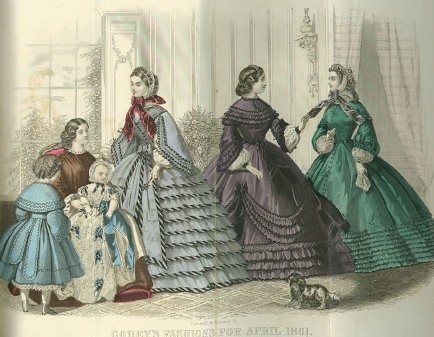 Engageantes are false
sleeves worn with women's
clothing in the 18th and
19th centuries.
In the 18th century, engageantes took the form of ruffles or flounces of linen, cotton, or lace, tacked to the elbow-length sleeves then fashionable.
In the mid-19th century, the term engageante was used for separate false sleeves, usually with fullness gathered tight at the wrist, worn under the open bell-shaped "pagoda" sleeves of day dresses. This fashion reappeared briefly just after the turn of the 20th century.
| The above article is licensed under the GNU Free Documentation License. From Wikipedia, the free encyclopedia (https://en.wikipedia.org/wiki/engageante). 1/15/06 |
False Sleeves: A Finish That Is Not Part of the Dress
An engageante is a sleeve that is not really a sleeve. Engageantes are false sleeves worn with women's clothing in the 18th and 19th centuries: separate pieces, made to be attached for wearing and detached afterward, which supply the visible lower portion of a sleeve while the dress itself ends higher on the arm. The idea served several practical purposes at once. The part of a sleeve nearest the hand is the part that soils first, catches on table edges and dips toward food and ink, and it is also the part most likely to be made of fine, delicate, expensive material such as lace. Making that part separate meant it could be removed and laundered frequently without washing the whole dress, replaced when it wore out without remaking the garment, and moved between dresses, so one fine pair of engageantes could finish several outfits in turn.
In the 18th century, engageantes took the form of ruffles or flounces of linen, cotton or lace, tacked to the elbow-length sleeves then fashionable. The dress sleeve stopped at the elbow, and below it fell the engageante: tiered, soft frills of white or fine fabric that moved with the forearm and framed the hand. Tacking, a few loose stitches rather than a permanent seam, is the telling construction detail, because it made attachment and removal a matter of minutes with a needle. The effect was deliberate display as well as practicality. Lace at the wrist was costly and visible in every gesture, and a deep fall of it signaled the quality of the wearer's wardrobe precisely where onlookers could inspect it most closely, at the hands. Engageantes in this form belong with the period's wider system of detachable fine linen: cuffs, neck pieces and sleeve finishes in washable white set against dress fabrics that were rarely washed at all.
Pagoda Sleeves and the Mid-19th Century Form
Fashion changed the sleeve, and the engageante changed with it. In the mid-19th century, the term engageante was used for separate false sleeves, usually with fullness gathered tight at the wrist, worn under the open bell-shaped pagoda sleeves of day dresses. The pagoda sleeve flared wide and ended open partway down the arm, which left a gap that modesty and finish both required to be filled: a bare forearm emerging from a wide silk sleeve was neither warm nor considered complete. The engageante answered by providing a soft white undersleeve, full through the arm and gathered tight at the wrist, so the pagoda's bell showed its colored silk outside while the engageante's white fullness filled the opening and finished at the hand. The pairing is a small lesson in how period garments were assembled from cooperating parts rather than built as single pieces.
This fashion reappeared briefly just after the turn of the 20th century, when revival styles again wanted a soft, detachable finish at the wrist, and then the engageante faded as sleeves simplified and dresses became single, washable constructions. Its interest today is in what it reveals about historical dressmaking economy. A wardrobe built on detachable parts stretches fine materials further: lace is bought once and worn many ways, laundering is concentrated on the small white pieces that need it, and a dress is updated by changing its finishes rather than its body. Engageantes connect directly to the sleeve, shirt and blouse vocabulary of the period, and to related detachable trims such as flounces, since an 18th-century engageante was itself made of ruffles or flounces of linen, cotton or lace, a false sleeve built from the same gathered strips used to trim a skirt or a neckline.
Common Questions
What are engageantes?
Engageantes are false sleeves worn with women's clothing in the 18th and 19th centuries. They were detachable sleeve finishes rather than part of the dress itself, so they could be removed, laundered and transferred between dresses.
What form did engageantes take in the 18th century?
In the 18th century, engageantes took the form of ruffles or flounces of linen, cotton or lace, tacked to the elbow-length sleeves then fashionable. They showed below the dress sleeve as tiers of fine, light fabric at the forearm.
How were engageantes worn in the mid-19th century?
In the mid-19th century the term engageante was used for separate false sleeves, usually with fullness gathered tight at the wrist. They were worn under the open bell-shaped pagoda sleeves of day dresses, filling the wide sleeve opening with a soft white undersleeve.