Chemisette
Clothing Definitions — definitions of garments and clothing terms from Apparel Search
A chemisette, from the French for little chemise, is an article of women's clothing worn to fill in the front and neckline of any garment. Chemisettes give the appearance of a blouse or shirt worn under the outer garment without adding bulk at the waist or upper arm. Chemisettes of linen or cotton were often worn with day dresses in the mid-19th century and could be decorated with tucks, embroidery — especially whitework — or lace; when wide pagoda sleeves were fashionable in the 1860s, chemisettes might have matching engageantes, false undersleeves. This page explains the garment and its use.
A Chemisette (from French, "little chemise") is an article of women's clothing worn to fill in the front and neckline of any garment. Chemisettes give the appearance of a blouse or shirt worn under the outer garment without adding bulk at the waist or upper arm.
Chemisettes of linen or cotton were often worn with day dresses in the mid-19th century, and could be decorated with tucks, embroidery (especially whitework), or lace.
When wide pagoda sleeves were fashionable (1860s), chemisettes might have matching engageantes (false undersleeves).
See also
Godey's Lady's Book (links to online editions)
| The above article is licensed under the GNU Free Documentation License. From Wikipedia, the free encyclopedia https://en.wikipedia.org/wiki/chemisette Definition Modified by Apparel Search 1/22/06 |
Designer Definition (from U.S Department of Labor)
Photos
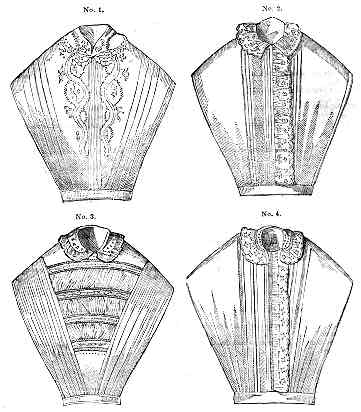
Whitework and the Washable Trim
The chemisette belonged to the same economy of dress as the chemise: white linen and cotton pieces at the neck and wrist took the soil of wear and could be washed, bleached and starched fresh, while the silk or wool dress they trimmed was cleaned rarely. That practical role made the chemisette a canvas for whitework — embroidery in white thread on white ground, with tucks, drawn-thread work and lace edging — the standard demonstration of a needlewoman's skill in the period.
Detachable collars and cuffs, the chemisette's direct descendants, stayed in wardrobes well into the 20th century, and modern dickeys and modesty panels do the same job. The chemisette is the fullest form of the idea: not just a collar but a complete false front, giving one dress several necklines depending on which chemisette was pinned inside it.
Surviving chemisettes in museum collections show the range of the form, from plain tucked cotton fronts worn every day to elaborately embroidered pieces for best dresses. Because they were small, washable and personal, chemisettes were common subjects for home needlework and for the pattern pages of magazines such as Godey's Lady's Book, which published designs for making them through the 1850s and 1860s.
Common Questions
What is a chemisette?
A chemisette is a small garment — essentially a front, collar and partial bodice — worn inside the neckline of a dress to fill it in. It gives the look of a blouse or shirt underneath while adding no bulk at the waist or arms, and the name is French for little chemise.
When were chemisettes worn?
Chemisettes were a standard part of women's dress in the mid-19th century, worn with day dresses whose necklines were cut low or open. They provided modesty and a fresh white finish at the throat, and could be changed and laundered far more easily than the dress itself.
What are engageantes?
Engageantes are false undersleeves: detachable white cuffs of lace or embroidered cotton worn at the wrist under wide pagoda sleeves in the 1860s. They were often made to match the chemisette at the neckline so the white work at throat and wrist formed a set.
More to Explore
- chemise
- clothing
- blouse
- shirt
- linen
- cotton
- dresses
- embroidery
- lace
- 1860s
- 1850s in fashion
- Trim (sewing)
- Victorian fashion
- GNU Free Documentation License
- https://en.wikipedia.org/wiki/chemisette
- Fashion Accessories
- Victorian Dress Reform
- Designer Definition
- Casual Fashions
- Fashion Accessories
- Style
- Catwalk
- Fashion Design
- Apparel Definition