Victorian Fashion
Fashion Definitions — fashion history and style definitions from Apparel Search
Search Apparel Search
At a Glance
Definition: Victorian fashion is the fashion in clothing of the Victorian era, the reign of Queen Victoria from 1837 to 1901 — strictly a term for the United Kingdom and its colonies, though often used loosely for Western fashions of the period.
Category: Fashion Definitions
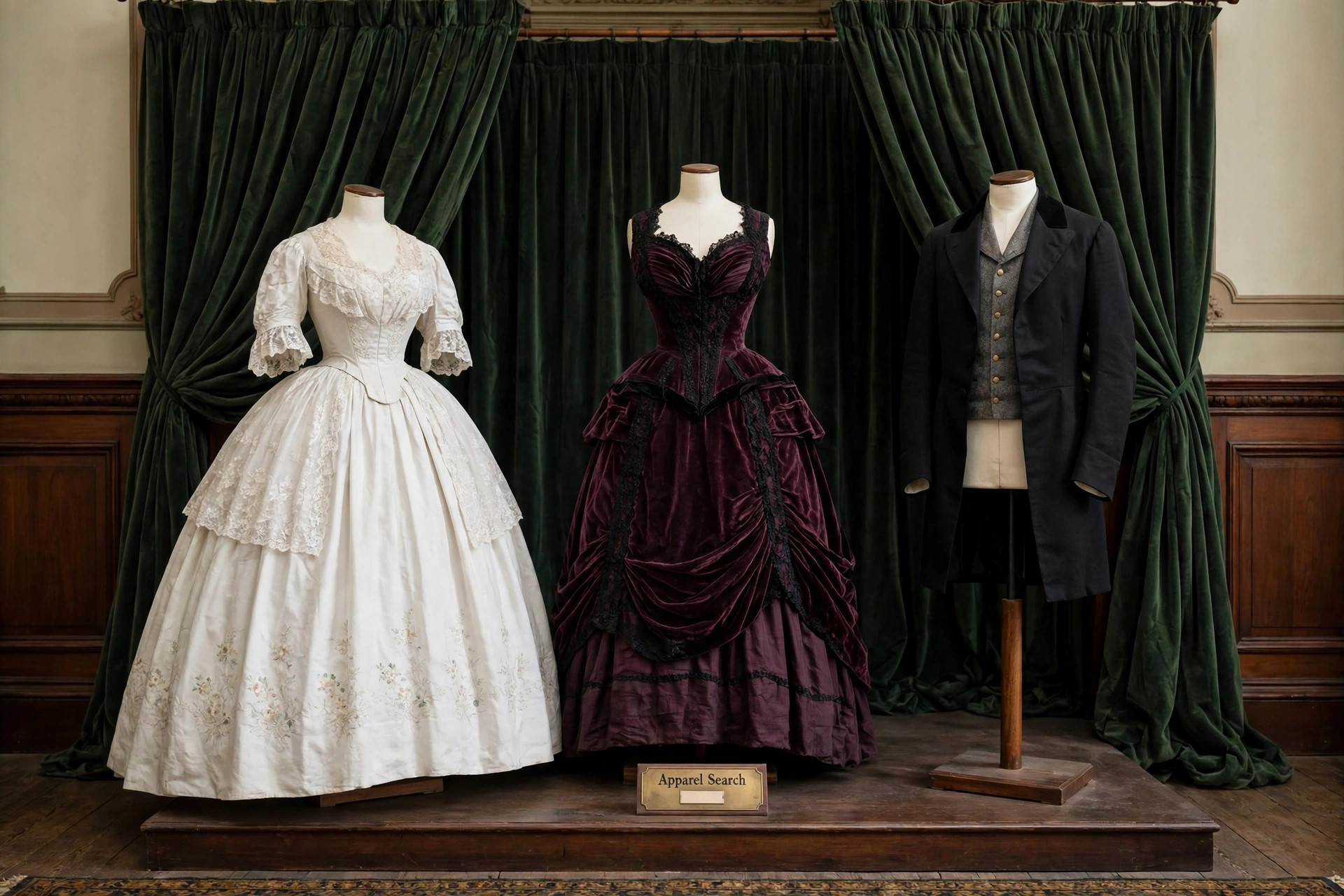
Victorian fashion refers to fashion in clothing in the Victorian era, the reign of Queen Victoria from 1837 to 1901. The term is strictly used only with regard to the United Kingdom and its colonies, but is often used loosely for Western fashions of the period. Women's fashionable clothing started with a straight Regency silhouette, bloomed into exaggerated skirts and sleeves, moved to small shoulders and even wider skirts supported by crinolines and hoops, and narrowed by way of the bustle to hobble skirts. Against the period's elaboration stood its internal opposition — Artistic dress on grounds of beauty, and dress reform and rational dress on grounds of health.
On This Page
Using the Term Carefully
Those who have studied the period in detail protest against vacuous generalisations, and with reason: clothing, decor, manners and morals varied from year to year, country to country and class to class, and whether there is a style or unified culture connecting a Scottish fisherwoman, for example, and an aristocratic London lady might well be debated. The term may also be used for a supposedly unified style in clothing, home decor, manners and morals said to be prevalent in the West during this period — which is exactly the usage that needs care.
Used carefully, however, the term can be restricted to the dress — or, in a wider sense, the culture — of an upper-middle-class London family of fashion and conventional attitudes, described as it varied from decade to decade. The decade surveys carry that detail: 1830s–1840s, 1850s, 1860s and 1870s. Contemporary stereotypes of the Victorian era, while not historically valid, are also part of what the term now means, and are examined below.
Several general style trends of the Victorian era transcend any one facet of fashion, with broad influence across clothing styles, architecture, literature and the decorative arts. Many had their roots in the 18th century but flowered in the Victorian age: Orientalism; the romanticising of the Scottish Highlands; the Gothic revival, which in turn generated the Pre-Raphaelites and Artistic Dress; and Aestheticism. The Great Exhibition of 1851 had a marked impact on fashion, especially home decor, and even social reform movements influenced fashion, through dress reform and rational dress.
How Clothing Was Made and Sold
Methods of clothing production and distribution varied enormously over the course of Victoria's long reign. In 1837, cloth was manufactured in the mill towns of northern England, Scotland and Ireland, but clothing was generally custom-made by seamstresses, milliners, tailors, hatters, glovers, corsetiers and many other specialised tradespeople, who served a local clientele in small shops. Families who could not afford to patronise specialists made their own clothing, or bought and modified used clothing. By 1907, clothing was increasingly factory-made and sold in large, fixed-price department stores; custom sewing and home sewing were still significant, but on the decline.
New machinery and materials changed clothing in many ways. The introduction of the lock-stitch sewing machine in mid-century simplified both home and boutique dressmaking, and enabled a fashion for lavish application of trim that would have been prohibitively time-consuming if done by hand. Lace machinery made lace at a fraction of the cost of the old, laborious methods. New materials from far-flung British colonies gave rise to new types of clothing — rubber, for example, made gumboots and mackintoshes possible. Chemists developed new, cheap, bright dyes that displaced the old animal or vegetable dyes, changing the colour of ordinary clothing, not just of luxury dress.
Women's Clothing: From Regency Line to Hobble Skirt
The women's sequence is the period's most dramatic story. Fashionable clothing started with a straight, Regency silhouette, bloomed into exaggerated skirts and sleeves, moved to small shoulders and even wider skirts supported by crinolines (that had many dangers) and hoops, and narrowed by way of the bustle to hobble skirts. No single reign in fashion history contains so complete a reversal of the fashionable shape.
Against that industrial background stands the period's most influential individual. Charles Frederick Worth, the “father of haute couture” and the prototype of the fashion designer as the dictator of modes, was a London draper who relocated to Paris in the 1840s. His success led to the dominance of Paris fashion houses over women's upper-class clothing in both Britain and America. Reactions to the elaborate confections of French fashion led to various calls for reform on the grounds of both beauty — Artistic and Aesthetic dress — and health — dress reform. Arthur Lasenby Liberty challenged the dominance of French fashion when he showed English gowns in Paris at the end of the century.
Men's Clothing and the Home
Men's fashionable clothing was perhaps the least volatile, but there was still an enormous difference between the wasp waist and frock coats of the 1830s dandy and the sober sack suits and Norfolk jackets of 1901. The direction of travel was toward sobriety in public dress — which makes the colour that survived in private and informal dress, examined below, all the more telling.
Home decor started spare, veered into the elaborately draped and decorated style we today regard as Victorian, then embraced the retro-chic of William Morris as well as pseudo-Japonaiserie. Charles Eastlake's Hints on Household Taste in Furniture, Upholstery and other Details (1868) attempted to educate the middle class on the proper artistic decoration of homes, which required “taste” rather than lavish expenditure — the domestic version of the same argument the dress reformers were making about clothing.
Victorian Prudery: The Stereotype Examined
For most, the Victorian period is still a byword for sexual repression. Men's clothing is seen as formal and stiff, women's as fussy and over-done; clothing covered the entire body, we are told, and even the glimpse of an ankle was scandalous; corsets constricted women's bodies and women's lives; homes were gloomy, dark, cluttered with massive and over-ornate furniture and proliferating bric-a-brac; even piano legs were scandalous, and covered with tiny pantalettes. Much of this is untrue, or a gross exaggeration. The stereotype descends largely from the era's immediate successors: Lytton Strachey's 1918 book of biographical essays, Eminent Victorians, was an amusing but acerbic attack on attitudes Strachey believed to be Victorian, expressing a generation that despised the staid, prim, proper and fusty era just past.
The evidence points the other way. Men's formal clothing may have been less colourful than it was in the previous century, but brilliant waistcoats and cummerbunds provided a touch of colour, and smoking jackets and dressing gowns were often of rich Oriental brocades. Corsets stressed a woman's sexiness, exaggerating hips and bust by contrast with a tiny waist. Women's ball gowns bared the shoulders and tops of the breasts. The tight-fitting jersey dresses of the 1880s may have covered the body, but they left little to the imagination.
The famous piano legs collapse on inspection. There is no actual evidence that piano legs were considered scandalous. Pianos and tables were often draped with shawls or cloths — but if the shawls hid anything, it was the cheapness of the furniture: there are references to lower-middle-class families covering up their pine tables rather than show that they couldn't afford mahogany. The piano leg story seems to have originated in Captain Frederick Marryat's 1839 book, Diary in America, as a satirical comment on American prissiness. Home furnishing, likewise, was not necessarily ornate or overstuffed, and its heaviness had practical causes: London was noisy and its air full of soot from countless coal fires, so those who could afford it draped their windows in heavy, sound-muffling curtains and chose colours that didn't show soot quickly, in an age when all washing was done by hand. Victorian manners may have been as strict as imagined on the surface — one simply did not speak publicly about sex or childbirth, at least in the respectable middle and upper classes — but discretion covered a multitude of sins: prostitution flourished, upper-class men and women indulged in adulterous liaisons, and there were always the artists and bohemians, as well as the lower classes. The garments at the centre of the argument — the corset, tightlacing and bloomers — have their own pages.
Victorian Chic and Steampunk
The opposite distortion is nostalgia. Some people now look back on the Victorian era with wistful longing, imagining a dream world of lacy dresses, lavish balls, country house parties and charming cottages surrounded by old-fashioned flowers — the world, for example, of Thomas Kinkade's paintings. Historians would say that this is as much a distortion of the real history as the stereotypes emphasising Victorian repression and prudery.
A contemporary counter-cultural trend takes a third route. Steampunk wearers dress in Victorian-style clothing that has been “tweaked” in edgy ways — tattered, distorted, melded with Goth, Punk and Rivet styles. Contempt, nostalgia and playful revival are three very different responses, but all three confirm the period's hold on the imagination: Victorian fashion remains the reference point against which ideas about modesty, ornament, industry and respectability in dress are still argued. The era that followed, with its own reaction against Victorian shapes, is covered at Edwardian era fashion.
Common Questions
What years does Victorian fashion cover?
Victorian fashion covers the reign of Queen Victoria, 1837 to 1901, and strictly refers to the United Kingdom and its colonies, though it is often used loosely for Western fashions of the period. Clothing, decor, manners and morals varied from year to year, country to country and class to class within that span.
How did clothing production change during the Victorian era?
In 1837 cloth was manufactured in mill towns but clothing was generally custom-made by seamstresses, milliners, tailors, hatters, glovers and corsetiers serving a local clientele. By 1907 clothing was increasingly factory-made and sold in large, fixed-price department stores, helped by the lock-stitch sewing machine and lace machinery.
Were Victorian piano legs really covered for modesty?
There is no actual evidence that piano legs were considered scandalous. Pianos and tables were often draped with shawls or cloths, but if the shawls hid anything it was the cheapness of the furniture, and the story seems to have originated in Captain Frederick Marryat's 1839 Diary in America as a satirical comment on American prissiness.