Robe
Clothing Definitions — definitions of garments and clothing terms from Apparel Search
Search Apparel Search
At a Glance
Definition: A robe is a loose-fitting outer garment, usually with sleeves, covering ceremonial gowns of office — academic, judicial, religious and royal — and the informal bathrobe and dressing gown worn at home.
Category: Clothing Definitions
Word Origin
From Old French robe, a garment — a word of Germanic origin, related to rob, since cloth and clothing were among the most valuable spoils a household owned. The word has named the loose, wrapping outer garment ever since, in the wardrobe and in the courtroom alike.
A robe is a loose-fitting outer garment of many types, and the one word covers an unusual range. Robes are worn as part of the academic dress of faculty and students at convocations and graduations, as the professional attire of judges and barristers, as religious dress by clerics, choristers and monks, and as the official dress of peers and royalty. Informally, a robe is a garment such as a bathrobe, worn chiefly in the home. A robe is distinguished from a cape or cloak by the fact that it usually has sleeves. This page explains the robes of office, the robes of the home, and where the dressing gown and bathrobe sit between them.
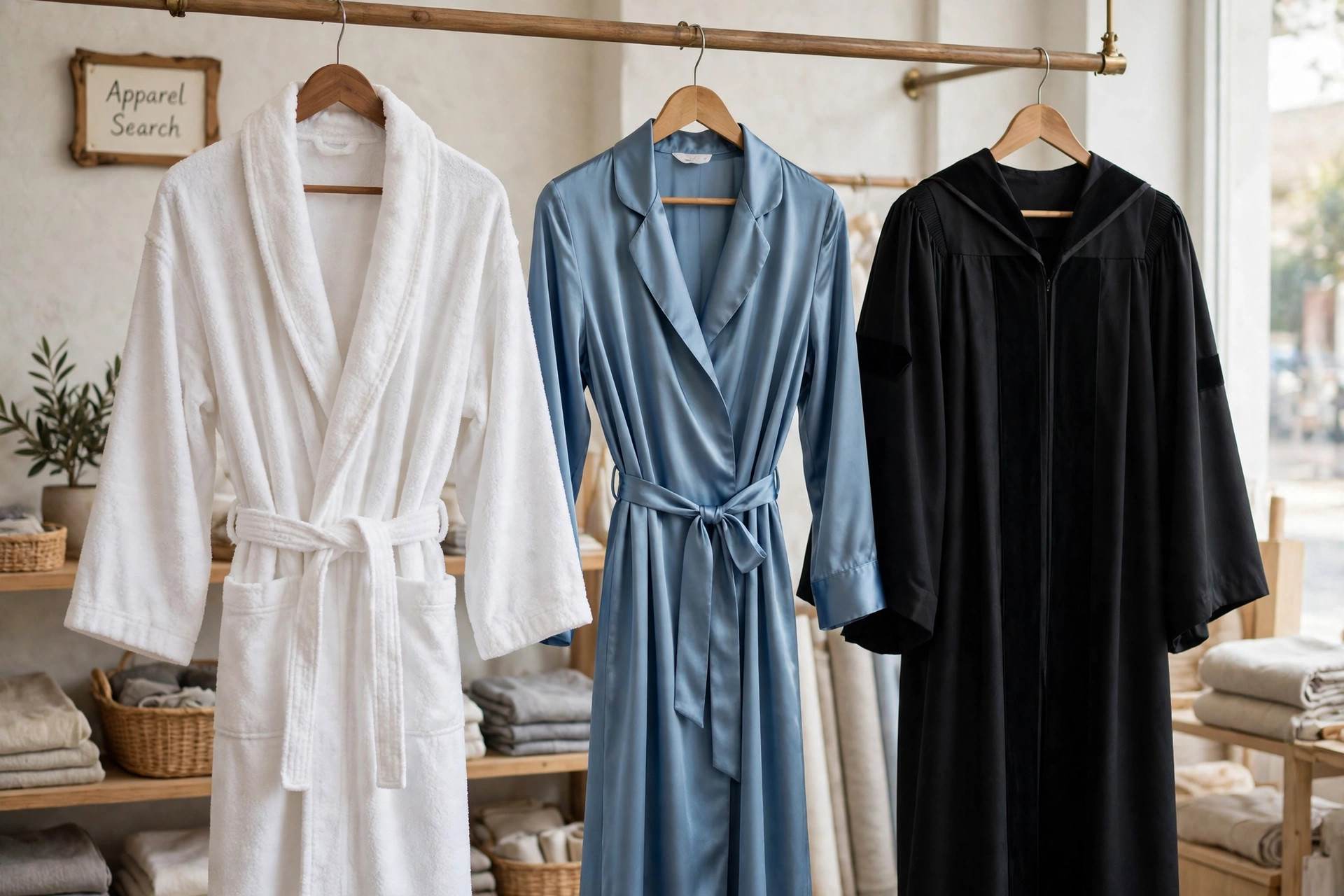
Robes of Office: Ceremony, Court and Church
The ceremonial robe is clothing as office. Academic robes grade their wearers by colour, facing and sleeve shape, so that a graduation procession can be read at a glance. Judicial robes strip away personal dress so that the court speaks through its officers rather than through individuals. Religious robes mark orders and seasons in their colours and cuts — the cassock, sometimes loosely called a robe though it is close-fitting, is the everyday dress beneath many of them. The robes of peers and royalty, worn with coronets and orders on state occasions, are the fullest survival of dress as rank.
In every case the looseness is the point. A robe covers the clothing beneath completely, replacing the individual's outfit with the dress of the role, which is why the same basic garment serves universities, courts, churches and thrones — and why storytellers dress wizards and magical characters in robes, the costume of authority detached from any real office. The robe's ancient ancestor in the classical world is the toga, the draped civic garment of Rome; the sleeved robe that replaced such draped forms, as a gown is also a robe in the wider sense, became the standard covering of formal and learned life.
Academic dress shows the system at its most legible. The robe's cut itself carries information: sleeve shapes differ by degree, with closed, pointed sleeves at the higher levels, and colours and facings identify the institution and the field of study, so that a procession is a catalogue of its members' qualifications worn on their backs. Judicial and religious dress work the same way at a simpler level — the robe suppresses the individual almost entirely, leaving only the office visible, which is precisely its function in a courtroom or a choir.
The Robe at Home: Bathrobe and Dressing Gown
The house robe keeps the construction and drops the ceremony. A bathrobe is a wrap-front robe in towelling cotton, made to be put on wet from the bath or shower, belted with a sash tie, with patch pockets and a shawl or hooded collar. A dressing gown serves the same place in the morning and evening routine in finer cloth — silk, satin or brushed cotton — worn over nightwear for warmth and modesty rather than for drying. The two are the home robe's practical and dressed forms, and most wardrobes hold one or the other rather than both. Wrap-front fastening with a sash belt is the standard construction for both, though zip-front and button-front house robes are also made for wearers who find a belt impractical.
Home robes are sold by ordinary clothing sizes with a deliberately generous cut, long or short by preference. They are surveyed as products in the robes influence guide, with fuller buying guides for women's robes and men's robes.
Fabrics and Choosing a Home Robe
Fabric decides a home robe's job. Towelling cotton absorbs water and washes hot like towels — the bathrobe proper. Silk robes are light, smooth and warm for their weight, washed gently and kept from rough surfaces. Satin robes give the same dressed effect at a lower price. Cotton robes in woven or brushed cotton are the everyday middle ground, and fleece and velour serve cold houses. Between the two poles of the word — the robe of office and the robe of the home — the professional robe survives in daily use wherever a role is still dressed rather than merely badged, and the word itself, applied loosely to any long flowing garment, shows how completely the sleeved, wrapping outer garment has become the default image of formal covering. Its sleeveless neighbours, the cape and the poncho, hang from the shoulders instead of wrapping the body.
Not to Be Confused With
The home robe has two forms, and the robe has two sleeveless neighbours. A bathrobe is a towelling wrap robe put on wet after bathing, belted, with patch pockets. A dressing gown is the same loose, sleeved wrap in finer cloth — silk, satin, brushed cotton — worn over nightwear, not for drying. Robe is the general word covering both, and the ceremonial robes of office besides. A cloak or cape is not a robe at all: both are sleeveless, fastened at the neck and hung from the shoulders, where a robe has sleeves and wraps the body.
Common Questions
What is a robe?
A robe is a loose-fitting outer garment, usually with sleeves. The one word covers ceremonial gowns — academic, judicial and religious dress and the robes of peers and royalty — and the informal bathrobe and dressing gown worn at home, all sharing the loose, wrapping cut.
What is the difference between a robe, a cape and a cloak?
A robe usually has sleeves and wraps the body; a cape and a cloak are sleeveless outer garments fastened at the neck and hanging from the shoulders. Informally, robe is sometimes used for any long flowing garment, though a close-fitting garment such as a cassock is properly a different cut.
What is the difference between a bathrobe and a dressing gown?
Both are house robes. A bathrobe is made of towelling to be put on wet after a bath or shower and to dry the wearer; a dressing gown is made of finer cloth such as silk, satin or brushed cotton and is worn over nightwear in the morning and evening for warmth and modesty.